

The use of AI in iGaming is already widely established, shaping odds, detecting fraud, and managing player safety. The challenge now is how ethical AI in online gambling is utilised.
By 2026, if responsibly integrated, it will not just meet rules. It will help operators earn trust, build loyalty, and show that progress and principles can work together. This is where iGaming is heading, and forward-looking operators are already pressure-testing how their models make decisions, not just how quickly they do.
The discussion of ethical AI in online gambling has shifted from performance to fairness, from automation to accountability.
Ethical AI in Online Gambling: From Smart to Fair Systems
Early AI in iGaming was built to boost performance by spotting fraud and detected risk faster than any human team. This integration of advanced technology systems revealed a new set of risks: bias, overreach, possible player exploitation, and a lack of transparency.
The focus is now shifting from how fast AI can act to … how fairly it actually behaves. When talking about the business case of ethical AI in online gambling, it has to include transparency, oversight, and accountability. When players are ensured that AI decisions are being checked for fairness, it helps build trust in the brand. The same goes for regulators when they can audit those systems without resistance, trust is gained.
A fair system is not one that never makes mistakes. It is one that can explain why it made a decision and correct itself when it is wrong. According to the EU Artificial Intelligence Act, any system that influences player safety or financial access must now meet strict transparency and oversight requirements¹.
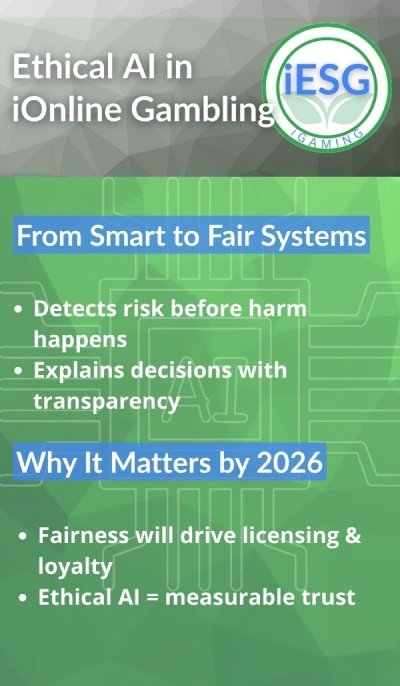
How Ethical AI in Online Gambling Looks Like in Practice
Trust is becoming a product feature in its own right. Ethical AI is not built in the compliance department; it is designed from the start.
Across leading operations, data teams are building transparency and consent directly into model design. Risk ratings and recommendations are being explained in plain language, and players are gaining control over how much data shapes their experience. Deloitte reports that over half of European firms now include ethical AI governance in their risk strategies for 2026².
The technology behind responsible gaming is evolving as well. Systems that used to react to player harm only after it already happened are being replaced. Now, the shift is to predictive models that identify risk earlier. When these tools are designed ethically, they prevent harm before it even happens.
Trust cannot be added after launch. It must be built into the code and the company culture from the start.
Players as Stakeholders, Not Data Points
The most important change in the next few years will be how the industry views its users. Ethical AI in gambling treats players as participants in the process, not as passive data sources.
Transparency dashboards are becoming more common in fintech and are expected to appear in gaming within the next two years. These interfaces will let players understand why certain recommendations, offers, or limits appear on their accounts. For example, an operator could show that a temporary deposit limit was triggered by spending patterns linked to responsible gaming guidelines rather than a hidden algorithm.
This kind of openness moves responsible gaming from a legal requirement to a loyalty driver. It also reduces the emotional distance between the platform and the player. The UK Gambling Commission continues to highlight data transparency as a cornerstone of safer gambling practices³.
Players are far more likely to stick around when they understand how their information is used as it’s a trust builder. The advantage is clear: open and transparent communication as well as messaging morph data into trust, by fostering responsible play.
Performance Measuring of Ethical AI
Progress counts when it is visible and fact-backed. By 2026, operators will measure the quality of ethical AI in online gambling just as precisely as they measure performance or profit.
Three emerging measures stand out:
- Fairness index: how often algorithmic decisions are reviewed, challenged, or overturned by human oversight.
- Transparency ratio: the percentage of AI decisions with clear and traceable outcomes.
- Player trust: insights from surveys or behavior analysis indicating how much confidence players have in these automated decisions and processes.
Many of these benchmarks are already being tested by data governance teams in other sectors. For iGaming, they could form the foundation of a shared “responsible technology scorecard.” Independent auditors could verify the accuracy of those results, giving investors a clear view of ethical risk.
Once these metrics are visible, investors start rewarding transparency the same way regulators reward compliance. That connection between ethical design and market value is beginning to take shape.
Fair technology is fast becoming a competitive advantage. In an industry where reputation moves markets, being able to show measurable ethics can be the difference between regulatory pressure and regulatory partnership.
Why Ethics Will Be a Business Advantage by 2026
The business logic behind ethical AI in online gambling is becoming clear. Operators who can show their systems are both transparent and fair, will hold an advantage in licensing process, while gaining investor trust.
Ethical AI also helps protect the brand. When algorithms act responsibly, the chances of reputational damage from bias, error, or overreach shrink dramatically. The same transparency that reassures regulators also builds credibility with players and stakeholders.
By 2026, technology ethics will no longer be a metaphysical niche discussion. It’s more likely to become a standard metric of due diligence in merger operations, investments, and licensing applications and audits. PwC’s Tech Trends 2025 report predicts that ethical technology governance will move from voluntary practice to market expectation⁴. The most successful companies will be the ones that design technology not just for performance, but for principle.
Responsible technology is not about slowing innovation. It is about making sure innovation is sustainable. Fairness and accountability are no longer optional extras. They are the foundations of trust, and trust now directly correlates with retention and regulatory leniency.
Conclusion: Ethical AI in Online Gambling
Fairness and transparency have outgrown their compliance label. They now define growth itself. When technology earns belief, loyalty lasts longer, and reputation becomes an advantage.
Ready to turn ethical AI in iGaming into your strongest asset? Book a free call and learn how the implementation of ethical AI in online gambling builds trust and become a business advantage.
FAQ – Ethical AI in Online Gambling
What is ethical AI in online gambling?
Ethical AI in online gambling means using AI in ways that are transparent, fair, and accountable, giving players trust that this technology works for their protection, and not exploit them.
How does ethical AI in online gambling tie into responsible gaming?
It spots risk early, protects player data, and explains why actions are taken, helping both players and regulators trust the outcome.
Why will ethical AI in online gambling matter by 2026?
As oversight tightens, operators who can prove fairness and accountability will find it easier to maintain trust with both regulators and investors.
What are good examples of ethical AI in online gambling?
Bias testing, human oversight of automated tools, player consent options, and transparency dashboards that show how data influences decisions.
How can operators track ethical performance?
By measuring fairness, transparency, and player sentiment, and then publishing those metrics as part of regular reporting.
Does ethical AI in online gambling slow down business?
It ensures innovation grows on solid ground, reducing risk while earning trust that lasts.
Sources:
- European Commission: “High-Level Summary of the EU Artificial Intelligence Act”
https://artificialintelligenceact.eu/high-level-summary - Deloitte: “AI Ethics Report 2024: Building Trust through Transparency”
https://www2.deloitte.com - UK Gambling Commission: “Player Safety and Data Transparency Guidance 2025”
https://www.gamblingcommission.gov.uk - PwC – PwC’s 2025 Responsible AI survey: From policy to practice
- https://www.pwc.com/us/en/tech-effect/ai-analytics/responsible-ai-survey.html

Steven
Great article on Ethical AI in online gambling! The shift from performance to fairness is indeed crucial for building trust. I noticed you mentioned transparency dashboards becoming more common—do you think integrating these with ad platforms could further enhance player trust? For example, platforms emphasizing controllability in Tier-1 markets—could similar principles be applied to AI governance dashboards? Would love to hear your thoughts on how ad tech and ethical AI might intersect in this space.
Wolfgang M. V. Resch
Thanks for the thoughtful question, Steven.
The intersection between ad tech and ethical AI is likely to become more relevant in 2026, but the key distinction remains governance versus optimisation. Transparency dashboards only build trust when they are owned and governed by the operator’s accountability framework, not when they are embedded as marketing performance tools designed to drive commercial objectives.
Where ad platforms have a role, it should be in enforcing constraints, such as market eligibility, audience exclusions, and compliance signals, rather than exposing player-level data or model-level decision logic. Ethical AI dashboards must first demonstrate accountability, auditability, and clear decision ownership. Any integration with ad tech should follow those principles, not redefine them.
We expect regulators to scrutinise this boundary more closely over the coming years, particularly in Tier-1 markets where marketing practices, AI systems, and consumer protection are increasingly converging.