
ESG in iGaming 2025 marked a clear break from the past. For years, ESG sat on a metaphysical middle ground, until it got too important to ignore, yet too vague to operationalise. That changed this year. In 2025, ESG stopped living in policy documents and started shaping infrastructure decisions, regulatory outcomes, and boardroom conversations across the iGaming sector.
The reason is simple: ESG gained consequences. Environmental choices began to show up as cost exposure and audit friction. Social safeguards were tested through enforcement, not intention. Governance quality started acting like a trust filter, influencing how regulators, partners, and investors assess risk.
This year-end review is not a highlight reel of good deeds. It is a short, evidence-led map of the three ESG signals that mattered most in ESG in iGaming 2025, one per pillar. Each signal is anchored in regulator-grade expectations and reporting direction, not brand messaging.
Three signals became impossible to ignore: energy and infrastructure accountability shifted into a finance issue, player protection became enforceable with clear remediation expectations, and transparency with board-level ownership emerged as a decisive credibility test.
Environmental ESG in iGaming 2025: energy as a cost line
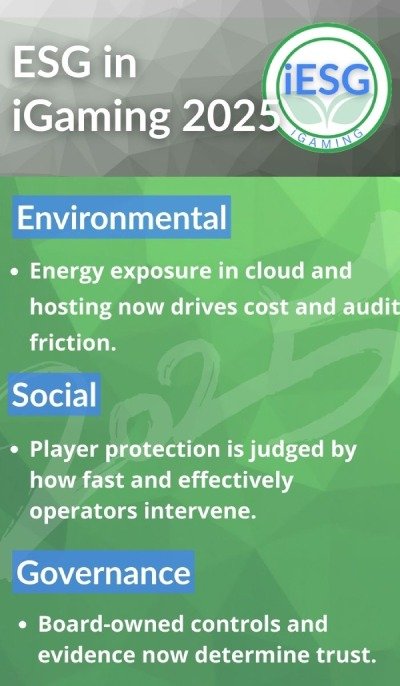
Environmental maturity in iGaming has historically lagged behind social and governance. Plenty of operators could talk about sustainability, but far fewer could explain energy exposure in a way that satisfies auditors, investors, or enterprise partners. ESG in iGaming 2025 pushed this pillar out of comms and into infrastructure.
The biggest driver was reporting pressure linked to the EU’s Corporate Sustainability Reporting Directive (CSRD). The European Commission has been explicit that the first companies subject to CSRD apply the new rules for the 2024 financial year, with reports published in 2025.¹ That timing matters. It means 2025 was when sustainability reporting expectations became real-world deliverables for many large groups, and the knock-on effects spread through supplier ecosystems.
Separately, the Commission also advanced a 2025 “Omnibus” proposal aimed at simplifying and reducing burdens in sustainability reporting and due diligence.1 Even with simplification debates, the direction of travel is clear: sustainability data is part of corporate reporting infrastructure, not a side document.
A tier-one European operator with multi-market exposure responded by treating hosting and cloud contracts as ESG risk, not just IT procurement. The work looked unglamorous: auditing energy-related disclosures, tightening supplier data access, and aligning internal reporting so finance could sign off confidently. The outcome was not a marketing campaign. It was reduced uncertainty and fewer blind spots.
The takeaway for operators is sharp: environmental ESG is increasingly a question of measurement and explainability. If you cannot show where emissions exposure sits (even indirectly through digital infrastructure), you create friction at exactly the moments that matter: audits, funding conversations, partnership reviews, and licensing scrutiny.
In ESG in iGaming 2025, the environmental pillar became less about slogans and more about operational credibility.
Social ESG Enforcement replaced intent
If environmental change was quiet, social change was not. ESG in iGaming 2025 reinforced that player protection is an operational obligation, not a positioning statement.
The UK Gambling Commission’s enforcement action list in 2025 shows ongoing penalties and regulatory failures across different operator types.² More importantly, the Commission’s formal guidance for remote licensees is clear on expectations: licensees must consider factors that make customers vulnerable and implement systems and processes to take appropriate and timely action where indicators of vulnerability are identified.3 That is a systems requirement, not a slogan.
At the same time, the Commission has published material addressing “affordability checks” and financial vulnerability checks with explicit thresholds and timing. Whether an operator labels this as affordability, vulnerability, or customer interaction, the operational implication is the same: you must detect risk earlier and intervene effectively.
A practical example from 2025 is an anonymised but realistic enforcement pattern: an operator with cross-market exposure receives regulatory scrutiny not because it lacked safer gambling messaging, but because controls did not trigger strong enough interventions when risk signals emerged. The remediation expectations that follow are the point. Regulators increasingly expect operators to prove their controls work, and to demonstrate ongoing effectiveness through monitoring, audit, and continuous improvement.
This is the social pillar’s core shift in ESG in iGaming 2025: player protection moved from policy to performance. It now sits alongside AML and data security as a risk domain that demands evidence, escalation paths, and accountable ownership.
For operators planning 2026, the conclusion is uncomfortable but useful. If you cannot demonstrate timely action, you do not have a safer gambling programme. You have a compliance story waiting to be tested.
Governance ESG in iGaming 2025: Transparency became a trust filter
Governance is the pillar that’s not the trendiest one, yet it decides who gets trusted. ESG in iGaming 2025 made governance more visible because sustainability reporting and risk ownership are moving closer to core corporate reporting.
The European Commission’s CSRD reporting saw many large groups publish sustainability information under new expectations in 2025.¹ When reporting expectations rise, governance gaps … show up fast: unclear accountability, weak controls, no board-level ownership, and vague KPIs that cannot be defended under scrutiny.
In parallel, the UK Gambling Commission’s annual report for 2024–2025 underscores the regulator’s ongoing focus on compliance and enforcement capability and how it delivers its strategic aims.⁶ For operators, the message is clear: governance is not theoretical (anymore). It is how you prove you can run a gambling business safely and predictably.
A common 2025 pattern seen across high-scrutiny industries also applies to iGaming: governance maturity increasingly affects capital discussions. An anonymised multi-jurisdictional operator pursuing funding or strategic partnership faces deeper due diligence on governance than it expects. Not “do you have an ESG policy?”, but “who owns ESG risk, how is it escalated, how do you evidence control effectiveness, and what happens when KPIs slip?”That is why governance is the quiet pivot of ESG in iGaming 2025. Transparency is no longer a nice-to-have. It is a credibility test. Operators that treat ESG reporting as a board-owned system, with auditable controls, reduce friction across regulators, investors, and partners. Operators that cannot evidence governance invite uncertainty, and uncertainty is getting more and more expensive.
What these ESG signals mean for 2026
The combined message of ESG in iGaming 2025 is blunt: ESG is no longer a parallel initiative. It is an operating system.
Environmental credibility increasingly comes from infrastructure visibility and data discipline.¹
Social credibility comes from whether protections work in practice, not whether they exist on a page.⁴
Governance credibility comes from transparent ownership, escalation, and evidence under scrutiny.⁶
2025 did not reward ESG ambition but it did reward execution. If you want resilience in 2026, ESG needs to live inside operational processes, not some boardroom PDFs.
Conclusion: ESG in iGaming 2025
ESG in iGaming 2025 proved that the industry’s ESG baseline has moved. Environmental accountability is drifting into finance and infrastructure. Social expectations are enforceable. Governance is becoming the trust filter.
For operators and investors alike, the takeaway from 2025 is unambiguous: ESG capability now signals operational maturity. Those who embedded ESG into systems, controls, and governance gained resilience … those who treated it as disclosure risk will feel the gap widen in 2026. If you want to future-proof your ESG strategy for 2026 and beyond, book a free call to assess where your current ESG setup creates resilience and where it creates risk.
FAQ – ESG in iGaming 2025
What changed most in ESG in iGaming 2025?
Accountability: reporting pressure, enforceable player protection expectations, and higher scrutiny of governance controls.
Does ESG in iGaming 2025 affect smaller operators too?
Yes. Even when CSRD does not apply directly, its expectations can flow through suppliers, partners, and investor due diligence.¹
What is the biggest social ESG risk for operators in 2026?
Failing to detect vulnerability signals and to take timely action with demonstrable effectiveness.
How should operators approach environmental ESG after ESG in iGaming 2025?
Treat it as infrastructure accountability: measure energy exposure, improve data access, and reduce audit friction.
Why does governance matter so much in ESG in iGaming 2025?
Because transparent ownership and controls influence regulator confidence and investor trust.
Sources:
- European Commission: “Corporate sustainability reporting” (CSRD timeline and first reporting in 2025).
https://finance.ec.europa.eu/capital-markets-union-and-financial-markets/company-reporting-and-auditing/company-reporting/corporate-sustainability-reporting_ - UK Gambling Commission: “Enforcement action” (2025 enforcement actions list)
https://www.gamblingcommission.gov.uk/news/enforcement-action? - European Commission: “COM(2025) 80 proposal (Omnibus proposal to amend CSRD/CSDDD)“
https://commission.europa.eu/document/download/0affa9a8-2ac5-46a9-98f8-19205bf61eb5_en?filename=COM_2025_80_EN.pdf - UK Gambling Commission: “Customer interaction guidance for remote licensees” .”
https://www.gamblingcommission.gov.uk/guidance/customer-interaction-guidance-for-remote-gambling-licensees-formal-guidance/requirement-3-customer-interaction-guidance-for-remote-gambling-licensees-sr? - UK Gambling Commission: “Affordability Checks”
https://www.gamblingcommission.gov.uk/about-us/freedomofinformation/affordability-checks? - UK Gambling Commission: “Annual report and accounts 2024–2025“
https://www.gamblingcommission.gov.uk/report/annual-report-and-accounts-2024-to-2025/annual-report-2024-to-2025-strategic-focus-2?
