
Revenue gets a company into the room. Risk decides whether money lands. That is the real role of ESG due diligence in iGaming. Investors are not scanning for polished sustainability claims or a pretty PDF. They are testing whether an operator can withstand scrutiny, protect its licence base, and manage the sort of governance failures that can quickly destroy value.
In gambling, that usually means responsible gambling controls, regulatory exposure, AML discipline, marketing conduct, and board oversight. The sustainability angle matters, but it is rarely the first thing investors obsess over. The pressure is also getting harder to ignore. The European Commission says large companies and listed companies must report on sustainability risks and impacts, specifically because investors and other stakeholders use that information to evaluate performance.1 The first CSRD wave already applied to the 2024 financial year for reports published in 2025. That shifts ESG from “nice to have” to part of the capital-readiness stack.
In iGaming, ESG due diligence is no longer a sustainability exercise … it is how investors decide whether a business is governable, reliable, and sustainably profitable.
Why ESG due diligence matters in gambling
Gambling sits in a category investors already view as high-friction. It is regulated, politically exposed, and vulnerable to headline risk. When a company has weak safer gambling controls, poor AML discipline, or aggressive affiliate practices, the downside is not theoretical. It can mean fines, licence reviews, restrictions, and a damaged valuation story. The UK Gambling Commission’s enforcement register makes that point without much effort.2 Regulatory action is a standing feature of the market, not an outlier.
That is why smart investors use ESG due diligence as a filtering tool. They want to know whether management has control of the business, whether reporting is credible, and whether the operator can handle regulatory pressure across jurisdictions. In this sector, ESG is less about moral positioning and more about operational proof.
What investors actually test
A ESG due diligence review usually falls into three buckets, but they do not carry equal weight.
#1 Social risk
This is often the first pressure point. Investors want to see whether responsible gambling is embedded in operations or parked in a policy document. They look for intervention systems, player monitoring, self-exclusion tools, affordability or risk markers where relevant, and evidence that safer gambling is tracked rather than merely described. Flutter’s 2024 Sustainability Report is a good example of what credible disclosure looks like: it reports that 44.5% of active online players engaged with at least one Play Well tool in 2024, up 4.8 percentage points from 2023.3
#2 Governance risk
This is where deals often get colder. Investors test board oversight, accountability for compliance, AML controls, reporting lines, incident disclosure, and how the business supervises affiliates and marketing partners. Betsson’s public sustainability framing is a useful benchmark here. It says responsible gaming is at the core of its sustainability framework, while business compliance is the foundation of a sustainable business model.4 That is the kind of language investors want backed by structure and evidence.
#3 Environmental exposure
This matters in ESG due diligence, but usually carries less weight way than people pretend. For most iGaming companies, investors are not carrying out a forensic audit of hosting architecture. They want to know whether the company measures environmental impact, discloses the basics, and shows that climate and infrastructure exposure are governed sensibly. Flutter’s report references GRI and says it is integrating SASB standards into its reporting framework, which is a more realistic investor signal than broad claims about “green infrastructure.”5
💡During ESG due diligence, investors increasingly look at how operators document behavioural risk patterns rather than isolated gambling incidents. Escalation risk often appears through signals such as session intensity, loss-response behaviour, and previous intervention outcomes. Frameworks like our iESG Assessment can help organise these signals within governance and reporting processes.
ESG red flags that put investors off
Some issues might “only” weaken the story in a ESG due diligence, but then there are others breaking it.
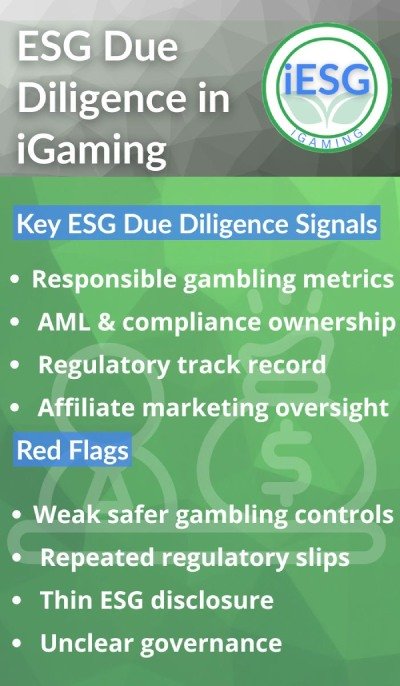
The first is weak responsible gambling controls. If the operator cannot show how it identifies at-risk play, intervenes, and tracks outcomes, investors will assume the risk sits unresolved.
The second is a history of regulatory action. One issue may be survivable. Repeated action across jurisdictions suggests a deeper control problem. The UK Gambling Commission’s public register exists for a reason, and investors will look.
The third is thin disclosure. If management says ESG matters but cannot produce clear metrics, investors start asking what else is missing.
The fourth is weak governance ownership. If nobody clearly owns compliance, reporting, and conduct risk, the company looks loose.
The fifth is uncontrolled affiliate marketing. In iGaming, growth partnerships can become governance liabilities very quickly.
What good disclosure looks like
Flutter is a useful example because the reporting is concrete. Its 2024 Sustainability Report does not stop at broad commitments. It publishes a measurable customer-wellbeing target, reports current Play Well tool usage, and explains the reporting frameworks it uses and is integrating.3 That gives an investor something to interrogate: targets, trend lines, tools, and governance.
That is the standard operators should aim for when preparing for ESG due diligence … not perfection and no ESG theatre. Just evidence that risk is understood, tracked, and managed.
Investor ESG due diligence checklist for iGaming
In practice, ESG due diligence is less about abstract sustainability narratives and more about testing whether an operator can manage regulatory, governance, and reputational risk. Investors want clear evidence that the business is controlled, transparent, and resilient under scrutiny.
Before allocating capital, investors are usually testing questions like these:
- Does the company disclose clear responsible gambling metrics?
- Can management explain how player risk is identified and escalated?
- Is regulatory exposure transparent, including past incidents?
- Are AML, compliance, and conduct controls clearly owned?
- Is affiliate oversight documented and enforced?
- Does the board have visible oversight of key ESG and regulatory risks?
- Is environmental impact measured and reported at a sensible level?
- Is reporting structured enough for comparison year to year?
That is a more realistic checklist than asking whether an investor has personally verified the hosting stack.
🏅 During ESG due diligence, investors increasingly look at how operators structure governance, oversight, and documentation around responsible gambling and risk management. Our iESG Membership can serve as a sector-specific reference point for organising governance and reporting practices.
Conclusion: ESG due diligence
In iGaming, ESG due diligence is really a test of whether the business is governable.
Investors want proof that management can handle scrutiny, protect players, control marketing risk, and report with enough clarity to support conviction. The operators that make this easy will always look more investable than the ones hiding behind vague sustainability language.
FAQ – ESG due diligence
What is ESG due diligence in iGaming?
ESG due diligence is the investor review of environmental, social, and governance risks before backing an operator, platform, or gambling business.
What matters most to investors in gambling ESG reviews?
Usually responsible gambling controls, regulatory track record, governance ownership, AML discipline, and affiliate oversight.
Do investors really check environmental issues in iGaming?
Yes, but usually through disclosure and governance, not a deep technical audit of hosting infrastructure.
Why is ESG reporting becoming more important?
Because EU rules increasingly require sustainability reporting, and the Commission explicitly says that ESG due diligence helps investors evaluate company performance.
Which operator is a good example of practical ESG reporting?
Flutter is a strong example because it publishes measurable safer-gambling usage data and explains the reporting frameworks behind its disclosures.
Sources:
- European Commission: “Corporate Sustainability Reporting Directive (CSRD)“
https://finance.ec.europa.eu/capital-markets-union-and-financial-markets/company-reporting-and-auditing/company-reporting/corporate-sustainability-reporting_en - UK Gambling Commission: “Enforcement Action Register“
https://www.gamblingcommission.gov.uk/licensees-and-businesses/enforcement - Flutter Entertainment: “Sustainability Report 2024“
https://flutter.com/media/wfrh0jcs/flutter-entertainment-sustainability-report-2024.pdf - Betsson Group: “Sustainability Strategy and Reporting“
https://www.betssonab.com/sustainability - KPMG: “ESG Due Diligence – A Strategic Imperative for Investors“
https://assets.kpmg.com/content/dam/kpmg/de/pdf/Themen/2024/02/esg-due-diligence-en.pdf
