
In iGaming, growth has never been the problem; credibility has. Regulators, players, and now investors want proof that operators can run profitable businesses without cutting corners on responsibility. The financial markets are speaking the same language: 79% of global investors factor ESG risks into their decisions¹. For a sector often scrutinized for compliance breaches and social impact, that figure should be a wake-up call and that’s where ESG investing in iGaming comes into play.
This is not about optics. ESG investing in iGaming is about proving to capital markets that your license is safe, your operations are resilient, and your brand can withstand scrutiny. The operators who lead here don’t just tick boxes. They attract investment on better terms.
Why ESG Investing in iGaming Matters for Investors
Capital is selective. When investors screen iGaming opportunities, they aren’t only looking at revenue growth; they are calculating risk exposure. ESG performance is the fastest way to show that you can withstand regulatory shocks, avoid fines, and keep player trust intact.
The EU’s Corporate Sustainability Reporting Directive (CSRD) now requires operators of a certain size to publish ESG data². Investors don’t see this as red tape. They see it as a transparency benchmark. Companies that already report with accuracy and consistency demonstrate they’re ahead of the curve.
From an investor’s standpoint, ESG signals:
- License security – less chance of regulatory clashes that put operations at risk.
- Regulatory resilience – readiness for CSRD, SFDR, and similar frameworks.
- Brand durability – reassurance that reputational landmines are being managed.
Brand resilience is built on managing reputational risks before they erupt. BDO’s 2024 review found that … drumroll … operators with robust ESG frameworks secure capital easier as well as on more favorable terms³. That means that operators who are already integrating ESG not only lower their operational costs but have an easier path to investments. For those lagging behind … tighter conditions await with investors.
The ESG Premium: Why Sustainability Shapes Valuation
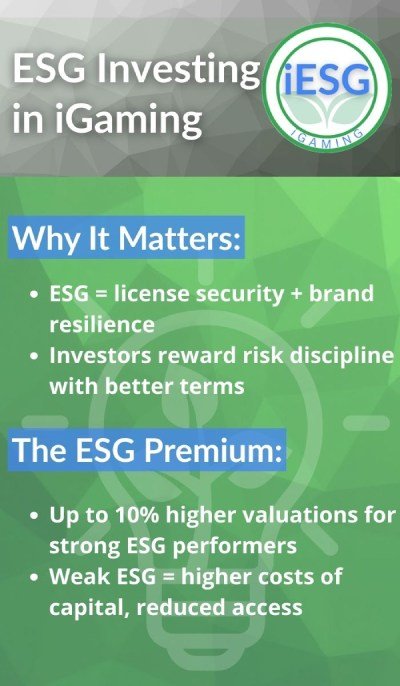
The equation is realtively simple: financial markets reward credibility and risk discipline. Companies with a strong and trackable ESG performance can achieve valuation premiums of up to a staggering 10% across industries⁴. While iGaming is still struggling with a stigmatized perceptions, ESG isn’t peripheral. On the contrary, it can be a direct lever for higher multiples.
Steps such as shifting to renewable-powered hosting or investing in efficient cooling deliver environmental impact while reinforcing financial value.
Environmental moves like switching to renewable-powered hosting or modern cooling systems don’t just reduce emissions. They cut costs. Social policies such as responsible gambling programs and DEI initiatives signal regulators and players that you’re building a long-term business, not chasing short-term profit. Governance practices, including board-level oversight and detailed ESG reporting, show investors that risks are being managed at the top.
Consider Kindred Group. By publishing annual sustainability reports that detail its carbon footprint and responsible gambling measures, Kindred has given investors tangible evidence of its risk management and growth discipline⁵. That sort of transparency reduces uncertainty, and signals foresight and long-term business planning while uncertainty is what investors punish in valuations.
📝 Our iESG Assessment is an independent and to the iGaming industry tailored framework that benchmarks current practices against ESG standards. It helps to identify gaps, highlight strengths, and create the transparency investors expect.
What Investors Look for in iGaming ESG
Investors view ESG investing in iGaming as more than a concept; it is a practical filter for risk and value. They don’t apply ESG screens in theory. They look for specifics. In iGaming, the checklist is clear:
Environmental
Investors paying attention to ESG investing in iGaming want clear evidence of environmental performance. This is where they look first for tangible data.
- Proof that data centers are energy-efficient or renewable-powered.
- Clear disclosure of emissions data paired with measurable reduction targets.
- Targeted carbon offset initiatives or investment in green infrastructure.
Social
In iGaming, the social dimension of ESG centers on responsible gambling practices and workplace culture, both of which signal long-term resilience to investors. investments.
- Robust responsible gambling safeguards.
- Visible DEI policies and workforce reporting.
- Community engagement initiatives that extend beyond PR.
Governance
Governance sits at the core of ESG investing in iGaming and is the number 1 confidence builder for investors.
- Effective AML and KYC controls.
- Independent board-level oversight of ESG strategy.
- Public reporting, that is aligned with CSRD or GRI standards.
4 Red Flags in ESG investing in iGaming
Capital allocators have sharp eyes and they look very closely for signs that an operator’s ESG plan is superficial or fragmented. It signals either trust or concern and especially since in iGaming, scrutiny is rigorous, due to regulations and potential reputational exposure. Shortcomings in this area can have dire consequences and be reason enough to deter investment altogether.
- No ESG reporting, or vague claims without data.
- Outdated infrastructure with no credible transition plan toward greener operations.
- Regulatory fines tied to weak AML or compliance controls.
- Greenwashing with grand pledges but no measurable targets.
Failures on these fronts are serious as they imply that a business is neither sustainable nor resilient enough to meet (growing) investor expectations. In the iGaming universe where fines and reputational damage can escalate quickly, ESG gaps read as … weak leadership. What investors want and seek is discipline and foresight backed by evidence, not pledges without follow-through. For access to serious capital, the ESG performance weighs in massively and might carries as much weight as projected business growth.
🎓 The iESG Certificate offers operators independent validation that commitments are backed by practice. Widely recognized as an industry benchmark, it assures investors, regulators, and players that ESG principles are embedded across operations rather than presented as window dressing.
Conclusion: ESG investing in iGaming
ESG investing in iGaming is not charity. It is capital strategy. The sector’s future leaders will be the operators who can prove, in hard numbers, that they are sustainable, responsible, and governed to investor standards. Everyone else will face higher costs of capital or be excluded from portfolios entirely.
The next five years will decide who attracts growth capital and who gets left behind. ESG will be the line investors draw.
Through our iESG membership, we help iGaming companies embed ESG strategies that investors trust—turning compliance into capital and sustainability into long-term growth.
FAQ – ESG Investing in iGaming
What is ESG investing in iGaming?
ESG investing in iGaming is the evaluation of gambling operators by their environmental, social, and governance performance alongside financial metrics.
Why do investors care about ESG investing in iGaming?
ESG shows whether a company can manage regulatory, reputational, and operational risks.
How does ESG impact valuation in iGaming?
Operators with strong ESG in investing iGaming records can achieve valuation premiums of up to 10%, while weak performers often face discounted multiples.
What ESG factors are top of mind for investors?
Top considerations include energy efficiency, emissions cuts, responsible gambling safeguards, AML controls, and transparent reporting.
Does ESG compliance help with licensing?
Yes. For ESG investing in iGaming, strong governance and accurate reporting lower the risk of license suspension and demonstrate regulatory readiness.
Sources:
- PwC: “2024 Investor Survey”
https://www.pwc.com/gx/en/issues/c-suite-insights/global-investor-survey.html - European Commission: “Corporate Sustainability Reporting Directive (CSRD)”
https://finance.ec.europa.eu/capital-markets-union-and-financial-markets/company-reporting-and-auditing/company-reporting/corporate-sustainability-reporting_en - BDO: “ESG Strategy for Gaming (2024)”
https://www.bdo.com/insights/industries/gaming-leisure/gaming-companies-unlock-the-power-of-esg-strategy-and-investment - McKinsey: “The Triple Play: Growth, Profit, and Sustainability”
https://www.mckinsey.com/capabilities/strategy-and-corporate-finance/our-insights/the-triple-play-growth-profit-and-sustainability - Kindred Group: “Sustainability Reports”
https://www.kindredgroup.com/sustainability/
