

User experience design has become one of the most powerful growth levers in iGaming. Every click path, prompt, and friction point is carefully optimised to improve conversion, session length, and lifetime value. That optimisation is commercially rational and, in most markets, entirely legal. But there is a growing disconnect between how UX is treated internally and how its effects are increasingly interpreted externally. Certain forms of manipulative UX can shape player behaviour in ways that create measurable social risk, even when no harmful intent exists¹.
This is where ESG conversations are becoming quiet. Unlike marketing, campaigns or bonus terms, UX decisions often sit outside formal compliance reviews. Unsurprisingly, they are rarely audited (through a social impact lens) and almost never disclosed in ESG reporting. Yet interface design directly influences player autonomy, decision-making speed, and loss control². In a sector already under scrutiny for player protection, that influence matters.
This article examines how standard optimisation practices can produce social outcomes that regulators, investors, and stakeholders increasingly scrutinise. The risk is not theoretical. It sits in product design itself and becomes visible when manipulative UX shapes player behaviour at scale.
Manipulative UX Is Not Behaviour-Neutral in iGaming
In most digital industries, UX is about reducing friction. In the gambling context, manipulative UX does not remove choice per se, but it can alter how and when decisions are made. Removing it changes behaviour.
iGaming platforms operate within a behavioural context defined by variable rewards, financial risk, and emotional volatility. Small design choices can therefore have outsized effects.
Examples include:
- Withdrawal flows that are technically available but visually de-emphasised³
- Bonus opt-ins that default to acceptance rather than active choice
- Time-limited prompts that encourage rapid decisions without reflection
None of these elements are unusual in digital products. What makes iGaming different is the interaction between design and vulnerability. Research on digital consumer behaviour shows that cognitive load and decision speed materially affect risk-taking and self-control².
From a Social ESG perspective, the question is not whether these designs are permitted. It is whether their behavioural effects are understood, monitored, and owned.
When Manipulative UX Creates Unintended Player Outcomes
Most UX decisions are driven by KPIs such as retention, frequency, or deposit completion. Those metrics are legitimate business signals. Problems arise when optimisation focuses exclusively on short-term performance while overlooking downstream effects.
In iGaming, this can manifest as:
- Asymmetrical friction, where entering play is easier than exiting it
- Choice architecture that nudges continuation rather than reflection
- Visual hierarchy that prioritises action over control tools
Academic research and policy analysis increasingly describe these mechanisms as “dark” or “sludge” patterns that impair consumer autonomy without removing formal choice³. Crucially, intent is not the defining factor. The effect on user behaviour is.
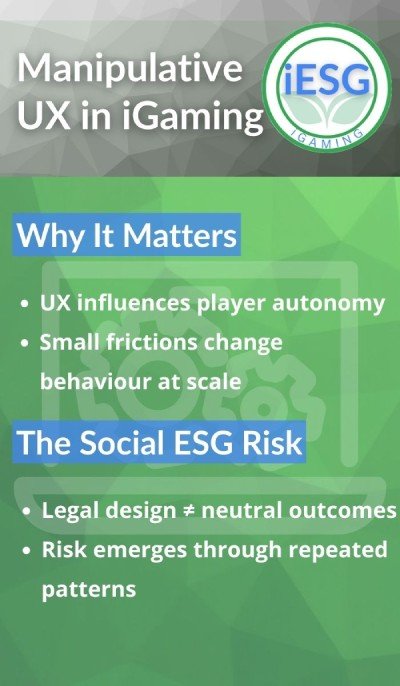
From a Social ESG perspective, manipulative UX becomes relevant when design choices systematically influence player behaviour at scale. Regulators and investors are less concerned with why a design choice was made and more concerned with what it does at scale.
This is where manipulative UX in iGaming becomes a risk exposure rather than a moral accusation.
The Social ESG Blind Spot Inside Product Teams
One of the most persistent gaps in ESG strategies in iGaming is ownership. While environmental impact has clear metrics and governance has reporting structures, social impact, especially at product level, is … diffuse.
UX design typically sits between functions:
- Product teams own performance
- Compliance teams own regulatory adherence
- Responsible gambling teams own interventions
What often falls through the cracks is the interface itself. ESG reports generally reference player protection tools, but …
They rarely examine how easily those tools are found, and activated, or easily to comprehend within the user journey⁴.
This creates a blind spot. UX audits focus on usability and conversion, not behavioural consequence. ESG reporting primarily focuses on policies, not so much on the implementation of these product mechanics. As regulatory expectations evolve, especially this separation becomes harder to sustain. Stakeholders increasingly expect operators to demonstrate not just the presence of safeguards, but their practical accessibility and effectiveness.
💡 In practice, escalation risk is rarely driven by a single issue and is more often identified through patterns across governance, player protection, and manipulative UX. The iESG Assessment is designed to reflect this pattern-based view.
Why Social UX Risk Is Gaining External Attention
Regulators and policymakers are already moving in this direction, even if the language differs. Consumer protection enforcement increasingly considers misleading or coercive design, not just misleading text5.
Authorities such as the UK Gambling Commission and the Malta Gaming Authority emphasise outcomes over form when assessing player protection obligations⁴. At EU level, the European Commission has explicitly prohibited manipulative UX or interface practices in other digital markets under the Digital Services Act².
The implication for iGaming is clear. Even where UX design is not explicitly regulated, its effects are increasingly relevant to how compliance, social responsibility, and brand trust are judged.
From an investor perspective, this is also a reputational issue. Social ESG controversies rarely start with product roadmaps. They emerge when scaled patterns attract regulatory, media, or advocacy attention.
🏅 The iESG Certificate offers a sector-specific reference point for how social and responsible gambling frameworks are typically documented and presented to regulators and investors.
Rethinking UX as Part of Social Responsibility
None of this requires abandoning optimisation or commercial realism. It requires recognising that UX design is not neutral infrastructure. It is an active contributor to player experience and social impact.
Forward-looking operators are beginning to treat UX as part of their broader responsibility framework by:
- Reviewing key journeys through a behavioural, not just functional, lens
- Stress-testing friction asymmetry between play and exit flows
- Including interface accessibility in responsible gambling assessments
This is not about redesigning platforms overnight. It is about acknowledging that manipulative UX carries social weight, especially in a gambling context.
Conclusion: Manipulative UX
The debate around manipulative UX in iGaming is not about ethics posturing or design shaming. It is about recognising an emerging category of social ESG risk that sits quietly inside product decisions.
As ESG scrutiny deepens, operators that understand how UX shapes player behaviour will be better positioned to manage reputational, regulatory, and investor expectations. Those that treat UX purely as a growth lever may find themselves explaining outcomes they never formally measured. In iGaming, social impact does not start with policy documents. It starts with the interface.
If you want to pressure-test how UX decisions could translate into social risk, a short, exploratory conversation can help frame the right questions.
FAQ – Manipulative UX
What is manipulative UX in iGaming?
Manipulative UX in iGaming refers to design choices that influence player behaviour in ways that may reduce autonomy or delay disengagement, often without explicit intent¹.
Why is manipulative UX relevant to Social ESG in gambling?
Because interface design can materially affect player decision-making, control, and risk exposure at scale².
Is manipulative UX illegal in iGaming?
Not necessarily. The risk lies in behavioural outcomes and stakeholder perception, not automatic non-compliance⁵.
Do regulators currently audit iGaming UX design?
UX is rarely audited directly, but its effects are increasingly considered in enforcement and consumer protection actions⁴.
How can operators reduce UX-related social risk?
By reviewing key journeys through a behavioural lens and ensuring player protection tools are genuinely accessible and usable¹.
Sources:
- OECD: “Dark commercial patterns.“
https://www.oecd.org/en/publications/dark-commercial-patterns_44f5e846-en.html - European Commission: “Digital Services Act (ban on manipulative interfaces).“
https://digital-strategy.ec.europa.eu/en/policies/digital-services-act - Society for the Study of Addiction: “Sludge, dark patterns and dark nudges: A taxonomy of online gambling platforms’ deceptive design features“
https://onlinelibrary.wiley.com/doi/10.1111/add.70085 - UK Gambling Commission: “Customer interaction: formal guidance for remote operators.“
https://www.gamblingcommission.gov.uk/licensees-and-businesses/guide/customer-interaction-formal-guidance-for-remote-gambling-operators - Digital Regulation Cooperation Forum (ICO & CMA): “Harmful design in digital markets.“
https://www.drcf.org.uk/siteassets/drcf/pdf-files/harmful-design-in-digital-markets-ico-cma-joint-position-paper.pdf
