
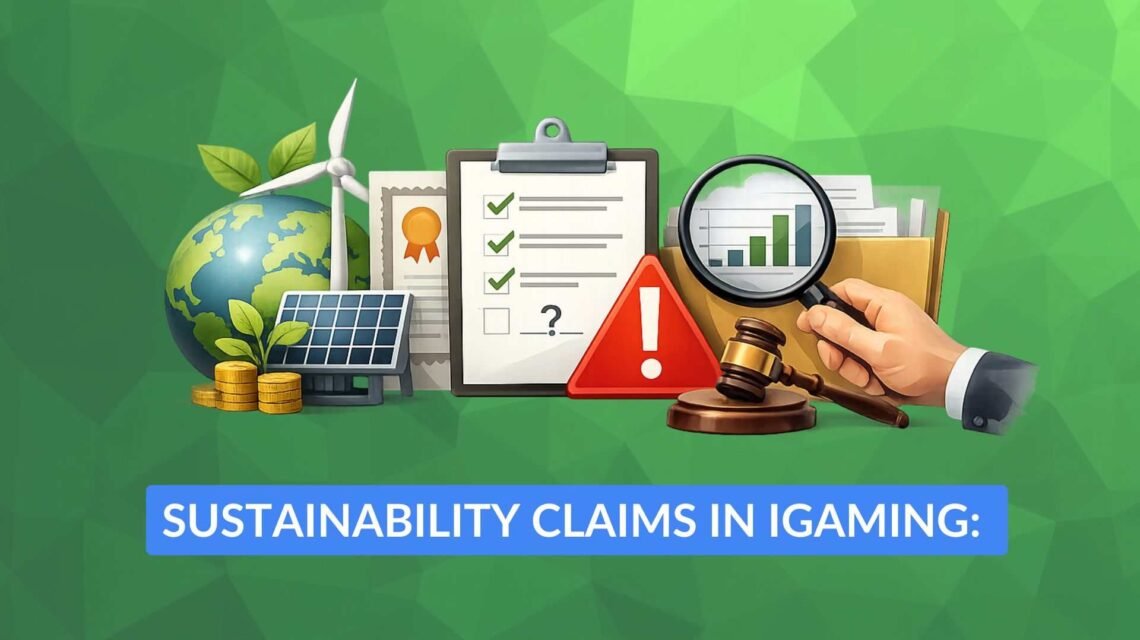
Sustainability claims in iGaming are being read very differently than they were a few years ago. What once functioned mainly as a signal of intent is now treated more like a statement of fact and, in many cases, as a proxy for governance quality. Platforms that continue to publish broad sustainability claims without evidence are discovering that the downside has quietly overtaken the upside. This shift is not about a loss of interest in sustainability. It is about patience running out. Investors, regulators, payment providers, and B2B partners are no longer asking whether an operator cares about sustainability. They are asking what can actually be measured, checked, and defended if needed.
In iGaming, where trust is already under pressure, this matters more than it might elsewhere. Public statements about environmental responsibility, social impact, or governance standards now sit alongside licensing, compliance, and risk management in how businesses are judged. A claim that cannot withstand scrutiny does not simply fade into the background. It tends to linger. At this point, the takeaway is hard to miss.
Sustainability claims in iGaming either need evidence behind them or they need to go. Neutrality is often safer than overstatement. Proof matters more than posture now.
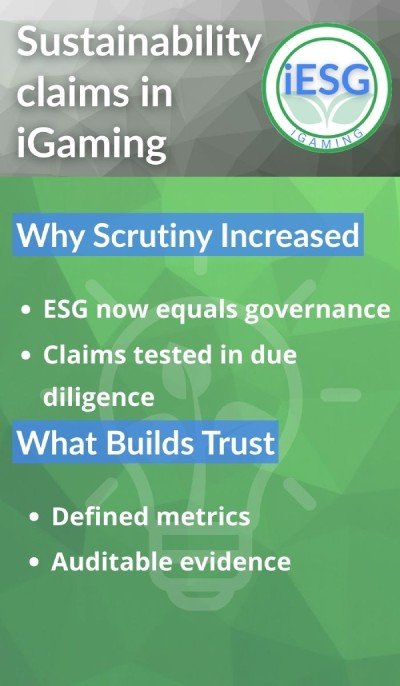
Why sustainability claims in iGaming face more scrutiny
Regulatory expectations are tightening, even if the rulebooks themselves have not always kept pace. Sustainability language that once sat on the margins is now increasingly read as a signal of how an operator approaches governance and control in practice. Authorities such as the UK Gambling Commission consistently emphasise transparency, accountability, and responsible conduct as core licensing principles. Sustainability claims in iGaming are no longer separate from that conversation.
Investor patience for narrative ESG has also worn thin. Recent institutional investor surveys show growing scepticism around how sustainability performance is presented, alongside rising expectations for clearer metrics, standardised disclosures, and independent assurance.¹ Claims that once passed without comment are now examined more closely during funding rounds, acquisitions, and partnership discussions.
There is also some history to contend with. In iGaming, sustainability language was adopted quickly by many operators, often before ownership, baselines, or reporting discipline were fully in place. What worked as signalling during the early ESG wave now attracts a more sceptical, less forgiving review.
Three factors driving closer scrutiny:
- Tighter regulatory expectations
- More rigorous investor verification and due diligence
- Risk controls applied by platforms, partners, and suppliers
💡 The iESG Assessment reflects common escalation risk indicators. It reviews governance, player protection, and sustainability controls to identify patterns that typically precede regulatory or due-diligence concern.
Where sustainability claims break down first
Most sustainability claims in iGaming do not fail because they are false. More often, they fail because they are loosely defined, borrowed from elsewhere, or left unsupported once someone looks past the headline.
Where things usually start to break down is not at the headline level, but in the detail.
- Labels like “safe gambling” or “responsible by design” are used, but there is no real indication of what they are or cover, when they apply, or how anything is measured.
- Frameworks or partnerships are referenced for credibility, but what they actually cover, why they matter, or whether they apply in practice is never made clear.
- In some cases, player protection, community impact, or diversity are referenced without any clear sense of how these areas are monitored or improved over time.
- Targets are also sometimes announced in isolation, with no indication of current performance, which makes it difficult to understand what progress would actually mean.
In practice, these weaknesses tend to cluster rather than appear in isolation. Sustainability claims in iGaming are assessed alongside licensing obligations, internal controls, and external disclosures. When inconsistencies show up across those layers, the risk of greenwashing in iGaming tends to surface quietly and then stick around.
High-risk claim types are:
- “Responsible” positioning unsupported by measurable actions
- “Carbon neutral” statements with no scope definition or methodology
- “Certified” claims that omit the issuer, audit, or coverage
A practical example: when claims outpace enforcement
Sustainability claims in iGaming rarely stay within the boundaries of the licence that permits them. An operator may be authorised in a jurisdiction with lighter disclosure requirements and face no immediate challenge for broad sustainability statements. Those same claims, however, remain visible to investors, affiliates, payment providers, and regulators applying higher transparency standards.
This creates a credibility gap. A statement that raises no issue under one licensing regime may attract scrutiny when assessed against higher disclosure standards during due diligence, partner onboarding, or investor review. In many cases, the exposure comes later rather than sooner, when claims are evaluated outside their original regulatory context.
In practice, sustainability claims in iGaming are no longer judged solely by what a licence allows, but by how they hold up across jurisdictions aligned with higher reporting expectations, including those shaped by the European Commission sustainability reporting directive.²
🏅 The iESG Certificate reflects common ESG verification expectations in iGaming.
It provides independent, sector-specific confirmation that governance, responsible gambling, and AML controls are documented and applied with a level of consistency typically examined during regulatory or due-diligence review.
What credible sustainability claims look like now
The response to this shift is not louder messaging. It is tighter claims. When sustainability claims in iGaming hold up, they tend to rest on a few consistent foundations. The emphasis is less on ambition and more on defensibility. The standard is not perfection, but clarity about what exists, what is measured, and what can be verified if challenged.
What tends to be in place
- Even simple measurements carry more weight than broad or aspirational statements without any defined metrics.
- Named ownership: Someone inside the organisation is clearly responsible, rather than sustainability sitting everywhere and nowhere.
- Policies show how claims are applied in practice, in a documented processes, not just how they are described externally.
- Where frameworks or disclosures are referenced, enough context is provided for an external reader to understand what is actually being relied on.
- Limits are addressed just as plainly, with scope, assumptions, and known gaps stated outright rather than glossed over.
Sustainability claims in iGaming that earn trust are usually narrow in scope, restrained in tone, and possible to audit.
🎓 The iESG Membership provides a structured framework for ongoing ESG review.
It focuses on identifying recurring governance and escalation issues and supporting periodic reassessment as regulatory expectations change.
Why saying less often builds more trust
One of the less intuitive lessons of the current environment is that over-communication increases exposure. Every public claim expands the surface area for challenge, whether that challenge comes from a regulator, an investor, or a partner’s compliance team.
Operators that narrow what they say and strengthen what they can support tend to outperform those that prioritise visibility over substance. Investors and regulators are starting to read restraint itself as a signal of governance maturity.
Deloitte’s work on ESG assurance points in the same direction, linking credibility less to ambition and more to controls, oversight, and follow-through.³ In iGaming, where scrutiny compounds across jurisdictions, that distinction carries real weight.
In iGaming, credibility is built by what you can prove, not by what you can publish.
This is not an argument against sustainability. It is an argument for precision when making sustainability claims in iGaming.
Conclusion: Sustainability claims in iGaming
Sustainability claims in iGaming are no longer a branding exercise. They function as governance statements that influence how operators are assessed by regulators, investors, and partners. The post-hype environment rewards those who align claims with evidence and quietly penalises those who rely on narrative alone. For operators navigating multiple jurisdictions and rising scrutiny, the safer position is becoming clearer.
Where a sustainability claim cannot be supported, it should be removed. Where it can be supported, it should be stated narrowly and with care.
Audit your sustainability claims before someone else does. If you’re unsure whether your sustainability claims would stand up to outside scrutiny, it’s usually worth pressure-testing them before someone else does.
FAQ – Sustainability claims in iGaming
What are sustainability claims in iGaming?
Public statements an operator makes about environmental, social, or governance practices, directed at players, partners, investors, or regulators are considered sustainability claims in iGaming
Why are sustainability claims in iGaming under scrutiny?
Because regulators, investors, and partners now expect claims to be supported by evidence and disclosure, not broad statements of intent.
What evidence supports sustainability claims in iGaming?
Sustainability claims in iGaming are backed by defined metrics, documented processes, internal ownership, and verifiable references.
Is it risky to make ESG claims without reporting?
Yes. Unsupported claims increase reputational, regulatory, and investor risk.
How can operators reduce greenwashing risk?
By narrowing claims, documenting evidence, and avoiding language they cannot defend.
Sources:
- PwC: “Global Investor Survey 2025”
https://www.pwc.com/gx/en/global-investor-survey/pwc-global-investor-survey-2025.pdf - European Commission: “Corporate Sustainability Reporting Directive (CSRD).”
https://finance.ec.europa.eu/capital-markets-union-and-financial-markets/company-reporting-and-auditing/company-reporting/corporate-sustainability-reporting_en - Deloitte: “2025 C-suite Sustainability Report”
https://www.deloitte.com/global/en/issues/climate/c-suite-sustainability-report.html
