
The Finland Gambling Act effectively ends Veikkaus’ grip on the country’s online betting and digital casino market. From 1 July 2027, private operators will be able to enter under a new licensing system¹. It is a major structural shift, not a cosmetic adjustment.
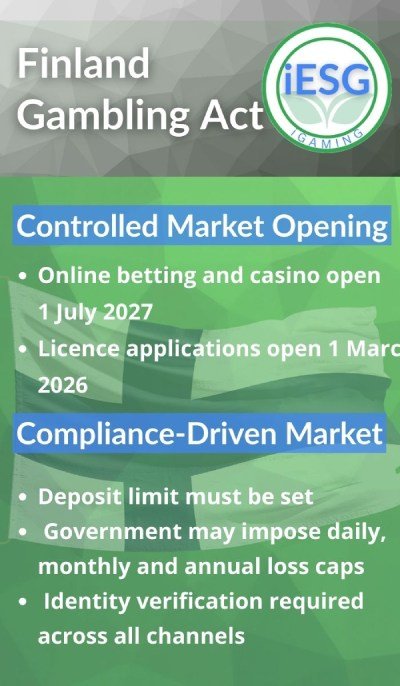
Parliament approved the reform in December 2025, and from 1st March 2026 operators can begin submitting licence applications ahead of launch1. Veikkaus will continue to hold exclusivity over lotteries, scratch cards and most land-based operations, but online betting and online casino are moving into competitive territory.
What makes the Finland Gambling Act strategically important is not simply that it opens the market. It is how deliberately controlled that opening is.
Governance Architecture: Control Without Monopoly
From July 2027, a newly created Licensing and Supervision Authority will take responsibility for the system1. It will grant licences, oversee compliance, enforce marketing rules and target unlicensed offshore operators. In practical terms, oversight shifts from monopoly control to regulatory supervision.
The Finland Gambling Act introduces three licence categories:
- Exclusive licence for Veikkaus,
- Gambling licence for B2C online betting and casino,
- Separate gambling software licence that becomes mandatory from July 2028.
Licensed operators will only be allowed to use licensed suppliers, tightening accountability across the supply chain and making technical compliance harder to outsource or ignore. Sanctions include licence suspension, revocation and financial penalties1. The policy objective is straightforward: increase channelisation and draw offshore activity back into a supervised framework. Finland is not loosening control, it is rather redistributing it.
Social Responsibility Embedded in Market Design
Where the Finland Gambling Act becomes particularly assertive is in player protection. Customers must set personal deposit limits before they can play1. This is a structural requirement, not a marketing feature. The government also retains the power to introduce daily, monthly and annual loss limits through secondary regulation, with online poker currently excluded².
Further product constraints are likely to follow. Regulators could step in with caps on stake sizes, adjust game speed mechanics or restrict certain high-intensity features. Even session length may come under scrutiny.
- Identity checks remain mandatory across all channels, reinforcing both age control and anti-money laundering safeguards1.
- Marketing is permitted, but it must remain “moderate” in scope and tone1. That wording is intentionally broad and will likely be tested in early enforcement decisions.
- Direct marketing requires explicit, active consent. Pre-ticked boxes or implied permissions are not acceptable1.
- Bonuses may only be offered within an established customer relationship and must be made available on equal terms. Free credits cannot be linked to time spent playing or wagering volume.
- Cryptocurrencies are not permitted as a payment method under the Finland Gambling Act1.
This framework leaves little room for aggressive acquisition tactics.
💡 Escalation risk in this framework will rarely hinge on a single behavioural trigger. It typically becomes visible through cumulative patterns across session intensity, loss-response behaviour and prior intervention outcomes. Structuring how those patterns are documented, escalated and reviewed inside a formal governance model is exactly where tools like our iESG Assessment become operational rather than theoretical.
Channelisation and Competitive Tension
The shift to licensing reflects a simple reality: Finnish players already access offshore platforms, regardless of national borders. The goal of the Finland Gambling Act is to bring that activity back into a regulated system and improve channelisation into licensed operators1.
At the same time, tight marketing rules and constrained promotional tools create an obvious tension. If licensed operators are too restricted, the competitive balance becomes fragile. Nordic experience shows that when regulation tilts too far, grey-market alternatives do not disappear. They adapt.
Finland is trying to strike a workable balance between social protection and market viability. Whether it succeeds will depend less on legislative intent and more on how proportionately the new authority enforces the rules in practice.
What Operators Must Prepare for Before 2027
Licensing applications open on 1 March 20261. That leaves little room for delay. Marketing will need a rethink. Acquisition strategies built around influencers or high-intensity bonus mechanics will not fit in the Finland Gambling Act. Operators will need to build trust over time, communicate clearly and focus on long-term player relationships instead of chasing quick promotional wins.
Compliance systems must be embedded at product level. Deposit limits, potential loss caps and AML processes cannot sit on the surface. They must be integrated into the architecture from day one. Supply chains also require attention. The upcoming software licence requirement means vendor relationships must withstand regulatory scrutiny.
Structured oversight does not eliminate opportunity. It simply means that only operators comfortable operating within visible guardrails are likely to benefit.
🏅 As regulatory scrutiny increases, operators will need structured ways to evidence how responsible gambling analytics are governed and reviewed. A sector-specific benchmark such as the iESG Certificate provides a reference framework for documenting these processes in a format regulators and institutional stakeholders recognise, without implying guaranteed outcomes.
Conclusion: Finland Gambling Act
The Finland Gambling Act does not represent deregulation. It represents controlled liberalisation. Online gambling will open to competition, but within a framework built around deposit limits, potential loss caps, marketing constraints, software licensing and centralised supervision.
For operators, this is not just a market entry decision. It is a governance decision. The brands that approach Finland with mature compliance structures and long-term positioning will find opportunity. Those dependent on aggressive acquisition models may struggle. The transition period has already begun.
FAQ – Finland Gambling Act
When does the Finland Gambling Act take effect?
The competitive licensing system launches on 1 July 2027, with applications opening on 1 March 2026.
What remains under Veikkaus’ exclusive control?
Lotteries, scratch cards and most land-based casino and EGM operations.
Are deposit limits mandatory in the new Finland Gambling Act?
Players must set deposit limits before playing, and further loss limits may be introduced by decree in the Finland Gambling Act.
Is influencer marketing allowed?
Influencer-led promotion is expressly prohibited in the new Finland Gambling Act.
Can licensed operators accept cryptocurrencies?
Cryptocurrency payments are not permitted under the Act.
Sources:
- Ministry of the Interior (Sisäministeriö): “Parliament adopted the new Gambling Act and the related acts on 16 December 2025.
https://intermin.fi/en/projects/reform-of-the-gambling
