
There’s no single model for gambling regulation anymore, gambling regulation trends are no longer moving in sync across markets. Operators aren’t navigating a global standard, they’re rather dealing with a patchwork … and that patchwork is getting messier.
The shift isn’t just in the rules themselves, it’s in what regulators expect those rules to achieve. In several markets, responsible gambling is no longer assessed on intent or policy. It’s judged on outcomes: Can you detect risk early? Can you intervene in time? Can you demonstrate it¹?
Recent policy moves make that direction hard to ignore. Finland is preparing to open its monopoly system through a licensing framework, reshaping how operators enter and operate in the market². At the same time, New Zealand is moving toward a regulated online casino model, with tighter control over who can operate and how³. These aren’t isolated changes, they point to something broader.
Gambling regulation trends are becoming more local, more specific, and less predictable.
Gambling regulation trends are fragmenting across markets
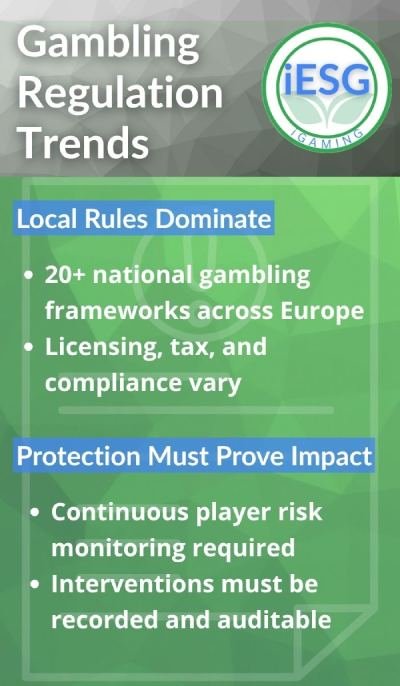
Zoom out, and the pattern becomes clear: gambling regulation trends are not aligning … they are drifting apart. Within the European Union, there is no unified framework to anchor operators. Gambling remains a national responsibility, which means each country defines its own regulatory system. The result is a landscape of more than 20 distinct frameworks, each with its own licensing rules, tax structures, and player protection requirements.¹
In the United States, the situation is even more fragmented as regulation happens at the state level. What works in one jurisdiction often does not translate to another. This divergence is not temporary, it reflects deeper differences in political priorities, public health approaches, and market maturity.
Finland’s planned transition illustrates this clearly: instead of adopting an existing model, it is building a new one, designed to open the market while tightening control and oversight.²
The takeaway is straightforward … standardized compliance does not scale anymore.
New markets are accelerating regulatory divergence
Gambling regulation trends are not always happening in established markets. They are emerging in jurisdictions where regulation is being built from the ground up. New Zealand is one of them. The government has confirmed plans to introduce a regulated online casino licensing system, aimed at reducing harm and limiting offshore operator activity.³
What matters here is not market size, it is design.
Markets like Finland and New Zealand are not adjusting legacy systems. They are defining new ones which allows regulators to set stricter entry requirements, clearer accountability, and stronger player protection measures from the outset.
For operators, these markets are not yet benchmarks, but they are signals. They show where regulatory expectations are moving: toward tighter control, clearer rules, and greater accountability.
Gambling regulation trends: The shift toward evidence-based player protection
Responsible gambling trends are being redefined. It used to be enough to have policies in place but today, regulators increasingly want to see how those policies perform in practice and that changes the requirement completely.
Operators are now expected to show:
- how player behavior is monitored
- how risk is identified
- when intervention happens
- what actions were taken, and why
This is where ESG becomes operational while player protection is no longer a narrative, it becomes something measurable and auditable. Regulatory expectations reflect this shift: The UK Gambling Commission, for example, requires operators to identify indicators of harm and act on them, not simply document them.¹
Industry analysis supports the same direction, according to BDO, integrating ESG into gaming operations strengthens risk management and long-term resilience.⁴ One of the biggest shitfs in gambling regulation trends is that responsible gambling is no longer about having the right policies, it is about demonstrating that they work.
💡Assessing iGaming supplier risk goes beyond basic checks. It requires visibility across systems and partners. The iESG Assessment provides a structured approach to evaluate and document supplier-related ESG exposure.
What fragmentation means for gambling compliance strategy
Fragmentation shows up quickly in day-to-day operations:
- compliance frameworks multiply
- costs increase with each new market
- timelines stretch
- systems become harder to manage
The old model does not hold … building once and rolling out everywhere no longer works.
It’s replaced by a more flexible, scalable gambling compliance strategy that keeps pace with new gambling regulation trends.
Central core, local execution
A unified framework that can be adapted market by market without starting from scratch.
Real-time player risk systems
Continuous monitoring that meets regulatory expectations for evidence-based protection.
Aligned ESG and compliance reporting
One reporting structure, not parallel systems.
Modular technology
Systems that can adapt quickly as regulations evolve.
This is no longer about efficiency alone, it is about staying operational across multiple jurisdictions … operators who solve this, move faster and those who do not face constant friction.
Conclusion
Gambling regulation trends are not moving toward alignment … they are moving further apart. At the same time, expectations are increasing whereas regulators want evidence, not intent. That combination creates pressure across the entire operating model.
Some operators will treat this as a constraint while others will treat it as a system problem to solve. Operators that treat compliance as infrastructure will scale faster across fragmented markets. The rest will keep reacting.
🏅 As supplier risk increases across the iGaming stack, structured oversight becomes essential. The iESG Certificate provides a framework to assess and manage supplier-related ESG exposure.
FAQ – gambling regulation trends
What are current gambling regulation trends?
Gambling regulation trends point toward fragmentation, with each market defining its own rules for licensing, player protection, and compliance.
Why is gambling regulation becoming more fragmented?
Because regulation is shaped locally, based on political priorities, cultural attitudes, and market maturity.
How does Finland’s regulation change impact operators?
It introduces a licensing model with stricter oversight, changing both market access and compliance requirements.
What is evidence-based player protection?
It involves using player data to detect risk, intervene appropriately, and demonstrate that those actions are effective.
How should operators adapt to gambling regulation trends?
By building flexible, modular systems that can adapt to different regulatory environments.
Will gambling regulation become more unified globally?
Current gambling regulation trends suggest continued divergence rather than convergence.
Sources:
- European Commission: “Gambling regulation and national competence”
https://ec.europa.eu/growth/sectors/gambling_en - Finnish Ministry of the Interior: “Gambling system reform”
https://intermin.fi/en/police/gambling - New Zealand Department of Internal Affairs: “Online casino regulation”
https://www.dia.govt.nz/Online-Casino-Gambling - BDO: “ESG Strategy for Gaming”
https://www.bdo.com/insights/industries/gaming-leisure/gaming-companies-unlock-the-power-of-esg-strategy-and-investment
