
Affiliate compliance in gambling used to sit somewhere between marketing and legal … not anymore. Regulators now expect operators to demonstrate active oversight of affiliate activity, especially when promotions involve bonus advertising, responsible gambling messaging, or market-specific restrictions. That expectation has fundamentally changed the role affiliates play inside modern compliance frameworks.
For years, many operators treated affiliates as independent acquisition partners operating outside core governance structures. That distinction is fading quickly. Across regulated markets, authorities increasingly view affiliate activity as part of the operator’s wider compliance responsibility.¹ That creates a problem many operators still underestimate.
Most affiliate programs are built around acquisition metrics: CPA efficiency, first-time deposit volume, and conversion performance. Oversight mechanisms often remain secondary until a breach surfaces publicly or triggers regulator attention. By that point, the operational damage is usually already done.
The uncomfortable reality is this: many operators still cannot produce a reliable audit trail showing how affiliate campaigns were monitored, reviewed, or escalated over time. And that is exactly where affiliate compliance in gambling is heading.
The industry’s weakest governance layer: affiliate compliance in gambling
The affiliate model was designed for speed and scale, not governance: landing pages change constantly, campaigns move across jurisdictions overnight, and sub-affiliate structures create additional layers between operators and traffic sources. The result is an ecosystem where visibility disappears quickly unless monitoring is continuous.
That operational complexity is now colliding with stricter enforcement standards.
The UK Gambling Commission has repeatedly stated that operators remain responsible for affiliate conduct connected to their license, including third-party marketing activity.¹ The Advertising Standards Authority has also intensified scrutiny around gambling advertising, particularly where bonus transparency or social responsibility standards are unclear.²
The problem is not simply bad affiliate behavior. The bigger issue is weak operational oversight.
An operator may already have policies covering:
- bonus transparency
- restricted wording
- responsible gambling disclosures
- geo-specific restrictions
But policies alone do not prove governance exists in practice.
Can the operator demonstrate:
- when an affiliate page was reviewed
- who approved it
- what changes were requested
- whether remediation happened
- how long the issue remained live
Those are the questions regulators increasingly care about. And for many operators, the answers are scattered across inboxes, Slack messages, spreadsheets, or verbal conversations that were never formally documented.
Affiliate Monitoring Is Becoming an Evidence Problem
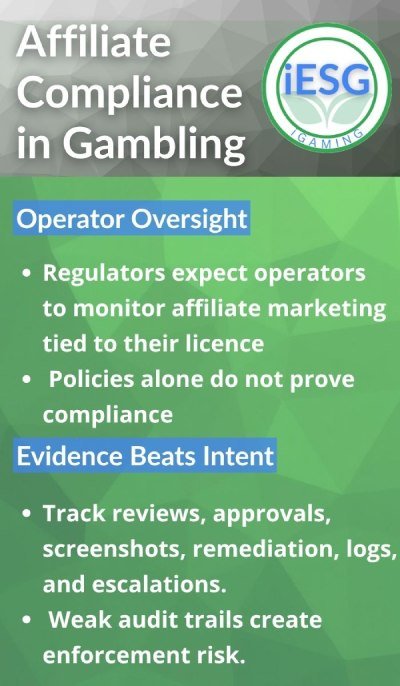
Most conversations around affiliate compliance in gambling focus on prevention and yet, the larger issue is evidence. When regulators investigate affiliate activity, they are not only reviewing the breach itself. They are assessing whether the operator maintained credible oversight before the issue escalated. That distinction changes the entire conversation.
An operator with imperfect affiliates but strong documentation is often in a far more defensible position than an operator with cleaner affiliates and weak audit controls. This is where many affiliate programs remain exposed.
Some still rely heavily on manual spot checks and fragmented approval processes. Many operators review affiliate campaigns consistently but keep almost no historical record of what was flagged, who approved changes, or how issues were resolved once they surfaced. That becomes dangerous when investigations look backward.
A problematic bonus page removed today may still become relevant months later if regulators request proof showing:
- when the issue was first identified
- how quickly action was taken
- whether the affiliate complied
- what internal escalation followed
Without documented evidence, oversight becomes difficult to prove.
The operators handling affiliate compliance in gambling effectively are moving toward structured evidence retention:
timestamped screenshots
archived landing pages
remediation logs
approval histories
documented escalation records
The shift is subtle but important: affiliate oversight is slowly moving away from reactive compliance management and toward formal governance infrastructure.
The Small Failures That Become Bigger Problems
Major enforcement actions rarely begin with a single catastrophic breach. Most affiliate problems do not start with a major breach. They start with smaller issues nobody escalates properly: outdated bonus terms staying live for weeks, missing RG messaging buried on landing pages, or affiliate edits approved quickly without anyone documenting the follow-up.
Individually, these problems may look manageable but collectively, they create a pattern regulators increasingly interpret as weak governance. That is why affiliate compliance in gambling is becoming less about isolated incidents and more about demonstrating operational control over time.
The strongest operators are now building frameworks capable of answering three questions immediately:
- What happened?
- When was it identified?
- What evidence shows the operator responded appropriately?
Those answers matter far more than generic ESG statements or broad compliance promises.
Most large affiliate programs eventually hit the same problem: manual checks stop being reliable once campaigns are spread across dozens of markets, languages, and landing pages. That is where platforms like Rightlander and GiG Comply are typically brought in.
But software alone does not solve governance weaknesses. Monitoring only becomes meaningful when operators connect detection with documented escalation procedures and enforceable remediation processes. That operational discipline is becoming the real differentiator.
💡Affiliate compliance failures rarely come from one major breach. More often, risk builds quietly through delayed reviews, fragmented oversight, and gaps between affiliate monitoring, compliance, and governance teams. Our iESG Assessment helps identify where those control gaps exist before they escalate.
Why strong affiliate compliance creates competitive advantage
Most operators still frame affiliate compliance in gambling as a defensive obligation …
The smarter ones increasingly treat it as operational infrastructure. Strong governance reduces friction across the business.
Compliance teams spend less time cleaning up avoidable problems, and legal teams are dragged into fewer reactive investigations. Affiliate expectations become clearer. Regulator conversations become easier to navigate because evidence already exists when questions arise.
There is also a commercial advantage emerging beneath the surface.
Larger affiliate publishers increasingly prefer operators with stable governance structures because inconsistent compliance environments create risk for them as well. Affiliates do not want partnerships disrupted by sudden enforcement actions or unclear standards between markets.
At the same time, investor scrutiny around governance continues expanding beyond environmental reporting. Third-party oversight, operational accountability, and reputational controls increasingly form part of broader ESG evaluations.³
That makes affiliate compliance in gambling much bigger than a marketing issue. It is becoming a signal of operational maturity and in heavily regulated sectors, maturity itself becomes a competitive advantage.
Conclusion
Affiliate compliance in gambling is no longer measured by whether operators have policies written down somewhere. It is measured by whether they can demonstrate active oversight, maintain reliable evidence trails, and show how issues were handled when problems surfaced.
That requires infrastructure, documentation, and operational discipline. The operators that succeed over the next few years will not necessarily be the ones with the largest affiliate networks. They will be the ones capable of scaling acquisition without losing governance control over it.
Because when regulators investigate affiliate activity, they are no longer only assessing the affiliate. They are assessing the operator behind it.
FAQ – affiliate compliance in gambling
What is affiliate compliance in gambling?
Affiliate compliance in gambling refers to the systems operators use to monitor, review, and enforce compliant affiliate marketing activity across regulated markets.
Why is affiliate compliance in gambling important?
Because regulators increasingly expect operators to maintain oversight of third-party marketing connected to their brand and license.
What are the biggest affiliate compliance risks?
Some of the biggest risks come from misleading bonus promotions, weak oversight of sub-affiliate traffic, and affiliate changes that were never properly reviewed or documented.
How often should gambling affiliates be monitored?
Most operators check higher-risk affiliates at least once a month. Larger programs usually monitor continuously because things can change very quickly once campaigns go live.
What tools help with affiliate compliance in gambling?
Most large affiliate programs eventually hit the same problem: manual checks stop being reliable once campaigns are spread across dozens of markets, languages, and landing pages. That is where platforms like Rightlander and GiG Comply are typically brought in.
Sources:
- UK Gambling Commission: “Marketing and advertising compliance”
https://www.gamblingcommission.gov.uk/licensees-and-businesses/guide/page/marketing-and-advertising - Advertising Standards Authority: “Gambling advertising rules”
https://www.asa.org.uk/advice-online/gambling-betting-and-gaming-personal-financial-problems.html - Deloitte: “Third-Party Risk Management and Governance”
https://www.deloitte.com/global/en/services/consulting-risk/perspectives/third-party-risk.html
