
Most responsible gambling tools fail when they’re actually needed. Pop-ups, deposit limits, session reminders tend to appear after the situation has already shifted. By then, the player isn’t weighing decisions anymore. They’re reacting and that often means chasing losses. Early intervention in gambling doesn’t try to fix behavior at its peak. It acts while it’s still forming, not with stronger messages, but with better timing.
The pressure is building from both sides. Regulators are moving away from reactive safeguards and pushing toward prevention. At the same time, investors are starting to look for measurable proof that player protection actually works.
Early intervention in gambling is quickly becoming the difference between compliance on paper and real control in practice.
Why late-stage gambling interventions fail
Late interventions assume players will respond rationally once prompted. That assumption breaks the moment behavior escalates. False positives and loss-chasing change how decisions are made. Players stop evaluating outcomes and start reacting to previous losses. At that point, a warning doesn’t interrupt the behavior. It competes with it … and usually loses.
The UK Gambling Commission has consistently pushed operators to adopt early intervention in gambling: a more tailored customer interactions, emphasizing the need to identify risk before harm escalates¹.
The issue isn’t a lack of safeguards but how they’re triggered. Most systems rely on fixed thresholds, e.g.: deposit limits, session length, loss markers. Once crossed, an intervention fires. The problem is that these thresholds detect endpoints but don’t capture direction.
By the time a trigger activates, the behavior it’s meant to correct is already established while the system just records the problem but doesn’t prevent it.
The gap is that operators can meet regulatory requirements while still having limited influence on real player behavior because timing is off. That’s where most late-stage systems fail and where early intervention in gambling becomes necessary.
What early intervention in gambling actually means
Early intervention in gambling starts with a different question … It’s not “has the player crossed a limit?”, but “how is their behavior changing?”
That distinction matters.
A single large deposit doesn’t say much on its own, and neither does a long session. What matters more is acceleration: a player increasing deposit frequency within a short window, sessions gradually stretching while bet sizes creeping upward.
Individually, these signals look harmless … together, they point to a shift. That’s where early intervention in gambling operates … at the inflection point, not the endpoint.
Most legacy systems miss this because they are built around static rules. They wait for something to happen and early intervention systems react to how quickly things are changing.
Industry research and advisory work increasingly point toward behavioral monitoring and dynamic risk detection as the next step in player protection². The intervention itself doesn’t need to be aggressive. A small amount of friction at the right moment, such as slowing deposits, adjusting pacing, prompting reflection, can interrupt escalation without breaking the experience.
This is the core principle behind early intervention in gambling: act on momentum, not outcomes.
The timing advantage: intervening before escalation
There is a point where behavior is still flexible but after that, it hardens quickly.
Miss that window, and the nature of intervention changes and you’re no longer guiding behavior but you’re trying to override it.
The difference is timing:
- Early: behavior is shifting, still responsive
- Mid: patterns are forming, harder to influence
- Late: behavior is entrenched, resistant
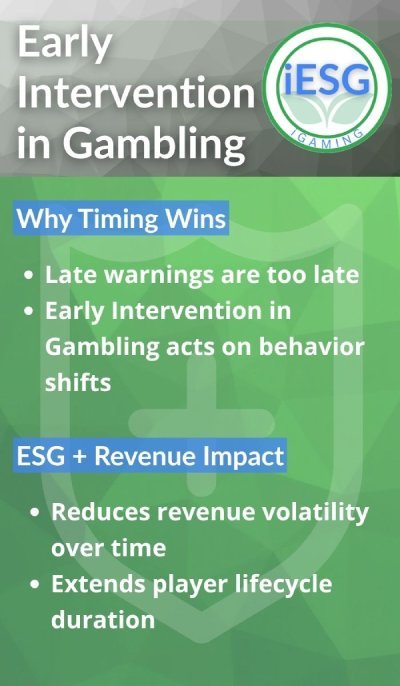
Early intervention in gambling sits in that first phase and that’s exactly where minimal input can still change direction.
Once behavior progresses, responsiveness drops and interventions feel intrusive. Players ignore them or push back against them.
What could have been a small correction becomes a forced restriction. Evidence from regulators and behavioral research suggests that earlier interventions are more effective than relying on late-stage controls when addressing gambling-related harm³.
The implication is simple: Effectiveness is front-loaded and early intervention in gambling is effective precisely because it operates within this narrow window.
💡Early intervention in gambling depends on how quickly risk signals move across systems, including suppliers.
The iESG Assessment helps identify where those signals may be delayed or fragmented.
Business and ESG impact of early intervention in gambling
The commercial impact of early intervention in gambling shows up in player value patterns. Without early intervention, value tends to concentrate in short bursts: Players increase spend rapidly, hit a peak, and then drop out … either through self-exclusion, burnout, or restriction.
That creates the illusion of high value but in reality, it’s unstable. From a revenue perspective, this is leakage: you extract value quickly, then lose the player entirely.
Early intervention changes the shape of that curve. Instead of sharp peaks followed by drop-offs, engagement stretches over time. Lower volatility, longer lifecycles, more predictable revenue.
It also changes perception where players can tell when a system is guiding behavior versus shutting it down. Early interventions feel embedded while late ones feel imposed. From a regulatory standpoint, the direction is clear. The Malta Gaming Authority continues to emphasize risk-based and proactive player protection frameworks⁴.
From an ESG perspective, expectations are shifting as well. ESG-focused investors are placing greater emphasis on measurable player protection outcomes and long-term sustainability signals⁵.
The assumption that early intervention in gambling reduces revenue doesn’t hold up … it redistributes it.
Conclusion
The industry doesn’t lack responsible gambling tools. It lacks timing.
Late-stage warnings are easy to deploy and easy to justify, but they consistently arrive after the point where they can change anything.
Early intervention in gambling offers a more effective path. Act while behavior is still shifting, and you have influence. Wait until it peaks, and you’re reacting.
Operators don’t need more tools, they need better timing.
FAQ – Early Intervention in Gambling
What is early intervention in gambling?
It means identifying early behavioral shifts and acting before they escalate into harm.
Why is early intervention in gambling more effective than warnings?
Because regulation is shaped locally, based on political priorities, cultural attitudes, and market maturity.
How do operators detect early risk signals?
Because it targets players while decisions are still flexible, not reactive.
Does early intervention in gambling require AI?
Not necessarily, but advanced analytics improves timing and accuracy.
Is early intervention required by regulators?
Not explicitly everywhere, but regulatory expectations are clearly moving in that direction.
Sources:
- UK Gambling Commission: “Customer Interaction (LCCP section)“
https://www.gamblingcommission.gov.uk/licensees-and-businesses/lccp/condition/3-4-1-customer-interaction - UK Gambling Commission: “Evidence Review (behavior + harm)“
https://www.gamblingcommission.gov.uk/statistics-and-research/publication/evidence-review-of-gambling-related-harms - European Commission: “Online Gambling & Consumer Protection”
https://ec.europa.eu/growth/sectors/gambling_en - Malta Gaming Authority: “Player Protection Directive”
https://www.mga.org.mt/player-protection/ - BDO: “ESG Strategy for Gaming”
https://www.bdo.com/insights/industries/gaming-leisure/gaming-companies-unlock-the-power-of-esg-strategy-and-investment
