
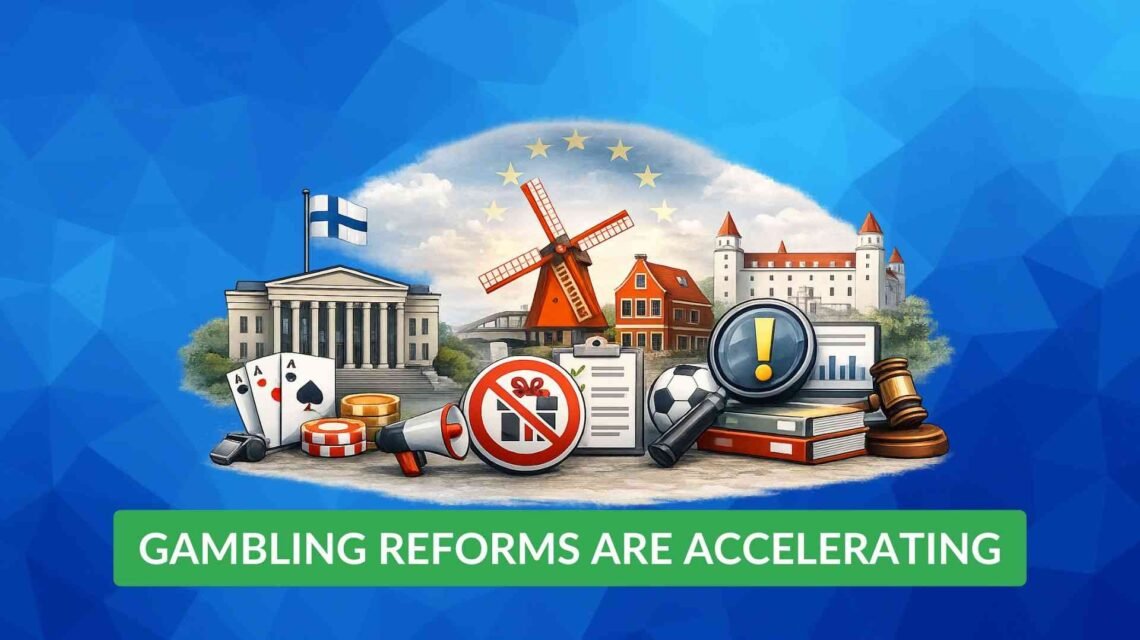
Gambling reforms are accelerating across Europe, with Finland, the Netherlands, and Slovakia each introducing measures that point in the same direction. These are different markets, with different politics, but the direction is … similar.
The old regulatory model was easier to read: get licensed, follow the rules, renew the licence. That model is being replaced by something more active: regulators want evidence of control, not just policy documents. They are looking at how operators advertise, how they protect players, how quickly they detect problems, and whether their systems hold up during high-risk periods.
For operators, the indication seems to be that gambling reforms are no longer only about market access … they are about conduct after market access.
What recent gambling reforms reveal
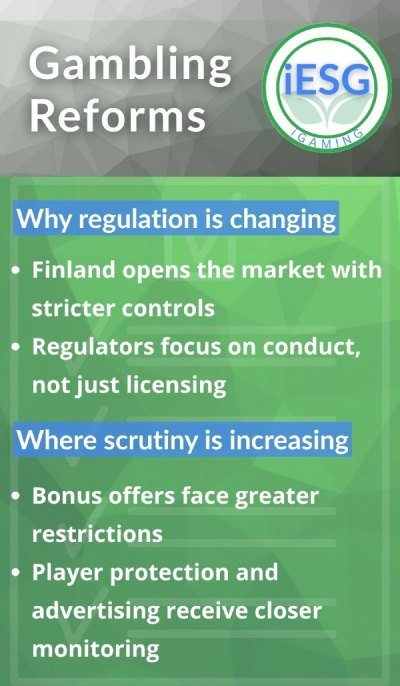
Recent gambling reforms point in the same direction: a shift from expansion to control and Finland is the clearest example. The country has approved a new Gambling Act that will open betting, online slot games, online casino games, and online money bingo to competition under a licensing model. Licence applications can begin on 1st March 2026, while licensed gambling services can start on 1st July 2027, and until then, Veikkaus keeps its monopoly.¹
That sounds like liberalisation, and it is, but only on the surface: the same reform also introduces tighter supervision, marketing restrictions, anti-money laundering requirements, and a new licensing structure. Finland is not simply opening the market … it is redesigning control.
That distinction matters because recent gambling reforms are not simply opening markets. They are redefining how those markets are controlled. Governments want the tax and channelisation benefits of licensed markets, but they also want stronger tools to manage harm, advertising, and illegal supply.
This is the new bargain for operators:
access comes with closer scrutiny
growth tactics are being tested against player protection
marketing is becoming a compliance issue
documentation matters more than intent
Operators that view gambling reforms primarily as market-opening opportunities only see half the picture. The sharper reading is this: European regulators are allowing competition where they believe they can supervise it.
What gambling reforms mean for player protection
The Netherlands shows where this is heading … the Kansspelautoriteit treats bonuses as advertising, not as a harmless retention tool. Its rules state that gambling advertising includes bonuses, sponsorship visibility, and other promotional activity. Advertising cannot target minors, and licensed operators cannot direct bonuses or loyalty schemes at young adults aged 18 to 24.²
Regulators are not only asking whether a promotion is legal, they are asking who it reaches, what behaviour it encourages, and whether the operator can prove control.
The Ksa has already acted against cashback bonuses: in its annual report, the regulator said it told all online licence holders to stop offering cashback bonuses because this type of bonus gives players part of their losses back. The Ksa considered that these bonuses could encourage excessive gambling, and operators stopped offering them.³
This is where these recent gambling reforms are showing a more behavioural approach, meaning the bonus itself is not always the issue … the real risk is the behaviour it can trigger.
For operators, that changes how promotional strategy should be reviewed, where a promotion cannot just pass a legal wording check but a real risk check:
- Is the offer likely to encourage chasing losses?
- Could it reach young adults or vulnerable players?
- Is the affiliate version of the offer controlled?
- Is responsible gambling messaging clear enough?
- Can the operator evidence who received the promotion?
Commercial teams may see bonuses as acquisition mechanics but regulators increasingly see them as player protection triggers.
What gambling reforms reveal about modern oversight
Ahead of the 2026 World Cup, the Slovak Gambling Regulatory Authority said it would strictly monitor gambling advertising, including from the perspective of consumer protection law. The regulator also pointed to its newer powers in consumer protection supervision.⁴
That matters because major sports events compress risk: betting volume rises, advertising intensifies, affiliates become more aggressive, and operators push harder for market share. Regulators know this and they are no longer waiting for complaints after the event, they are setting expectations before the pressure arrives.
The Netherlands did something similar around the 2022 World Cup where the Ksa reported that it ran a dedicated project to monitor betting offers and advertising around the tournament, received 45 signals, and intervened 13 times with eight providers.³
This is where recent gambling reforms become more focused on behaviour than rules:
Old model: licence, audit, renewal.
New model: licence, monitoring, intervention.
Operators should assume that high-risk periods will receive targeted scrutiny, including major football tournaments, national sporting events, new product launches, bonus-heavy acquisition periods, and affiliate campaigns.
The operational question shifted from “Are we compliant on paper?” to “Can we prove control while the campaign is live?”
That requires faster evidence, clearer ownership, and better internal escalation. Compliance cannot sit outside the commercial engine, it needs visibility before campaigns go live and while they are running.
💡 As gambling reforms reshape regulatory expectations across Europe, operators need a structured way to assess governance, compliance, and operational readiness. The iESG Assessment helps identify gaps before increased regulatory scrutiny exposes them.
What operators should prepare for next
The practical response is not panic .. it is discipline.
Gambling reforms are becoming more demanding, but the direction is increasingly clear.
Operators should focus on five areas.
#1. Review promotional governance
Every bonus, campaign, and affiliate offer should have a documented approval trail. Riskier offers need stronger review.
#2. Strengthen player protection evidence
Policies matter less than proof which is why operators need records showing how limits, interventions, monitoring, and exclusions work in practice.
#3. Treat affiliates as an extension
Regulators do not care that a message came from a third party if the operator benefits from it. Affiliate controls need live review, not annual paperwork.
#4. Prepare higher scrutiny
World Cups, Euros, and big national events should trigger enhanced monitoring plans, even before campaigns start.
#5. Build clear reporting
Boards and executives need simple visibility: campaign risk, player risk, complaint trends, intervention rates, and compliance exceptions.
The winners will not be the operators with the longest policy documents but the ones that can show control quickly when regulators ask.
Conclusion
Recent gambling reforms reveal regulators that are becoming more active, more interventionist, and more focused on outcomes. Finland shows controlled market opening, and the Netherlands shows pressure on bonuses and player protection while Slovakia requires event-based monitoring before risk peaks.
The message is clear: licence holders need to prove they are in control, not just claim they are compliant.
Operators that understand regulatory direction early will make better commercial decisions before enforcement forces them to.
FAQ: gambling reforms
What is meant by gambling reforms?
Gambling reforms refers to the national rules reshaping how gambling licensing, advertising, player protection, AML controls, and operator supervision is handled.
Are gambling bonuses under pressure in Europe?
The Netherlands treats bonuses as advertising and has restricted certain bonus practices where they may encourage excessive gambling.
What does continuous gambling oversight mean?
It means regulators monitor operator behaviour during live market activity, not only during licence applications or renewals.
What should operators do with accelerating gambling reforms?
Tighten oversight of promotions, affiliates, and player protection processes before regulators do it for them.
Sources:
- Ministry of the Interior Finland (2025): “Reform of the Gambling System”
https://intermin.fi/en/projects/reform-of-the-gambling - Kansspelautoriteit: “Rules for Gambling Advertising”
https://kansspelautoriteit.nl/belangrijkste-regels-voor-kansspelreclame - Kansspelautoriteit (2022): “Annual Report 2022”
https://kansspelautoriteit.nl/sites/default/files/jaarverslag_kansspelautoriteit_2022_online.pdf - Úrad pre reguláciu hazardných hier (2026): “The Gambling Regulatory Authority Calls on Operators to Act Responsibly Ahead of the 2026 FIFA World Cup”
https://www.urhh.sk/2026/06/10/urad-pre-regulaciu-hazardnych-hier-apeluje-na-zodpovednost-prevadzkovatelov-pred-ms-vo-futbale-2026-reklamu-bude-prisne-sledovat-aj-z-pohladu-zakona-o-ochrane-spotrebitela/
