
Securing a gambling licence now requires far more than proving financial stability and technical competence … across regulated markets, iGaming licensing requirements test in practice how an operator is governed, how it manages risk, and whether its compliance systems work. Regulators want to see clear ownership, credible controls, effective player protection, and evidence that senior leaders understand the risks and obligations attached to the licence.¹
They may not call this “ESG” and in most cases, they do not … yet much of what licensing authorities examine sits firmly within its Governance and Social pillars: board oversight, anti-money laundering controls, customer protection, transparency, accountability, and conduct.
Operators that treat ESG as a separate reporting exercise can miss the areas that matter most during a licensing review. Clear decision-making, reliable documentation, and a visible compliance culture help an authority judge whether a business is fit to operate … they also matter after approval, when regulators assess whether the operator remains suitable to hold the licence.
Why iGaming Licensing Requirements Are Becoming More Demanding
iGaming licensing requirements have moved well beyond the initial application … in mature regulated markets, an operator must continue to show that its controls, leadership, and risk systems remain effective after launch. A licence is not the end of scrutiny, it is the start of an ongoing supervisory relationship.²
The UK Gambling Commission and Malta Gaming Authority both place weight on governance, risk management, internal controls, and the quality of evidence supplied by operators. A polished policy document is not enough: regulators want to know who owns the policy, how it is tested, what management information reaches the board, and what happens when controls fail.³
The reason is straightforward: financial crime, customer harm, cyber risk, advertising failures, and weak supplier oversight rarely exist in isolation. They often point back to the same problem: poor governance and for licensing authorities, the quality of an operator’s decision-making can be as important as the wording of its procedures.
Modern iGaming licensing requirements are designed to ensure operators can continue to meet regulatory expectations long after a licence has been granted.
Governance Drives Modern iGaming Licensing Requirements
If one ESG pillar consistently influences regulatory confidence, it is Governance. Across modern iGaming licensing requirements, governance has become one of the strongest indicators of an operator’s long-term suitability.
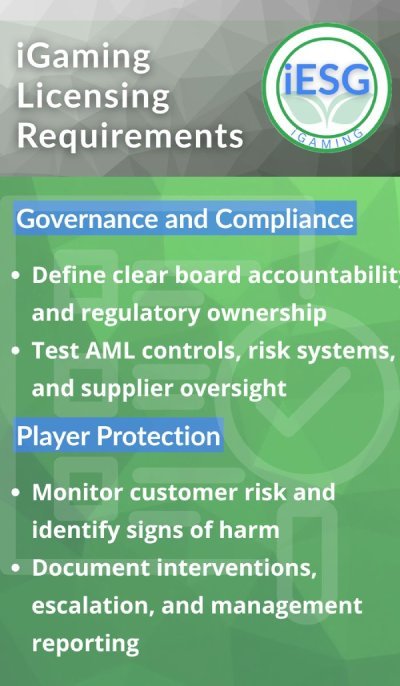
Strong governance gives an operator the structure to spot risks early, assign responsibility, test controls, and act before a weakness becomes a regulatory breach. Regulators may not describe that work as ESG per se, but they examine it (very) closely during licensing reviews and ongoing supervision.⁴
Board accountability is central: senior leaders are expected to know where the main regulatory risks sit, whether compliance teams have enough authority and resources, and whether corrective action is taken when performance falls short. Compliance cannot operate as an isolated function which means the board remains accountable for the way the business is run.
AML controls are another clear test of governance quality where operators need credible customer due diligence, transaction monitoring, suspicious activity reporting, and risk assessments that reflect national law and relevant Financial Action Task Force guidance. An AML weakness is rarely viewed as a narrow technical failure … it can raise wider questions about leadership, oversight, and control.⁵
The same applies to internal compliance systems: regulators expect policies to have named owners, review dates, testing procedures, escalation routes, and supporting records. What matters is not whether a document exists, but whether the operator can show that the control is understood, monitored, and used.
Effective oversight of third parties has therefore become another important component of modern iGaming licensing requirements, particularly as regulators place greater emphasis on operational accountability.
Governance signals within iGaming licensing requirements
The following governance signals show whether iGaming licensing requirements are embedded in an operator’s daily controls, oversight, and decision-making:
- Named board and executive accountability
- Policies linked to operational controls
- Effective AML monitoring and escalation
- Independent assurance and testing
- Live risk registers with clear owners
- Supplier and affiliate oversight
- Records showing how weaknesses were corrected
These signals tell a regulator whether compliance is part of the operating model or … simply assembled for the application.
💡As iGaming licensing requirements place greater weight on governance, player protection, and operational accountability, the iESG Assessment can help operators review board oversight, compliance controls, supplier risk, and licensing readiness.
Responsible Gambling Within iGaming Licensing Requirements
While governance dominates licensing assessments, the Social pillar of ESG also plays an important role in modern iGaming licensing requirements.
Responsible gambling is not merely a customer-facing policy: it shows how an operator handles risk when commercial incentives and player welfare come into conflict. Regulators expect businesses to identify signs of harm, protect vulnerable customers, intervene when necessary, and assess whether those interventions work.
Meeting that expectation requires more than placing safer gambling tools on a website, operators need suitable customer-monitoring systems, clear escalation triggers, trained staff, documented interactions, and management information that reveals where controls are failing.
Responsible gambling performance also exposes the quality of governance behind it,as poor customer interactions may point to weak training and repeated failures may very well expose unclear ownership or inadequate board oversight. A policy can look credible on paper while breaking down at the point where a customer needs protection.
This is where ESG becomes relevant without becoming a licensing label. Player protection sits within the Social pillar, but its effectiveness depends on Governance: accountability, reporting, testing, challenge, and corrective action. Those same principles increasingly underpin iGaming licensing requirements across regulated markets.
Building ESG Readiness Before Your Next Licensing Review
Preparing for future iGaming licensing requirements cannot be treated as a last-minute exercise since it should (ideally) be built into the operator’s normal control cycle, with regular testing, clear escalation, and evidence that weaknesses are corrected.
Senior management should be able to explain where regulatory responsibility sits and how key risks are reported. Compliance functions need enough independence to challenge the business, while board reporting should show more than activity and it should give decision-makers a clear view of exposure, control failures, and required action.
A practical readiness review should ask:
- Can senior leaders explain their regulatory responsibilities?
- Are AML controls independently tested?
- Are safer gambling outcomes reported to the board?
- Are affiliates and suppliers monitored after onboarding?
- Do risk registers identify owners and deadlines?
- Are major decisions and corrective actions documented?
- Can the operator prove that policies work in practice?
Environmental reporting may become more relevant for larger groups subject to broader sustainability disclosure rules. For most licensing reviews, however, governance, financial crime controls, and player protection remain the areas with the clearest connection to regulatory suitability.
✅ As iGaming licensing requirements place more emphasis on governance, player protection, and ongoing suitability, the iESG Membership helps operators track regulatory developments, compliance expectations, and governance risks shaping future licensing reviews.
Conclusion
ESG does not create a separate route through the licensing process but its value lies in the fact that its strongest governance principles already sit inside many iGaming licensing requirements.
Operators that improve board oversight, compliance ownership, transparency, and player protection are doing more than strengthening an ESG narrative: they are building the evidence regulators use to judge suitability. That can support a stronger application, reduce friction during supervision, and make expansion into new regulated markets more credible.
For operators preparing for a licensing review, the priority is not to produce more ESG language … it is to prove that the business is controlled, accountable, and capable of meeting its obligations over time.
Strengthen your licensing position by treating governance readiness as an operating discipline, not an application-stage exercise.
FAQ:
What are iGaming licensing requirements?
iGaming licensing requirements are the financial, technical, legal, governance, and operational standards an operator must satisfy to obtain and retain a licence.
Do regulators assess ESG during licensing?
They do examine governance, accountability, AML, player protection, and transparency, which overlap with ESG principles.
Why does governance matter in a gambling licence application?
Governance shows regulators who is accountable, how risks are controlled, and whether senior management has effective oversight of the licensed business.
Can weak AML controls affect operator suitability?
AML failures can raise wider concerns about leadership, internal controls, risk ownership, and the operator’s ability to meet regulatory obligations.
How should operators prepare for iGaming licensing requirements?
They should test controls, confirm ownership, review board reporting, examine third-party risk, and ensure the evidence behind each policy is current and accessible.
Sources:
- UK Gambling Commission (2026): “Licence Conditions and Codes of Practice”
https://www.gamblingcommission.gov.uk/licensees-and-businesses/lccp - UK Gambling Commission (2026): “Licensing, compliance and enforcement under the Gambling Act 2005”
https://www.gamblingcommission.gov.uk/policy/licensing-compliance-and-enforcement-under-the-gambling-act-2005 - UK Gambling Commission (2021): “Operating licences: How we assess applications and suitability”
https://www.gamblingcommission.gov.uk/licensees-and-businesses/guide/operating-licences - Malta Gaming Authority (2022): “Fit and Proper Guidelines”
https://www.mga.org.mt/app/uploads/Fit-and-Proper-Guidelines.pdf - Malta Gaming Authority (2026): “Annual Report and Financial Statements 2025”
https://www.mga.org.mt/the-mga-publishes-its-2025-annual-report-and-financial-statements/
