
Brazil’s gambling debate is entering territory that goes well beyond whether another form of gambling should be legal Brazil gambling regulation is now being shaped by a collision between an old prohibition, a young regulated betting market and growing scrutiny of gambling’s social impact.
The Supreme Federal Court (STF) is examining RE 966177, the leading case for Theme 924, concerning whether Article 50 of Brazil’s 1941 Law of Criminal Misdemeanours remains compatible with the 1988 Constitution.¹ The provision criminalises establishing or exploiting games of chance; proceedings remain pending after Justice Flávio Dino requested additional time to review the matter … as of yet, there is no final STF ruling.
But the constitutional case arrives in a radically different gambling landscape: Brazil gambling regulation now includes a regulated fixed-odds betting market, while the regulator is strengthening responsible gambling, enforcement and bettor protection.² The bigger question is: if the boundaries of legal gambling change, what standards should accompany that permission?
Brazil gambling regulation is moving beyond legality
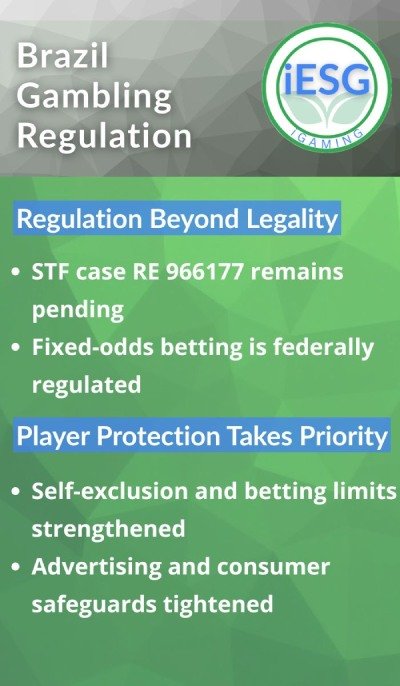
RE 966177 should not be confused with a general legalisation decision as the STF describes Theme 924 specifically as considering whether the conduct of establishing and exploiting games of chance remains a criminal misdemeanour under the 1988 Constitution.¹
Yet the case exposes a wider regulatory challenge: Brazil already permits fixed-odds betting under a federal framework while other games of chance remain subject to Article 50. Different gambling products can carry different legal treatment, consumer risks and regulatory requirements. That makes the question of what happens after permission even more important.
Brazil’s regulated betting market offers an early indication as the Secretariat of Prizes and Betting (SPA) says its 2026–2027 regulatory cycle has moved beyond initial market structuring towards reviewing accumulated regulatory experience and strengthening supervision, integrity and bettor protection.² Its agenda includes reviewing operator authorisation, monitoring and enforcement procedures, sanctions and responsible gambling policies.
Recent rules have also tightened advertising: Since July 2026, Brazil gambling regulation has required fixed-odds betting advertisements to display government warnings including that betting can cause addiction, lead to financial losses and should not be treated as an investment.³ Brazil has also introduced measures targeting payments to illegal operators and restrictions affecting certain financially vulnerable groups.⁴
Player protection is becoming the real regulatory test
The social side of Brazil gambling regulation is becoming harder to separate from market development …
Brazil’s Ministry of Health has expanded its involvement in gambling policy, including an agenda focused specifically on the impact of gambling and betting on public health. A Ministry of Health technical note has identified growing demand within Brazil’s psychosocial care network from people experiencing gambling-related problems.⁵
Success can no longer be assessed only through licences issued, tax collected or illegal operators blocked. Regulators increasingly need to ask what happens to consumers after a market becomes accessible. Brazil is already moving from policy towards infrastructure: in July 2026, the government launched a centralised self-exclusion platform allowing bettors to block access to all federally authorised betting sites at once.⁶ Operators are also required to provide responsible gambling mechanisms including player-set betting and deposit limits.
The crucial question for any future market development is therefore … If gambling availability expands, will player protection expand with it?
That means moving from policies on paper towards continuously measurable outcomes:
Are exclusion systems effective?
Are vulnerable consumers being identified?
Are advertising restrictions enforced?
Can risky behaviour be detected earlier?
Do operators provide regulators with enough data to assess whether interventions actually work?
The World Health Organization has linked the expansion of legal gambling opportunities with growing public-health concerns around gambling behaviour and gambling disorder.⁷ Its broader gambling guidance calls for effective regulation and population-wide measures to prevent and reduce harm.
Brazil gambling regulation is shifting from simply deciding which operators may participate towards understanding the social outcomes produced by regulated markets.
💡As Brazil gambling regulation moves beyond market access towards stronger player protection, governance and accountability, the iESG Assessment can help operators review board oversight, compliance controls, responsible gambling practices and regulatory readiness.
Could Brazil gambling regulation signal a global shift?
Brazil should not yet be called a regulatory model, as its fixed-odds betting framework is young, the STF case remains unresolved and the country’s regulatory architecture continues to … evolve. But it is becoming a test case worth watching.
Markets considering gambling liberalisation often focus on:
- investment,
- tax revenue,
- formalising existing demand
- bringing illegal activity within regulatory oversight.
Yet greater legal availability can also intensify scrutiny around advertising, vulnerable consumers, gambling-related harm and public health.
Brazil is experiencing those pressures in real time.
For the Brazil gambling regulation, this sequence is important:
permission
regulation
accountability
For regulators elsewhere, the Brazilian experience could help answer whether liberalising gambling markets increasingly leads not to lighter regulation, but to deeper social scrutiny as evidence of harm and consumer behaviour accumulates.
Conclusion
For operators, the Brazilian gambling regulation might influence how market opportunity is assessed, as the regulatory requirements increasingly extend beyond capital, technology and licensing into how operators monitor risk, control advertising and demonstrate effective player protection.
Investors face a similar calculation, because market size is only one part of regulatory opportunity. Enforcement capability, social acceptance, political durability, illegal-market competition and the cost of future consumer protections can materially affect the quality of that opportunity.
RE 966177 will eventually answer an important constitutional question … it will not settle the bigger debate.
Brazil’s next gambling chapter will be shaped not only by what operators are permitted to offer, but by what regulators expect them to prove once that permission is granted.
For operators and investors watching Brazil … regulatory readiness now means understanding social impact as closely as market opportunity.
FAQ: Brazil Gambling Regulation
What is Brazil’s current gambling regulation?
Brazil regulates fixed-odds betting under federal legislation, while Article 50 continues to prohibit establishing or exploiting other games of chance unless otherwise authorised by law.
What is RE 966177 in context of Brazilian gambling regulation?
RE 966177 is the STF case examining whether Article 50’s criminalisation of establishing or exploiting games of chance remains compatible with Brazil’s 1988 Constitution.
Has Brazil’s Supreme Court legalised gambling?
RE 966177 remains pending, and there is no final STF decision legalising the gambling activities covered by the case.
Why could other gambling regulators watch Brazil?
Brazil offers a developing case study of how rapid market formalisation can be followed by stronger consumer protection, public-health scrutiny and regulatory oversight.
What does Brazil gambling regulation mean for operators?
Operators should monitor not only market-access rules but also evolving expectations around player protection, advertising, risk monitoring, governance and regulatory reporting.
Sources:
- Supreme Federal Court, RE 966177
https://portal.stf.jus.br/jurisprudenciaRepercussao/verAndamentoProcesso.asp?incidente=4970952&numeroProcesso=966177&classeProcesso=RE&numeroTema=924 - Secretariat of Prizes and Betting, Regulatory Agenda 2026–2027
https://www.gov.br/fazenda/pt-br/composicao/orgaos/secretaria-de-premios-e-apostas/agenda-regulatoria/2026 - Ministry of Finance: Betting Advertising Requirements
https://www.gov.br/fazenda/pt-br/assuntos/noticias/2026/julho/ministerio-da-fazenda-amplia-exigencias-de-publicidade-de-apostas-no-pais - Ministry of Finance, Fixed-odds Betting Legislation
https://www.gov.br/fazenda/pt-br/composicao/orgaos/secretaria-de-premios-e-apostas/apostas-de-quota-fixa/legislacao/apostas - Ministry of Health: Gambling and Public Health
https://www.gov.br/saude/pt-br/assuntos/saude-de-a-a-z/s/saude-mental/nao-aposte-sua-saude/notas-tecnicas/nota-tecnica-no-4-2025-corap-cgesmad-desmad-saes-ms - Ministry of Finance: Centralised Self-exclusion
https://www.gov.br/fazenda/pt-br/assuntos/noticias/2026/julho/plataforma-centralizada-de-autoexclusao-permite-bloquear-sites-de-apostas-autorizados-de-uma-so-vez - World Health Organization: Gambling and Addictive Behaviours
https://www.who.int/news-room/fact-sheets/detail/gambling
