

Supplier accountability in gambling has rarely been part of the industry’s compliance conversation. For decades, regulators focused primarily on operators, who held the licence, faced regulatory scrutiny, and bore responsibility when things went wrong. Suppliers operated one step removed from that process, providing games, payment solutions, platforms, and technology without being viewed as direct enforcement targets. Brazil’s investigation into game provider Spribe suggests that may be changing.
According to Brazilian authorities, the investigation alleges that Spribe’s Aviator game was simultaneously available through federally licensed operators and unlicensed operators serving Brazilian players.¹ The case has sparked debate about whether suppliers should be accountable not only for the products they provide, but also for where those products ultimately appear. The real significance of the case is not what happens to Spribe …
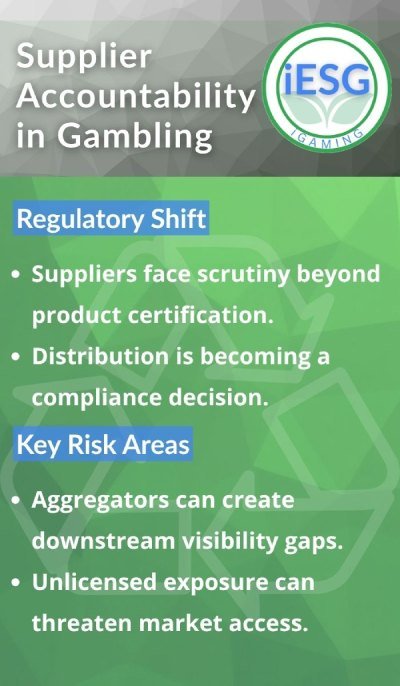
It is what the case reveals about supplier accountability in gambling. Distribution decisions are increasingly being treated as compliance decisions, with regulators paying closer attention to where products end up and who ultimately has access to them.
The case that put supplier accountability in gambling in the spotlight
According to the Ministério Público do Distrito Federal e Territórios (MPDFT), the investigation alleges that Aviator (developed by Spribe) was being supplied both to operators licensed under Brazil’s federal framework and to operators lacking federal authorisation.¹ Brazilian authorities argue that this raises important questions about market integrity and the responsibilities of suppliers operating within regulated environments.
The concern extends beyond the game itself …
Licensed operators absorb significant compliance costs through taxation, certification requirements, responsible gambling programmes, regulatory supervision, and independent audits. Unlicensed operators typically avoid those obligations while competing for the same player base.
MPDFT argues that, when certified content is allegedly made available to both groups, the regulated market may be placed at a competitive disadvantage.¹ The proposed response attracted particular attention across the industry:
The MPDFT recommended that Brazil's Secretariat of Prizes and Betting (SPA) evaluate whether Spribe's technical certification should be suspended pending the outcome of the investigation.¹ Authorities also requested that the Brazilian Agência Nacional de Telecomunicações (Anatel) assess measures relating to domains allegedly offering the game outside the regulated framework.¹
A fine addresses past conduct while certification affects future market access.
For suppliers operating in regulated markets, certification often determines whether products can legally remain on operator platforms. For years, distribution was largely treated as a commercial decision. Cases like this suggest regulators may be starting to view supplier accountability in gambling differently. If market access can be affected by where products are ultimately distributed, distribution oversight stops being solely a commercial concern and becomes a compliance issue.
Why regulators view supplier accountability in gambling as market protection
The logic behind the investigation is actually quite simple:
Licensed operators spend millions meeting regulatory requirements. They pay taxes, maintain compliance teams, implement responsible gambling controls, undergo audits, and absorb the ongoing costs that come with operating in a regulated market. Unlicensed operators do not.
According to Brazilian authorities, if the same certified games are available on both licensed and unlicensed sites, those costs stop being a competitive advantage and become a competitive burden.¹ That is why this case has attracted so much attention and the debate is no longer just about one game or one supplier. It is about whether suppliers have a role to play in protecting the markets they profit from.
Why supplier accountability in gambling is becoming a compliance issue
Historically, suppliers viewed distribution as … a commercial decision. If a market generated revenue and commercial partners were available, expansion followed while compliance obligations remained concentrated at the operator level.
The Spribe investigation challenges that assumption and highlights why supplier accountability in gambling is becoming a much bigger regulatory concern.
- Who receives access?
- Where does content ultimately appear?
- What controls exist to prevent unauthorised distribution?
- How quickly can suppliers identify and fix breaches?
These questions point to a broader shift and the conversation is no longer limited to product certification or technical compliance. It increasingly includes oversight of the distribution chain itself.
The emerging principle is simple: where a product ends up may become just as important as how it was built.
For suppliers, that means supplier accountability in gambling can no longer stop at certification. It must extend into distribution oversight, partner management, and market monitoring.
💡 As supplier accountability in gambling moves up the regulatory agenda, the iESG Assessment can help operators take a closer look at governance, supplier oversight, and compliance readiness.
The hidden risks driving supplier accountability in gambling
For many suppliers, the biggest challenge is not compliance … it is visibility. In reality, few games move directly from a provider to a player: a title might leave a game studio, pass through an aggregator, appear on several white-label brands, and eventually end up on dozens of operator sites across multiple jurisdictions.
That creates scale, but it can also create blind spots.
Aggregator Risk
Aggregators are one of the industry’s most effective growth engines since they allow providers to reach hundreds of operators without negotiating hundreds of individual integrations. As supplier accountability in gambling gains attention, aggregators are likely to face greater scrutiny over where content is ultimately distributed.
Multi-Jurisdiction Exposure
A game approved for one market can quickly appear in another which sometimes happens through commercial arrangements. But it can also happen because controls are weak or oversight is limited. Either way, regulators are increasingly interested in who knew about it and what was done to stop it. As more markets regulate online gambling, cross-border distribution is becoming a much bigger compliance challenge. This is exactly where supplier accountability in gambling moves from theory to operational reality.
White-Label Complexity
White-label structures add more complexity: when multiple brands, platforms, and commercial partners sit between a supplier and the end customer, accountability can become … blurred very quickly.
The challenge is knowing who is responsible when something goes wrong. The defence of “we didn’t know” becomes much harder when regulators start asking questions about visibility, oversight, and control.
How Suppliers Should Assess Distribution Risk
The industry does not need to wait for additional enforcement actions before reassessing its approach.
As supplier accountability in gambling becomes a more prominent regulatory theme, four questions deserve particular attention.
1. Where Are Our Products Accessible Today?
Not where they are intended to be accessible but where are they actually accessible? Many suppliers have strong visibility over direct commercial relationships but considerably less visibility over downstream distribution.
2. Which Partners Control Downstream Distribution?
Most suppliers know who they sell to directly but the harder question what happens after that. If content passes through an aggregator or platform partner, who ultimately controls where it appears and do you have visibility over those decisions?
3. Can We Identify Unlicensed Exposure Quickly?
If one of your games suddenly appears on an unlicensed site tomorrow, how long would it take to find out: hours, weeks, months? A slow response can quickly become a regulatory problem.
4. What Happens When a Breach Is Found?
Finding a problem is only the first step, the next ones include: who gets notified, who investigates, who contacts the operator, and who has authority to suspend distribution?
Those decisions should be made before an incident occurs, not afterwards.
✅ Supplier accountability is becoming a bigger part of the regulatory conversation. Through the iESG Membership, operators can stay informed about emerging compliance trends, regulatory developments, and governance challenges shaping the future of iGaming.
What Operators Should Demand from Providers
Operators should not view this trend as solely a supplier issue, as a licensed operator whose certified games appear on unlicensed platforms may face reputational, commercial, and potentially regulatory challenges of its own.
That is why many operators are strengthening supply-chain protections within provider agreements.
Common safeguards include:
- Distribution restrictions tied to authorised jurisdictions
- Audit rights relating to compliance controls
- Reporting obligations for suspected breaches
- Contractual remedies for unauthorised distribution
- Technical safeguards designed to prevent access in restricted markets
These provisions do more than allocate responsibility: they demonstrate that operators have taken reasonable steps to ensure products remain within regulated environments.
Conclusion
The iGaming industry used to operate under a relatively clear division of responsibility, where operators were accountable to regulators, while suppliers focused on delivering products and services to the market. The Spribe investigation suggests that theis distinction may be becoming … less clear.
Whether the allegations are ultimately substantiated is less important than the principle emerging from the case itself: regulators are increasingly examining the wider ecosystem that supports gambling activity and asking whether suppliers should share responsibility for protecting regulated markets.
That shift has significant implications for game providers, aggregators, platform vendors, and payment processors alike. Supplier accountability in gambling is no longer a niche compliance discussion … it is becoming a core governance issue across the industry.
The gambling industry’s next regulatory challenge may not be about what suppliers create but it may be about where their products end up and what controls exist to prevent them from reaching the wrong places. For suppliers, the message is: market access increasingly comes with market responsibility.
FAQ: supplier accountability in gambling
What is supplier accountability in gambling?
Supplier accountability in gambling is the idea that responsibility may not stop with the operator, with regulators increasingly asking whether suppliers should also be accountable for where their products are distributed and how they are used.
Why is the Spribe investigation significant?
It is one of the first cases to put a supplier, rather than an operator, at the centre of the regulatory conversation. The broader question is whether suppliers should be held accountable for where their products end up.
Can regulators take action against supplier accountability in gambling?
Depending on the regulatory framework, suppliers may face certification reviews, market access restrictions, or other enforcement measures.
What does supplier accountability in gambling mean for game providers and aggregators?
Supplier accountability in gambling means that visibility matters: suppliers may increasingly be expected to understand where their content is distributed and what controls exist to prevent it reaching unauthorised operators.
Could supplier accountability in gambling become a wider industry issue?
The outcome of the Spribe investigation remains uncertain, but the questions it has raised extend far beyond Brazil and one game provider.
Sources:
- Ministério Público do Distrito Federal e Territórios (2025): “MPDFT instaura inquérito civil para apurar atuação da Aviator no mercado de apostas“
https://www.mpdft.mp.br/portal/index.php/comunicacao-menu/sala-de-imprensa/noticias/noticias-2026/17976-mpdft-instaura-inquerito-civil-para-apurar-atuacao-da-aviator-no-mercado-de-apostas
