
For most of the last decade, iGaming data strategy has focused on yield. Operators refined acquisition funnels, optimised bonus conversion, and engineered retention curves with precision. The dashboards were sophisticated, but the objective was simple: revenue efficiency. That era is closing. Responsible gambling analytics is no longer a compliance layer sitting beneath commercial analytics. It is becoming a governance benchmark.
Regulators increasingly expect operators to demonstrate not only that they monitor behaviour, but that they understand risk indicators, intervene proportionately, and document outcomes. The UK Gambling Commission’s customer interaction requirements make this explicit. Remote operators must identify customers at risk of harm, interact with them, and evaluate the effectiveness of those interactions.¹ That expectation is systemic, not symbolic.
Boards that still treat responsible gambling analytics as an operational afterthought are accumulating regulatory and reputational exposure. The strategic shift is clear: behavioural data is now a governance asset.
From Compliance Monitoring to Board-Level Oversight
The UK Government’s 2023 white paper on gambling reform reinforced a stronger emphasis on evidence-led regulation, enhanced affordability checks, and data-driven oversight.² The direction of travel is toward measurable systems rather than policy statements. This reframes responsible gambling analytics entirely.
Historically, compliance teams tracked red flags while commercial and CRM teams tracked lifetime value. These functions operated in parallel. Today, that separation introduces risk. If player behaviour data predicts both revenue and harm, it cannot be owned by only one side of the organisation.
Responsible gambling analytics becomes credible when three conditions are met:
- Risk indicators are clearly defined and consistently applied
- Intervention thresholds are defensible and documented
- Outcomes are measured and reviewed at governance level
If an operator cannot explain why a customer was flagged, what action was taken, and what behavioural change followed, then the system lacks accountability. Governance is not about having more data. It is about being able to explain decisions.
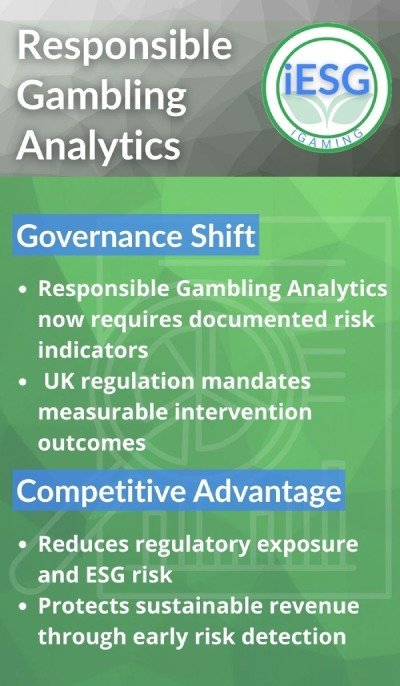
The Metrics That Signal Risk Early
The most effective responsible gambling analytics frameworks do not attempt to measure everything. They focus on a concentrated set of high-signal indicators that are both predictive and auditable. Session behaviour is often the earliest warning system. Repeated late-night play, unusually long sessions, and compressed bet cycles can indicate impaired control. The UKGC has previously referenced overnight gambling as a risk factor among higher-harm cohorts.¹
These patterns frequently appear before financial escalation. Loss response patterns are equally important. Rapid deposit top-ups, escalating stakes following losses, and shortened time-to-return after a heavy loss event can signal emerging loss-chasing behaviour. When measured consistently, these patterns provide earlier intervention points than blunt financial thresholds alone.
Equally revealing is how players respond to friction. Do they slow down after a reality check prompt? Do they adopt deposit limits when encouraged? Or does their intensity increase immediately after an interaction? Responsible gambling analytics must measure post-intervention behaviour, not just intervention volume.
The goal is not to eliminate risk entirely. It is to identify disproportionate risk early and respond proportionately.
Responsible Gambling Analytics as Competitive Differentiator
It is tempting to view safer gambling infrastructure purely as regulatory defence, but … that view is outdated. When embedded correctly, responsible gambling analytics improves retention quality by filtering out unsustainable value and protects long-term customer relationships. Investors increasingly scrutinise ESG disclosures and regulatory resilience alongside growth metrics. Operators that can demonstrate structured behavioural monitoring systems send a stronger signal to capital markets.
There is also an operational advantage. Clear behavioural indicators reduce subjectivity in customer interactions. Instead of relying on reactive judgement, teams operate against documented thresholds and predefined escalation paths. That consistency lowers enforcement exposure and strengthens internal governance controls.
Strong responsible gambling analytics does three things simultaneously:
- Reduces regulatory risk
- Protects sustainable revenue
- Strengthens investor confidence
- Few initiatives deliver that level of alignment.
💡 Escalation risk in responsible gambling analytics is rarely triggered by a single behavioural flag and is more often identified through cumulative patterns across session intensity, loss-response behaviour, and intervention outcomes. The iESG Assessment supports Responsible Gambling Analytics by structuring how these patterns are documented and reviewed within existing governance frameworks.
The Emerging Risk: Product Innovation Without Analytics Discipline
Product teams continue to innovate around volatility options, feature mechanics, and social engagement layers. Innovation itself is not the risk. The risk emerges when behavioural data does not evolve alongside product design. More complex features can compress betting cycles. Social mechanics can extend session length. Personalisation engines can amplify intensity if not governed carefully. Without disciplined responsible gambling analytics, innovation may unintentionally increase harm exposure.
This is not an argument against product evolution. It is an argument for synchronising product KPIs with risk indicators. Every feature that increases engagement should be evaluated against behavioural risk metrics before it scales. Governance requires that commercial growth and player protection move together, not in tension.
Building a Defensible Framework
Operationalising responsible gambling analytics does not require a new department. It requires integration.
First, define a limited set of behavioural indicators across session patterns, loss response, and intervention effectiveness. Second, establish tiered thresholds that trigger proportionate actions. Subsequently review outcomes at board or committee level on a recurring basis.
Documentation is critical. Regulators increasingly expect audit trails that demonstrate not just activity, but effectiveness.¹ A defensible system is one that can show learning and refinement over time.
Most importantly, success metrics must evolve. If dashboards still prioritise revenue-only indicators without corresponding risk measures, the governance picture is incomplete.
🏅 The iESG Certificate provides a sector-specific reference point for how Responsible Gambling Analytics frameworks are documented and structured for regulatory and investor review. It reflects common governance and reporting practices without implying certification of performance outcomes.
Conclusion: Responsible Gambling Analytics Is Becoming a Governance Test
Responsible gambling analytics is no longer a technical capability. It is becoming a test of governance maturity. Regulators expect evidence. Investors expect resilience. Boards expect clarity. The operators that lead in the next phase of market development will not be those with the most aggressive feature pipelines, but those with the most accountable systems.
If your organisation cannot articulate which behavioural indicators define risk, how thresholds are set, and how interventions change outcomes, then your analytics function remains commercially sophisticated but … governance-light.
In a tightening regulatory climate, that imbalance is not sustainable. The competitive advantage now lies in measurable responsibility.
FAQ – Responsible Gambling Analytics
What is responsible gambling analytics?
Responsible gambling analytics is the structured use of behavioural data to identify risk indicators, trigger proportionate interventions, and measure their effectiveness.
Why is responsible gambling analytics important for ESG?
Responsible gambling analytics demonstrates governance maturity by proofing that player protection decisions are not only data-driven, but documented, and reviewed.
Are operators required to monitor gambling behaviour?
Depending on their operational jurisdiction. For example, the UK Gambling Commission requires remote operators to identify customers at risk of harm and evaluate customer interactions.¹
What behavioural indicators are most predictive of risk?
Session intensity, repeated late-night play, rapid deposit top-ups, and loss-chasing patterns are commonly high-signal indicators.
How often should responsible gambling analytics be reviewed?
Core behavioural indicators should be monitored continuously, with formal executive review monthly and board oversight at least quarterly. If thresholds aren’t being adjusted as behaviour shifts, the system is static.
Does responsible gambling analytics reduce revenue?
It may reduce short-term volatility, but it protects long-term revenue by removing unstable, high-risk play. The alternative is growth that attracts regulatory and reputational damage.
Sources:
- UK Gambling Commission: “Customer interaction: formal guidance for remote gambling operators“
https://www.gamblingcommission.gov.uk/licensees-and-businesses/lccp/condition/3-4-3-remote-customer-interaction - UK Government: “High Stakes: Gambling Reform for the Digital Age“
https://www.gov.uk/government/publications/high-stakes-gambling-reform-for-the-digital-age
