
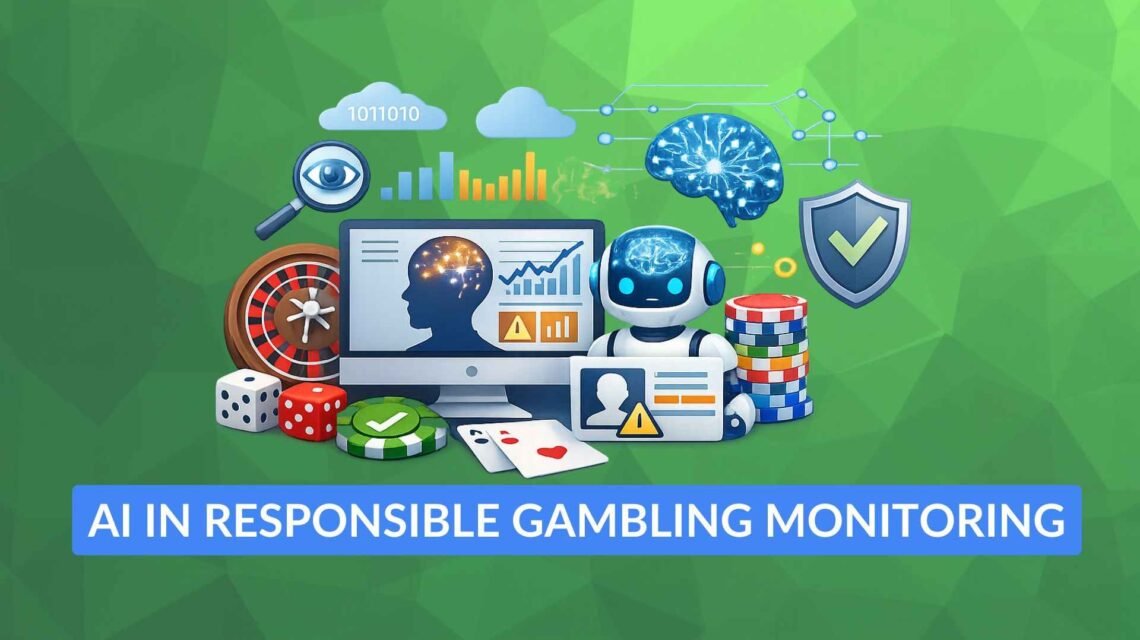
For years, responsible gambling has largely been treated as a compliance function within gambling operations. Policies were written, warning messages were deployed, and staff were trained to identify signs of problematic play. While these measures remain important, they often rely on reactive processes that only trigger once risky behaviour has already escalated. The use of AI in responsible gambling is beginning to change that model.
Instead of relying solely on manual reviews or fixed thresholds, AI systems allow operators to analyse behavioural data across large player populations and detect risk patterns much earlier. By identifying changes in behaviour as they emerge, operators can intervene sooner and provide support before gambling activity becomes harmful.
AI in responsible gambling is shifting the focus from a policy-based requirement to a measurable system of player protection.
Industry Insight: Responsible Gambling Is Moving From Policy to Evidence
For much of the past decade, responsible gambling programmes were judged by whether policies existed. Today regulators are asking a different question. Do those policies actually work?
Across multiple jurisdictions, authorities increasingly expect operators to demonstrate:
- how player risk is detected
- when interventions occur
- whether those interventions reduce harmful behaviour
This shift is reflected in guidance from the UK Gambling Commission, which emphasises the importance of identifying behavioural indicators of harm and responding quickly when risk signals appear.1 AI in responsible gambling helps operators answer these questions with data. Behavioural monitoring can run continuously, allowing teams to track how player behaviour evolves and whether interventions produce meaningful change. Responsible gambling is therefore becoming a measurable performance metric, not “simply” regulatory compliance.
Why regulators are demanding measurable player protection
Expectations around player protection are rising across regulated gambling markets. Regulators increasingly want operators to demonstrate that their systems detect risk early and support players effectively. Documented policies alone are no longer enough and this is where AI in responsible gambling plays an essential part. The challenge is scale. Modern online gambling platforms generate enormous volumes of player activity. Large operators process millions of transactions every day across thousands or even millions of customer accounts. Identifying behavioural changes within that amount of data is extremely difficult using manual monitoring.
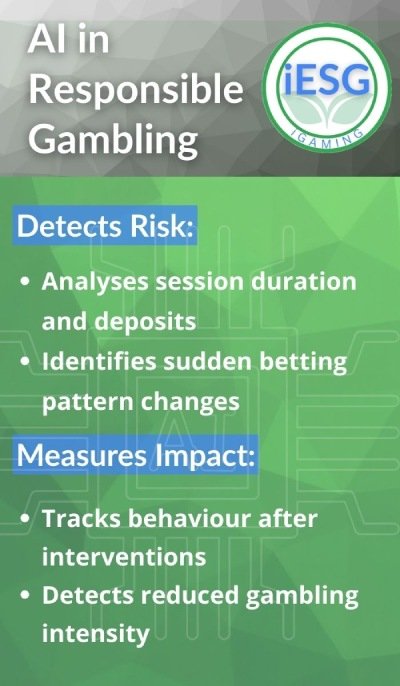
This is where AI in responsible gambling becomes so valuable. Artificial intelligence systems can analyse several behavioural signals simultaneously, including:
- session duration
- deposit behaviour
- gameplay intensity
- sudden changes in betting patterns
- time-of-day gambling activity
When a player’s behaviour begins to drift away from what is typical for them, the system can highlight the change much sooner than traditional monitoring approaches. That early visibility is quickly becoming a core component of modern responsible gambling programmes.
💡 Escalation risk in gambling behaviour rarely depends on a single trigger. It tends to emerge through patterns across session intensity, loss-response behaviour and previous intervention outcomes. Our iESG Assessment is designed as a sector-specific framework that can help structure how these behavioural signals are documented and reviewed within operator governance practices.
AI in responsible gambling: detecting risk beyond simple markers
Earlier responsible gambling systems often relied on simple signals. High spending or unusually long sessions were commonly used as primary warning indicators. The logic made sense at the time, but it only captured part of the picture. Gambling behaviour rarely follows predictable patterns. A single metric rarely provides enough context to determine whether a player is genuinely at risk.
Looking at behaviour on its own rarely explains very much. The real insight comes from seeing how several signals appear together and how they change over time. A player who deposits consistently and occasionally logs in late at night may simply be following their usual entertainment routine. A different player might suddenly increase deposits while spending long stretches gambling late into the night. That pattern may signal something quite different.
By examining behaviour in context, AI systems can reduce false alarms while identifying meaningful changes earlier. Responsible gambling teams can then focus their attention where it can make the biggest difference.
Understanding behavioural shifts utilising AI in responsible gambling
There is also a behavioural explanation for why this approach matters. Research from the University of Cambridge has shown that emotional pressure can influence how people make decisions and how much risk they are willing to take.2
In gambling settings this sometimes appears as behaviour that suddenly looks different from a player’s normal habits. Traditional responsible gambling tools often react after those changes have already become visible.
Leveraging AI in responsible gambling monitoring shifts that timing. Instead of waiting for losses or spending spikes, operators can spot the early signals of change and step in sooner. In many cases, a well-timed interaction is enough to break the pattern before it develops further. This approach reflects broader public-health strategies that favour early intervention over crisis response.
🏅 As AI in responsible gambling becomes more common, attention is shifting toward how these systems are governed and reviewed within operator frameworks. Our iESG Certificate can serve as a sector-specific reference point for structuring internal governance and reporting practices, without implying regulatory endorsement or specific outcomes.
Measuring whether interventions actually work
Detection alone is not enough. Responsible gambling programmes ultimately depend on whether interventions influence behaviour. In the past, operators could log that a warning message had been sent or that a player interaction occurred. Understanding whether that interaction actually influenced behaviour was far more difficult.
AI in responsible gambling changes monitoring , teams can see how behaviour evolves shortly after an interaction occurs. Instead of guessing whether a message helped, they can look for concrete changes in activity, such as:
- gambling intensity beginning to decline
- deposit behaviour returning to a steadier pattern
- session lengths gradually shortening
These signals give responsible gambling teams something they rarely had before: feedback. Over time, that feedback helps operators understand which types of interactions are genuinely useful and which approaches need adjustment.
What the data shows about AI in responsible gambling
Online gambling platforms generate enormous volumes of behavioural data. Every deposit, wager, and session contributes to a growing dataset that can reveal how players interact with gambling products. Advanced analytics and AI monitoring are increasingly being adopted throughout the industry to analyse behavioural patterns across large customer bases.3
Operators are deploying AI-supported monitoring tools because reviewing activity at that scale cannot be done manually. For responsible gambling teams, this shift changes how monitoring works:
- behavioural monitoring becomes continuous
- early risk signals become easier to detect
- intervention outcomes can be measured across entire player databases
Instead of reacting only when harm becomes visible, operators who leverage AI in responsible gambling can identify early warning signs and respond sooner.
Responsible gambling as a business enabler
Responsible gambling has historically been described purely as a regulatory requirement. In practice, many operators are beginning to view it through a wider strategic lens. Strong player protection frameworks can support the commercial side of the business as well.
Platforms that demonstrate clear safeguards tend to build stronger trust with players. In many cases that trust translates into longer and more stable engagement. Regulators also expect operators to show that protection measures are not just present but effective.
Seen this way, AI in responsible gambling becomes part of how a platform operates day to day rather than a separate compliance layer. This direction also reflects wider ESG discussions around responsible product design and consumer protection. Initiatives such as the United Nations Global Compact highlight the importance of embedding safeguards directly into products where consumer risk exists.4 Responsible gambling is therefore moving toward a model where outcomes matter as much as policies.
Conclusion: AI in responsible gambling
Responsible gambling is entering a different phase. Policies and messaging still matter, but regulators and stakeholders increasingly want to see whether protection measures genuinely influence behaviour.
AI in responsbile gambling provides operators with tools to analyse player activity at scale, identify emerging risk patterns, and evaluate the effectiveness of interventions. Operators that begin building these data-informed systems now will likely be better positioned as expectations around player protection continue to evolve.
FAQ – AI in responsible gambling
What is AI in responsible gambling?
AI in responsible gambling uses machine learning and behavioural analytics to identify patterns that may signal gambling-related risk.
How does AI detect risky gambling behaviour?
AI systems analyse behavioural signals such as deposit patterns, gameplay intensity, session duration, and sudden changes in betting activity.
Does using AI in responsible gambling prevent harm?
AI cannot eliminate gambling harm entirely, but it helps identify risk earlier and enables operators to intervene before behaviour escalates.
Why are regulators interested in AI in responsible gambling?
AI monitoring provides measurable evidence of risk detection and intervention outcomes, improving transparency for regulators.
Does AI replace responsible gambling teams?
AI supports responsible gambling teams by identifying behavioural signals while human specialists manage player interactions and decision-making.
Sources:
- UK Gambling Commission: “Customer Interaction – Guidance for Remote Gambling Operators”
https://www.gamblingcommission.gov.uk/guidance/customer-interaction-guidance-for-remote-gambling-operators - University of Cambridge: “Research on Gambling Behaviour and Decision-Making”
https://www.cambridge.org/core/journals/behavioural-public-policy - Deloitte: “AI and risk management”
https://www.deloitte.com/global/en/Industries/financial-services/perspectives/gx-ai-and-risk-management.html - United Nations Global Compact: “The world’s largest corporate sustainability intiative”
https://unglobalcompact.org/what-is-gc
