
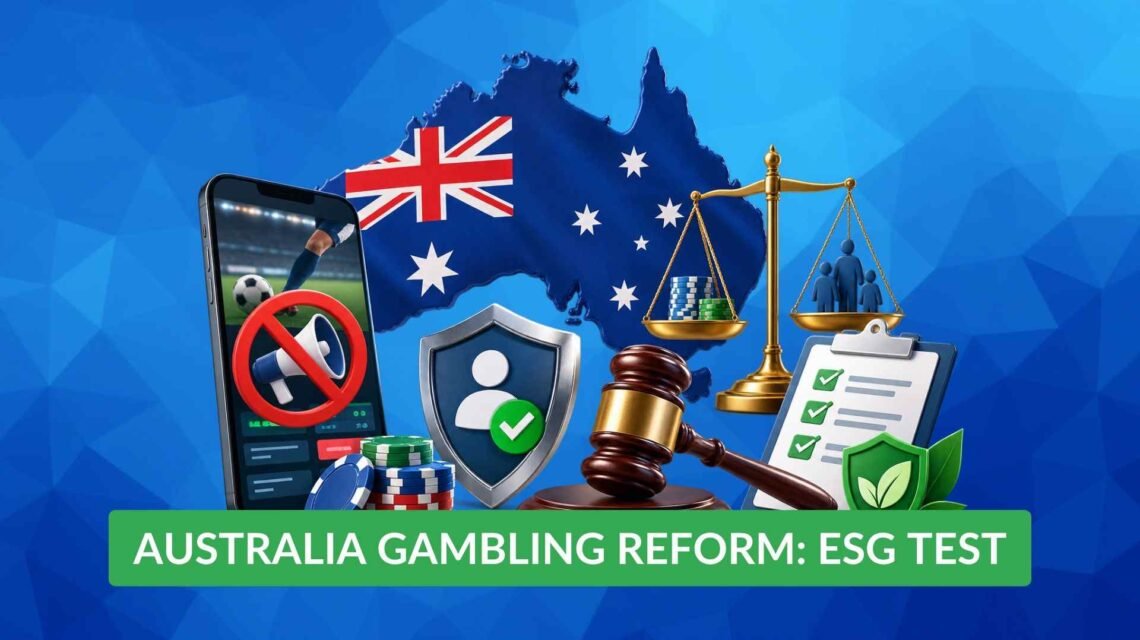
Australia gambling reform has just redrawn the boundaries of responsible gambling: On 19 August 2026, Parliament passed the Interactive Gambling Amendment (Gambling Reform) Bill 2026, introducing major restrictions covering wagering advertising, inducements, affiliates, self-exclusion and illegal gambling services.¹ (Most core provisions commence on 1 January 2027.²)
But the Australia gambling reform is bigger than another compliance update as it pushes player protection further into marketing, customer acquisition and corporate governance. Operators will face tighter rules on how they advertise around sport, which customers can receive inducements and how staff and affiliates can be rewarded.
Australia will also establish a national Wagering Advertising Opt-out Register, giving consumers greater control over their exposure to online betting advertising.³ For international operators, the Australia gambling reform also signals how responsible gambling controls may increasingly intersect with marketing governance.
The ESG question is therefore changing: It is no longer simply whether an operator supports responsible gambling … it is whether its marketing, technology, incentives and governance structures prove it.
Australia gambling reform moves protection upstream
Responsible gambling has traditionally focused heavily on what happens once someone is already gambling: deposit limits, behavioural monitoring, self-exclusion and intervention.
The Australia gambling reform moves protection further upstream into advertising and acquisition:
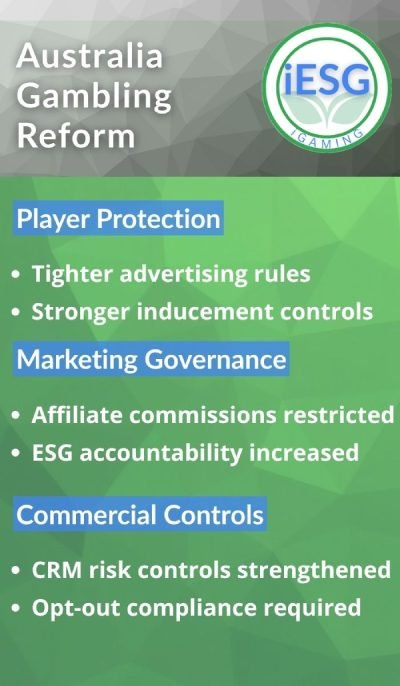
Wagering advertising will be prohibited during live sports coverage between 5:00 am and 8:30 pm, beginning 15 minutes before an event and ending five minutes afterwards. Advertising will also be prohibited in sports venues and on players’ and officials’ uniforms, while athletes, celebrities and influencers cannot be used to promote wagering products. Television advertising will be capped at three wagering ads per hour between 5:00 am and 8:30 pm.³
Online advertising introduces another significant shift as wagering advertising can only be delivered where users are logged in, over 18 and provided with an opt-out mechanism. The new national Wagering Advertising Opt-out Register will allow people to indicate across services that they do not want to receive wagering advertising.³
The Social ESG principle behind this is important: harm minimisation begins before the bet.
The legislation also adds protection around inducements: Direct marketing of inducements will be prohibited during the first 14 days after a customer opens an account, for three months after someone deregisters from BetStop, and for customers identified as being at risk of gambling-related harm.³
This changes the responsible gambling conversation … customer acquisition, advertising exposure and promotional targeting are becoming part of the player-protection framework rather than sitting outside it.
Australia gambling reform turns marketing into governance
Perhaps the biggest ESG lesson is not what Australia prohibits, but which business functions now become accountable for player protection.
ACMA confirms that the reforms include a ban on commissions to staff or affiliates based on customer activity.⁴ That connects remuneration and affiliate structures directly with gambling-harm governance.
For operators, this reaches far beyond the compliance department :
- Marketing teams need to know who can receive an inducement.
- CRM systems need to recognise customer-risk classifications.
- Affiliate managers need remuneration structures that do not reward harmful acquisition or retention behaviour.
- Digital advertising systems need to respect age, login and opt-out requirements.
Responsible gambling obligations are therefore moving deeper into commercial operations, giving regulators greater visibility into how player protection influences advertising, incentives and customer acquisition.
The practical ESG test is straightforward:
Can marketing systems suppress promotions when customer risk changes?
Can the operator demonstrate that opt-out preferences are respected?
Do affiliate incentives support or undermine responsible gambling policies?
Can compliance teams evidence how vulnerable customers are treated?
Does senior management receive meaningful information about these controls?
This is where Governance and Social ESG increasingly overlap as publishing a responsible gambling policy is “relatively” … easy. Building player protection into commercial incentives, customer data, advertising technology and management oversight is considerably harder. The Australia gambling reform increases that pressure by making those relationships more explicit and more measurable.
What the Australian Gambling Reform Means for Operators from 2027
The immediate temptation will be to treat January 2027 as a compliance deadline but operators should rather treat it as a governance deadline instead.
Most schedules of the legislation commence on 1 January 2027, although implementation of individual measures will require regulatory and technical work.² ACMA will have a central role in administering and enforcing the framework, including the advertising opt-out system and strengthened action against illegal gambling services.³
Preparation should therefore extend beyond … rewriting advertising guidelines.
Operators should map the customer journey from first advertising exposure through registration, promotions, behavioural monitoring, self-exclusion and possible return to gambling. At every stage, they should identify which system owns the decision, what customer data informs it and whether the resulting action can be evidenced.
Affiliate governance deserves the same review: If commercial incentives reward customer activity without sufficient regard for player risk, an ESG statement will not compensate for the underlying governance conflict.
There is a financial dimension too as the reforms provide for industry cost recovery associated with the opt-out register, inducement restrictions and strengthened BetStop activities.³ Operators are therefore not only being asked to comply with the new protection infrastructure; the regulated industry will contribute towards funding parts of it.
For boards and investors, that makes player protection increasingly relevant to operational risk, regulatory exposure and governance quality.
💡As Australia gambling reform pushes player protection deeper into advertising, customer acquisition, affiliate incentives and governance, the iESG Assessment can help operators review responsible gambling controls, marketing governance, affiliate oversight and regulatory readiness ahead of the 2027 reforms.
Stronger player protection still needs a viable regulated market
There is one ESG tension operators and policymakers should not ignore …
Australia is imposing stronger obligations on licensed businesses while simultaneously increasing its ability to disrupt illegal gambling services. The legislation expands measures targeting offshore operators, including mechanisms involving website access and payments.¹
Those two strategies need to work together tobe credible as a regulator.
If licensed operators face significantly higher restrictions while illegal alternatives remain readily accessible, consumer protection could be weakened rather than strengthened. Conversely, effective action against offshore gambling can support tougher standards within the regulated market because compliant operators are not competing on completely unequal terms.
This is why channelisation should be part of the ESG discussion: Good gambling governance cannot be measured purely by the number of restrictions introduced. It should also examine whether regulation keeps consumers within environments where age verification, self-exclusion, responsible marketing and regulatory oversight actually apply.
The legislation includes a three-year review mechanism, creating an opportunity to assess effectiveness and unintended consequences.⁵ That review should matter to the wider iGaming industry.
Australia is effectively testing whether advertising controls, consumer choice, vulnerability protections, commercial accountability and enforcement against illegal operators can function as one governance system … the outcome could offer lessons far beyond Australia.
Conclusion
The Australia gambling reform signals an important evolution in iGaming ESG.
Player protection is moving deeper into acquisition, advertising, affiliate management, customer data and executive oversight. That makes responsible gambling not simply a Social commitment, but a Governance responsibility with measurable operational consequences.
Operators preparing for 2027 should therefore not only ask: Are we compliant? They need to be able to answer whether their commercial systems reinforce the player-protection principles they publicly claim to support.
FAQ: Australia gambling reform
What is the Australia gambling reform 2026?
It is a package of reforms covering wagering advertising, inducements, BetStop, affiliate and staff commissions, illegal gambling services and other consumer protections.
When do Australia’s new gambling laws take effect?
Most core schedules of the Interactive Gambling Amendment (Gambling Reform) Bill 2026 commence on 1 January 2027.
How will gambling advertising change in Australia?
The reforms restrict wagering advertising around live sport, in sports venues, on uniforms, across broadcast media and on online platforms.
How does the reform affect gambling affiliates?
The reforms ban commissions to staff or affiliates based on customer activity, bringing commercial incentive structures more directly into responsible gambling governance.
Why is Australia gambling reform an ESG issue?
It links Social priorities such as harm minimisation and consumer protection with Governance issues including incentives, oversight, compliance systems and accountability.
Sources:
- Australian Parliament: “Interactive Gambling Amendment (Gambling Reform) Bill 2026”
https://www.aph.gov.au/Parliamentary_Business/Bills_Legislation/Bills_Search_Results/Result?bId=r7520 - Parliamentary Library: “Interactive Gambling Amendment (Gambling Reform) Bill 2026, Bills Digest No. 8, 2026–27”
https://www.aph.gov.au/Parliamentary_Business/Bills_Legislation/bd/bd2627/27bd008 - Minister for Communications: “Strongest ever gambling reforms passed”
https://minister.infrastructure.gov.au/wells/media-release/strongest-ever-gambling-reforms-passed - Australian Communications and Media Authority: “About the Interactive Gambling Act”
https://www.acma.gov.au/interactivegambling - Department of Infrastructure, Transport, Regional Development, Communications, Sport and the Arts: “Gambling Reforms 2026”
https://www.infrastructure.gov.au/media-communications/media-gambling-laws-regulation/gambling/gambling-reforms-2026
