
A bonus can look perfectly straightforward: deposit, receive a reward, meet the conditions, withdraw. But bonus terms and conditions sit within a much wider chain of decisions involving marketing, compliance, product, technology and customer service.
And that is where the real risk starts …
Operators naturally focus on whether their bonus terms and conditions contain the right clauses. But comprehensive terms do not automatically make a promotion fair, transparent or defensible as the advertisement may simplify the offer, the platform may allow behaviour the terms prohibit, or an enforcement decision may introduce an interpretation the player could not reasonably have anticipated.
Great Britain provides a timely example: Since 19 January 2026, operators cannot apply wagering requirements above 10x or combine different gambling products, such as betting and casino, within the same incentive.¹ The rules also require bonus terms and conditions attached to incentives to be clear, transparent, fair and readily accessible.¹
Bonus terms and conditions start with the offer
Compliance begins before anybody writes the legal copy: Consider a headline such as “Deposit £50, get £100.” Its actual value may depend on wagering requirements, expiry, maximum stakes, eligible games or markets and withdrawal conditions. These are not minor details as they shape what the player is actually being offered.
The UK Gambling Commission identifies eligibility, time limitations, qualification requirements, maximum stakes and wagering requirements among the significant conditions that can apply to a promotion. It also expects promotional bonus terms and conditions to be accessible before sign-up and, where they cannot be included directly in advertising, available within a single click.²
That creates a simple operational question: does the promotion still mean the same thing at every stage of the customer journey?
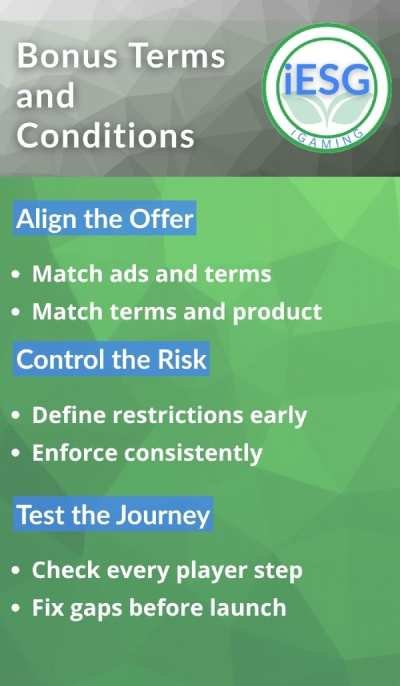
Before launch, compare four things:
Promise → Terms → Product → Decision
Promise
What does the advertisement tell the player?
Terms
What does the player actually agree to?
Product
What does the platform allow them to do?
Decision
What happens when those rules are enforced?
The 2026 wagering limit illustrates why this matters: A £10 bonus in Great Britain can no longer carry a requirement to wager more than £100 before bonus funds become withdrawable.¹ That is not simply a change to the bonus terms and conditions … it changes how the promotion itself can be designed.
When bonus terms and conditions meet “bonus abuse”
The difficult moment often comes after the promotion has worked: A player accepts a bonus or free bet, meets what they believe are the requirements, wins and requests a withdrawal. During review, the operator identifies behaviour it considers “bonus abuse”, “irregular play” or another prohibited strategy.
Now the wording is being tested rather than merely displayed.
UKGC guidance states that promotional play restrictions should clearly specify prohibited types or patterns of play and operators should not reserve sole discretion to decide afterwards what constitutes prohibited play. If winnings are removed or a withdrawal refused because a promotional restriction was breached, the customer should receive an explanation identifying the relevant breach.³
That gives operators a useful test:
Could the player have identified the prohibited behaviour before placing the bet? If the answer is no, the operator may be relying on hindsight rather than a clearly communicated rule.
This matters for both sportsbook and casino promotions: A free-bet offer may contain qualifying odds, markets or time limits while a casino bonus may restrict particular games, bet sizes or patterns of play. Different products create different conditions, but the same principle applies: bonus terms and conditions should define the restriction before enforcement becomes necessary.
Broad clauses such as “we reserve the right” do not solve that problem and the UKGC specifically warns against terms giving operators sole discretion over whether and how restrictions are applied.³
The strongest enforcement position is therefore not maximum contractual flexibility … it is maximum consistency between the rule communicated and the decision taken.
The platform has to match the bonus terms and conditions
There is another uncomfortable question worth asking:
If certain behaviour is prohibited, what does the product do when a player attempts it?
Contractual restrictions and technical capabilities will not always be identical, but the wider the gap becomes, the greater the potential for friction.
Imagine a casino promotion with a maximum stake while bonus funds are active: The player can nevertheless place a larger wager without any technical restriction or warning. The issue is discovered only after the player wins and attempts to withdraw.
Or consider a sportsbook promotion where eligibility, qualifying bets or account restrictions change how the customer ultimately receives the advertised reward.
In both cases, the bonus terms and conditions may technically contain the relevant rule and yet the player experience can still tell a different story.
This is why operators should test promotions as customer journeys rather than documents: The review should cover the advert, landing page, opt-in, deposit, bonus balance, qualifying activity, wagering progress, expiry and withdrawal.
Changes after opt-in deserve particular attention:UKGC guidance states that operators should not rely on terms allowing them to vary or discontinue a promotion for someone who has already opted in, deposited in expectation of a bonus or started participating, except in limited circumstances such as preventing fraud or similar unlawful behaviour.⁴ A promotion is ultimately delivered by the platform and operational decisions, not by the T&C page alone.
💡As bonus terms and conditions face closer scrutiny across promotion design, wagering requirements, platform controls and enforcement, the iESG Assessment can help operators review promotional governance, customer protection controls, cross-functional accountability and regulatory readiness across the full bonus journey.
Bonus terms and conditions are a governance test
Marketing wants an offer that converts while product needs mechanics that work and compliance needs conditions it can defend. Customer service needs rules it can explain and management needs confidence that the campaign can scale without creating regulatory or reputational exposure.
Those interests do not always point … in the same direction.
Good governance means resolving those conflicts before the player discovers them.
The four-point check provides a simple control:
Promise → Terms → Product → Decision
If marketing promises one thing, the bonus terms and conditions qualify another, the platform enables something different and enforcement introduces a fourth interpretation, the problem is no longer fine print … it is a control failure.
The recent British changes make that distinction particularly clear: The regulator has not merely asked operators to explain high wagering requirements better … it has capped them and demanded clearer disclosure around cross-product promotions. Incentives combining more than one gambling product are no longer permitted.¹
For operators, the direction is worth noting: promotion risk can begin with design, long before a player reaches the terms.
Conclusion
Strong bonus terms and conditions remain essential but they cannot compensate for a promotion that works differently from the way it was advertised.
Operators should treat every bonus as an end-to-end customer journey: The promise, written conditions, platform mechanics and eventual enforcement decision should produce the same outcome. When one contradicts another, the risk exists regardless of how comprehensive the legal wording may be.
That is what makes promotions a useful governance test as they show whether marketing, compliance, product and operations can make consistent decisions when commercial pressure and player funds meet.
FAQ: Bonus terms and conditions
What should bonus terms and conditions include?
They should clearly explain significant restrictions such as eligibility, qualification requirements, expiry, wagering requirements, maximum stakes and relevant play restrictions.
Can an operator withhold winnings for bonus abuse?
Rules depend on the jurisdiction and circumstances: In Great Britain, prohibited promotional play should be specified in advance, and operators should explain the relevant breach when winnings or withdrawals are affected.³
Can bonus terms and conditions be changed after a player opts in?
In Great Britain, operators generally should not rely on terms allowing a promotion to be changed or discontinued after the customer has opted in or started participating, subject to limited exceptions.⁴
Why should product teams review iGaming bonus terms?
Because the platform determines how the promotion actually behaves. A technical journey that conflicts with the advertised offer or written terms can create disputes even when the legal wording appears comprehensive.
Sources:
- UK Gambling Commission: “Gambling promotions to be safer and simpler“
https://www.gamblingcommission.gov.uk/news/article/gambling-promotions-to-be-safer-and-simpler - UK Gambling Commission: “Fair and transparent terms and practices: Transparency“
https://www.gamblingcommission.gov.uk/licensees-and-businesses/guide/page/transparency - UK Gambling Commission: “Fair and transparent terms and practices: Promotional play restrictions”
https://www.gamblingcommission.gov.uk/licensees-and-businesses/guide/page/promotional-play-restrictions - UK Gambling Commission: “Fair and transparent terms and practices: The right to vary a promotion“
https://www.gamblingcommission.gov.uk/licensees-and-businesses/guide/page/the-right-to-vary-a-promotion
