
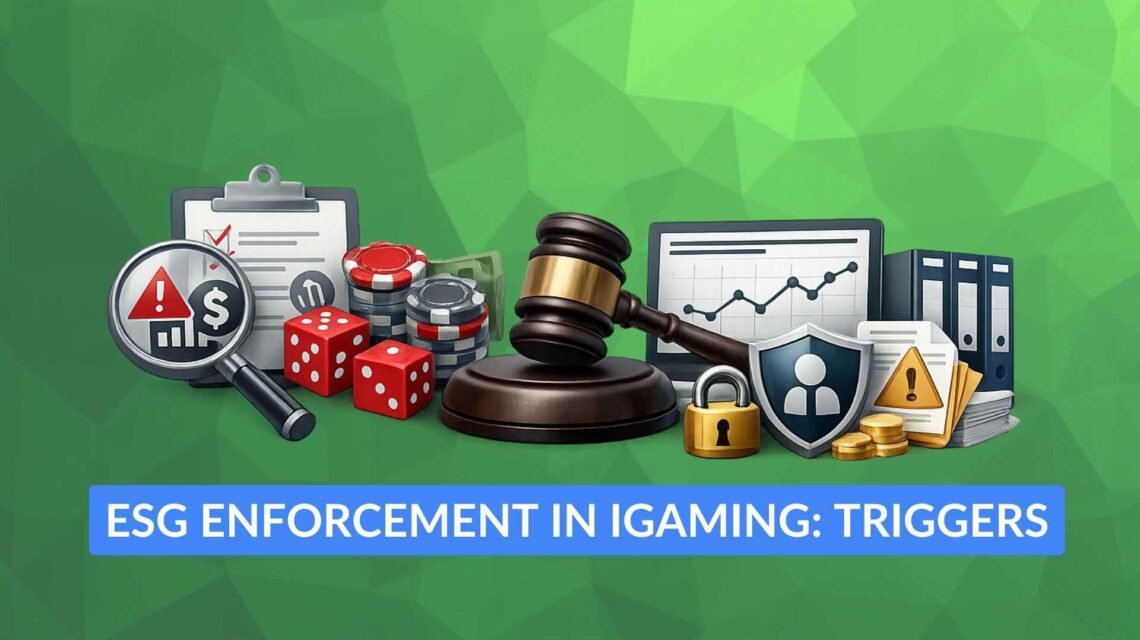
Major gambling enforcement actions rarely begin with ESG concerns. So-called ESG enforcement in iGaming typically starts with familiar failures: missed risk signals, weak controls, delayed reporting, or decisions that … prioritize revenue over player protection. What has changed is how regulators connect those failures.
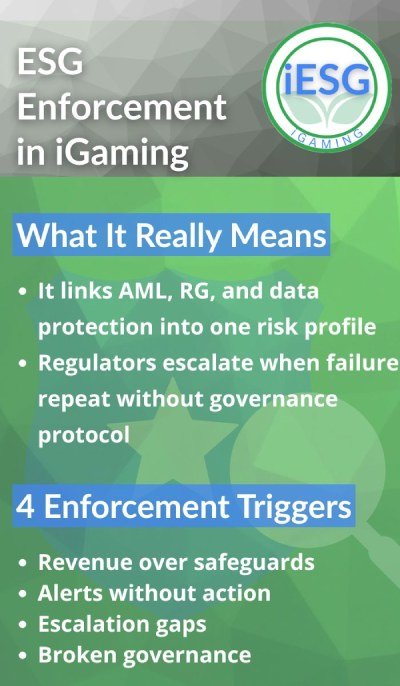
For many operators, ESG still feels like an external metaphysical label applied to obligations which are already commonly understood. In (audit) practice, it has become the framework regulators use to assess whether individual breaches point to a broader issue of governance, intent, and systemic risk. ESG does not replace AML, responsible gambling, or data protection rules. It links them.
Regulatory investigations are increasingly risk-based, cumulative, and pattern-driven. A single failure is rarely decisive. Repeated tolerance of harm, ignored data signals, or unresolved audit findings are what push operators from routine supervision into enforcement. At that stage, regulators are no longer asking whether a rule was broken. They are assessing whether the operator can be trusted to manage risk at all.
This article breaks down the four trigger categories that most often lead to ESG-linked investigations in iGaming, and explains how regulators such as the UK Gambling Commission, Malta Gaming Authority, and Kansspelautoriteit interpret the same signals through different supervisory lenses.
ESG Enforcement in iGaming Is Trigger-Based, Not Abstract
Regulators do not open investigations because an operator has “weak ESG”. They intervene when patterns indicate player harm, financial crime exposure, or governance breakdown. ESG functions here more like a supervisory framework which is used to interpret those patterns once they emerge.
From an enforcement perspective, ESG enforcement in iGaming is tested through practical considerations. Regulators examine whether systems can reliably surface risk, whether controls lead to timely intervention, and whether governance structures can override commercial pressure when required. Environmental, social, and governance factors are therefore assessed through execution, not merely stated intent.
Across jurisdictions, the logic is consistent even if the emphasis differs. The UK applies a risk-based supervision model focused on outcomes and repetition¹. Malta anchors enforcement in directive compliance and operationalised player protection³. The Netherlands places heavy weight on duty of care and early intervention⁴. In practice, ESG enforcement in iGaming tends to appear later in the supervisory process, once regulators have (already) formed a view on the underlying risk patterns.
💡 The iESG Assessment mirrors how regulators identify enforcement risk.
It tests governance, player protection, and sustainability controls to show where repeated signals or weak escalation could push supervision into enforcement.
Behavioural Triggers: When Revenue Overrides Risk
Investigations tend to accelerate once regulators conclude that safeguards were present but consciously sidelined for commercial gain.
This is most visible in the handling of high-value players. VIP managers continuing to engage customers who show clear loss-chasing behaviour, escalating deposits, or prior self-exclusion signals raise immediate concern for supervisors. Regulators apply the same scrutiny where operators continue to accept play from individuals already identified as high risk internally, including illegal bookmakers or intermediaries, even after prior warnings, restrictions, or internal flags have been raised. In regulatory terms, these are not control failures but tolerance decisions that point to severe governance issues¹.
From an ESG perspective, this ESG enforcement in iGaming is where social and governance risks intersect. Player harm indicators are weighed against incentive structures, escalation pathways, and the organisation’s willingness to interrupt revenue when risk thresholds are breached.
Data and Transaction Signals That Trigger Automated Scrutiny
Most major investigations begin quietly, without complaints or public attention. In many cases, regulatory attention originates inside the operator’s own monitoring setup. Transaction records, behavioural signals, and alert thresholds are examined to surface emerging risk long before issues escalate into visible harm or public scrutiny.
Certain transactional behaviours tend to recur in enforcement cases, such as repeated small deposits that avoid internal thresholds, betting activity that does not align with known income profiles, accelerated losses over short periods, or accounts showing sustained activity at atypical times. Additional concern arises where politically exposed persons are involved without clear source-of-funds verification, or where transaction flows resemble layering or recycling behaviour associated with money-laundering typologies².
Individual indicators on their own seldom trigger enforcement. Regulatory escalation is more likely when similar signals reappear over time without effective response, prompting scrutiny of how risk decisions are made and overseen rather than the monitoring tools themselves.
Reporting and Escalation Failures That Turn Signals Into Enforcement
Detection on its own rarely results in sanctions. Enforcement intensifies when operators fail to escalate, document, or report identified risks with sufficient speed and substance.
Typical escalation points include late or incomplete suspicious activity reports, risk assessments that fail to reflect known player behaviour, and control weaknesses that remain unaddressed despite prior identification. When similar issues resurface across audits or supervisory reviews, regulators interpret this as evidence that risk is being handled procedurally rather than operationally¹.
At that stage, the question is no longer whether systems exist on paper, but whether they are applied consistently and independently of commercial influence.
🏅 The iESG Certificate reflects how ESG enforcement in iGaming is judged in practice, providing independent, sector-specific verification that governance, responsible gambling, and AML controls are documented, applied, and defensible.
Governance Breakdown: Where ESG Enforcement in iGaming Becomes Inevitable
Once risks are recognised internally but left unresolved, the regulatory assessment changes materially. ESG becomes the framework used to demonstrate that failures are embedded across decision-making, escalation, and oversight rather than confined to isolated incidents.
Governance failure is the multiplier that turns individual breaches into systemic risk. When boards cannot evidence effective challenge, when risk and compliance functions lack authority over commercial teams, or when the same audit findings recur year after year, regulators lose confidence in the operator’s ability to self-correct.
Common warning signs include unclear ownership of ESG, AML, or responsible gambling controls, inconsistent application of policies across departments, and remediation programmes that exist formally but do not translate into behavioural change. At this point, ESG enforcement in iGaming is no longer about a single breach. It is about loss of supervisory trust⁴.
🎓 The iESG Membership supports ongoing ESG enforcement readiness by helping operators track recurring risks and keep governance, escalation, and evidence aligned with evolving regulatory expectations.
Conclusion: Why ESG Enforcement Rarely Comes as a Surprise
Most ESG enforcement in iGaming is not sudden. Operators are typically visible to regulators long before penalties are imposed, through behavioural patterns, monitoring failures, and unresolved governance issues that accumulate over time. The decisive factor is not whether risks exist, but whether they are recognised, escalated, and acted upon. Where controls exist but are overridden, data signals persist without intervention, or reporting obligations are treated as administrative friction, regulators begin to view failures as systemic rather than isolated. That is the point at which ESG enters the picture.
ESG has not created new regulatory obligations. It has changed how regulators interpret repetition, intent, and oversight across existing ones. What once appeared as separate AML, responsible gambling, or data protection issues is now assessed as a single risk profile.
For operators, the implication is clear. If governance cannot demonstrate control over behaviour, data, and escalation, enforcement is not a question of if, but when. If you want an independent view on where these enforcement triggers may already exist in your organisation, book a free call.
FAQ – ESG Enforcement in iGaming
What triggers ESG enforcement in iGaming?
Sustained behavioural, transactional, reporting, and governance failures that indicate systemic risk rather than isolated errors trigger ESG enforcement in iGaming.
Is ESG enforcement in iGaming distinct from AML or responsible gambling supervision?
Not in operational terms. Supervisors now tend to review AML, responsible gambling, and data protection shortcomings side by side, with ESG enforcement in iGaming providing context for how those risks combine and reinforce one another.
Do VIP programmes attract closer ESG-related regulatory scrutiny?
If VIP incentives weaken player safeguards or influence escalation decisions, regulators are more likely to view resulting failures as governance issues rather than isolated operational errors.
How early do regulators begin investigating operators?
Often months or years before penalties, once patterns of inaction or tolerance become visible.
Does ESG enforcement in iGaming create new obligations for operators?
ESG enforcement in iGaming changes how existing obligations are interpreted, connected, and escalated.
Sources:
- UK Gambling Commission: “Enforcement“
https://www.gamblingcommission.gov.uk/licensees-and-businesses/enforcement
Gambling Commission - Financial Action Task Force (FATF): “Risk-based Approach“
https://www.fatf-gafi.org/en/publications/Fatfrecommendations/Fatfguidanceontherisk-basedapproachtocombatingmoneylaunderingandterroristfinancing-highlevelprinciplesandprocedures.html? - Malta Gaming Authority: “Regulatory Framework“
https://www.mga.org.mt/our-work/regulatory-framework/ - Kansspelautoriteit: “Enforcement Policy Prioritisation“
https://kansspelautoriteit.nl/over-ons/publicaties/regels-leidraden/aanbieders-online-kansspelen/handhavingsbeleid-prioritering/
