
As 2025 wraps up and teams finally pause, many iGaming operators are taking stock of their ESG progress. The reports are signed off, the statements are live, and the dashboards look reassuring. Once the announcements fade, however, a more uncomfortable question starts to surface: which of those ESG decisions would still hold if they were challenged tomorrow? This is where ESG maturity in iGaming comes into play as an indicator.
Throughout the year, ESG activity became more visible across the sector. Operators invested in new policies, expanded responsible gambling controls, and worked to align disclosures with evolving reporting standards. Much of that progress was genuine. But as the year unfolded, a quieter pattern emerged. In many cases, the volume of ESG activity outpaced the organisation’s ability to defend it under pressure.
This distinction matters. ESG maturity in iGaming is not measured by how much is published or pledged, but by how organisations behave when incentives collide, scrutiny increases, or decisions carry consequences. Looking back at 2025, the industry revealed more about its preparedness than many operators may have intended.
ESG Activity Was Misread as ESG Maturity
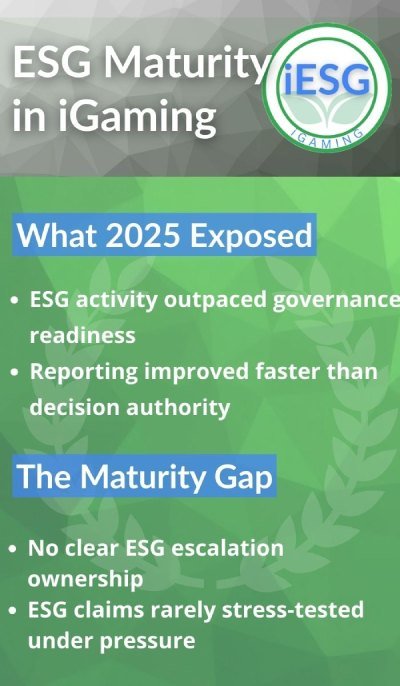
One of the clearest lessons from 2025 is that ESG activity and ESG maturity in iGaming are not the same thing. Many operators were actively doing ESG: launching initiatives, updating policies, publishing sustainability statements, and expanding responsible gambling programmes. Fewer organisations were prepared for the point where ESG stopped being additive and started competing with commercial priorities.
ESG maturity in iGaming becomes visible when decisions get uncomfortable. Commercial growth targets increasingly came into tension with affordability limits and player protection controls. Acquisition strategies run into player protection boundaries. Sustainability commitments prompt questions about who owns the data and who can stand behind it. At that point, ESG is no longer a narrative. It becomes a governance issue.
In 2025, many operators discovered that ESG accountability was spread thinly across teams, with no clear authority to escalate, pause, or override decisions when risk surfaced. Decisions involving ESG exposure were delayed or softened to avoid internal friction. In some cases, ESG initiatives sat alongside commercial strategy rather than actively shaping it.
This was rarely about motivation. ESG was taken seriously, and often in good faith. What the year revealed, however, is that commitment does not automatically translate into resilience. Without defined ownership, escalation routes, and internal challenge, ESG remains exposed when pressure replaces intention.
💡In practice, escalation risk rarely emerges from a single weakness; it becomes visible through patterns across governance, player protection, and oversight structures. The iESG Assessment mirrors this reality by identifying recurring gaps and accountability blind spots rather than treating isolated findings as standalone risks.
Reporting Progress Outpaced Decision-Making Discipline
Another signal from 2025 was the widening gap between ESG reporting sophistication and internal governance strength. Reports improved in structure, alignment, and presentation. For many operators, this created a sense of control.
In practice, stronger disclosures sometimes concealed unresolved governance questions, particularly around who owned ESG risks and how decisions would be taken if indicators deteriorated. Data was collected and published, but accountability was unclear. Metrics existed without defined thresholds or consequences.
This matters because reporting does not create discipline; it reflects it. Regulators and policymakers have repeatedly emphasised that disclosures are only credible when they are supported by governance and control frameworks¹. When reporting evolves faster than decision-making discipline, organisations can develop a false sense of assurance.
The operators that showcased ESG maturity in iGaming, treated reporting as an output of strong governance. Others treated it as evidence of governance itself. Under stable conditions, the difference was subtle. When scrutiny increased, it became visible.
🎓 The iESG Certificate reflects how ESG maturity in iGaming is assessed in practice, focusing on whether governance, responsible gambling, and AML controls are clearly defined, owned, and consistently applied. It provides structured, sector-specific confirmation that these frameworks can withstand regulatory, investor, or stakeholder scrutiny when pressure increases.
ESG Narratives Were Rarely Stress-Tested
A third pattern that emerged in 2025 sits at the intersection of language and risk. ESG maturity in iGaming and its narratives became more confident and more assertive. Operators spoke openly about commitments, values, and impacts. Yet few organisations appeared to systematically test how those narratives would hold up under challenge.
Stress-testing requires asking difficult questions. How would this statement be interpreted by a regulator rather than a marketer? What assumptions does this claim create internally? If challenged, who can evidence it, and how quickly?
In some cases, public ESG statements were agreed faster than the organisation had aligned internally around them. Commitments were approved without fully mapping how they would be interpreted externally or supported in practice. Where assurance was referenced, it often depended on third parties or informal checks that had not been pressure-tested.
Audit bodies have consistently warned that ESG statements can create implicit obligations if they are not carefully governed2. In 2025, some operators discovered that ESG narratives are not neutral. They shape expectations, influence regulatory perception, and define how organisations are judged when things go wrong.
What 2025 Revealed About ESG Maturity in iGaming
Taken together, these patterns point to a clear conclusion: ESG maturity in iGaming is uneven, and visible effort is no longer a reliable indicator of readiness. The industry made progress in 2025, but that progress also exposed where foundations remain thin.
True ESG maturity per se is quiet and shows up in how decisions are made when they are inconvenient. ESG maturity in iGaming appears in who has the authority to pause activity, escalate concerns, or challenge assumptions. It shows up when an operator is asked to explain or defend an ESG claim and has to act in real time, not after weeks of internal alignment.
2025 did not expose a lack of ambition. It exposed a lack of stress-testing. As ESG expectations continue to normalise, the gap between activity and resilience will matter more than the number of initiatives launched or reports published.
✅ For organisations seeking to embed ESG into daily decision-making, iESG Membership offers structured guidance, peer visibility, and practical resources that support ongoing governance discipline. It is designed to move ESG from an annual reporting exercise to a consistently applied management framework within iGaming operations.
Conclusion: ESG Maturity in iGaming
Looking back, 2025 did not reveal an ESG problem rooted in values or intent. It revealed a preparedness problem. The gap was not about what operators believed in, but about how well those beliefs were operationalised.
ESG maturity in iGaming is not demonstrated in calm conditions. It shows up when decisions carry consequences, when trade-offs are unavoidable, and when claims are tested rather than applauded. Over the past year, operators learned – sometimes quietly – where their ESG frameworks were robust and where they relied too heavily on goodwill and momentum.
As expectations continue to rise, the difference between visible effort and decision-ready governance will become harder to ignore. The operators best positioned going forward will not be those who said the most in 2025, but those who now understand which of their ESG commitments can withstand pressure.
That distinction is subtle, but it is decisive. To explore how ESG maturity applies to your operating model, you can book a free call to walk through common risk and governance gaps.
FAQ – ESG Maturity in iGaming
What does ESG maturity in iGaming actually mean?
ESG maturity in iGaming describes how well an operator can make and stand behind difficult decisions when ESG considerations conflict with commercial or operational priorities.
Is ESG maturity the same as ESG compliance?
Compliance centres on satisfying formal requirements. ESG maturity is tested elsewhere: in the quality of governance, the clarity of accountability, and the organisation’s ability to handle scrutiny or trade-offs without improvising.
Why did 2025 expose gaps in ESG maturity in iGaming?
Because ESG activity accelerated faster than internal controls, ownership, and stress-testing across many organisations.
How can iGaming operators assess ESG maturity?
By examining how ESG considerations influence real decisions, who owns escalation, and how claims hold up under scrutiny.
Does strong ESG reporting indicate high ESG maturity?
Not necessarily, reporting reflects maturity but does not create it. Weak governance can exist behind polished disclosures.
Sources:
- UK Gambling Commission: “How We Regulate“
https://www.gamblingcommission.gov.uk/about-us/guide/how-we-regulate - European Commission: “Corporate Sustainability Reporting Directive (CSRD)“
https://commission.europa.eu/business-economy-euro/company-reporting-and-auditing/company-reporting/corporate-sustainability-reporting_en
