
For years, ESG in iGaming was shaped largely by … intent. Sustainability roadmaps, responsible gambling commitments, and governance statements became standard across operator websites, annual reports, and investor decks. That phase is now fading.Over the last few years, the most important change has not been what operators say about ESG, but how closely those claims are examined. Across Europe, sustainability expectations have been pulled steadily into the same orbit as financial oversight.1 Regulators, investors, and commercial partners are showing far less patience for broad statements that cannot be backed up with evidence. In that context, ESG in iGaming 2026 is less a milestone and more a reckoning.
This shift is not driven by a single law or one regulatory announcement. It reflects the direction of travel. ESG is moving from narrative to infrastructure. From aspiration to execution. From what operators declare to what they can demonstrate, document, and withstand under scrutiny. For iGaming businesses, the implications are practical rather than philosophical. ESG is drifting out of communications and into the operational core.
ESG in iGaming 2026 becomes a test of governance discipline, internal controls, and audit readiness. Operators who recognise this early can adjust deliberately. Those who do not tend to encounter ESG later, as a (possibly painful) friction.
ESG in iGaming 2026 Is No Longer About Intent
Early ESG efforts were not wasted. They helped establish shared language, set expectations around responsibility, and push topics like player protection, governance, and sustainability into the open. The problem is not that intent was wrong. It is that intent stops being useful once scrutiny increases.
By 2026, ESG in iGaming is assessed less on what is promised and more on what can be shown. That shift is already visible in how disclosures are read and challenged. Where structure is missing or metrics are inconsistent, and evidence is thin, ESG commitments tend to raise more concern rather than progress.
In practice, the same weaknesses surface again and again during reviews:
- ESG ownership sitting with marketing rather than governance or risk
- Metrics reported without historical baselines or clear methodologies
- Different ESG narratives across jurisdictions and reports
- No documented audit trail behind public statements
These gaps start to matter once ESG is treated as part of core oversight rather than a supporting narrative. When questions move from “do you have a policy” to “who owns this and how is it monitored,” descriptive language is no longer enough. Operators are increasingly expected to show how decisions are taken, reviewed, and corrected in practice.
💡The iESG Assessment fits this shift from intent to evidence.
It is a structured, iGaming-specific diagnostic that tests governance, player protection, and sustainability against real operational criteria, producing a clear score, documented gaps, and a practical roadmap toward proof-ready ESG.
Regulatory Pressure Is Accelerating, Not Stabilising
A common assumption still appears in boardrooms: that regulatory intensity will level off once new frameworks are in place. Recent experience suggests otherwise.
Over the past few years, regulators have steadily expanded expectations around responsible gambling, AML, KYC, and governance. Much of this shift has occurred through guidance, supervisory practice, and reporting expectations rather than headline legislation. Each cycle narrows the margin for interpretation and increases emphasis on evidence.
One illustration of this broader direction can be found in Greece. Authorities have increased pressure on illegal operators through expanded blacklists, cooperation with financial institutions, and closer scrutiny of access and payment flows. While technical requirements are still evolving, the signal is consistent: oversight is becoming ongoing, data-led, and far less reliant on static disclosures.
Greece is not an outlier. It reflects a wider regulatory posture in which ESG expectations are treated more like operational controls than public statements. Documentation, consistency, and accountability are increasingly assumed, not negotiated.
Audits, Assurance, and Continuous Monitoring Take Centre Stage
As regulatory pressure increases, audits rarely arrive without warning. They tend to follow internal weaknesses that become visible first.
ESG in iGaming 2026 is being shaped by a combination of independent assurance, continuous supervision, and closer board involvement. Annual ESG reports still play a role, but they no longer carry the weight they once did. What matters more is whether the systems behind them can stand up to questioning.
This changes how ESG oversight works in practice:
- Responsible gambling is evaluated through intervention logs and outcomes, not policy wording
- AML and KYC effectiveness is tested via escalation trails and transaction monitoring evidence
- Governance is judged by decision ownership, controls, and documented review processes
Put simply, ESG becomes auditable once it is embedded into day-to-day operations rather than described after the fact.
🏅 The iESG Certificate reflects how ESG is now evaluated in practice.
It provides independent, sector-specific verification that an operator’s governance, responsible gambling, and sustainability controls are documented, auditable, and defensible under regulatory or investor scrutiny.
Operators Who Cannot Prove ESG Will Pay for It
The cost of weak ESG is rarely immediate. It tends to appear as drag.
Growth becomes more difficult to sustain. Expansion plans slow, and senior teams spend more time responding to questions than driving strategy. Left unresolved, that drag builds.
For operators unable to support ESG claims with evidence, the consequences are usually practical rather than punitive:
- Longer licensing processes and recurring clarification requests
- Closer and more frequent supervisory interaction
- Deeper scrutiny from partners and platforms
- Elevated risk perception among investors and lenders
Formal sanctions are not required for these effects to take hold.
What “Proof-Ready” ESG Looks Like in Practice
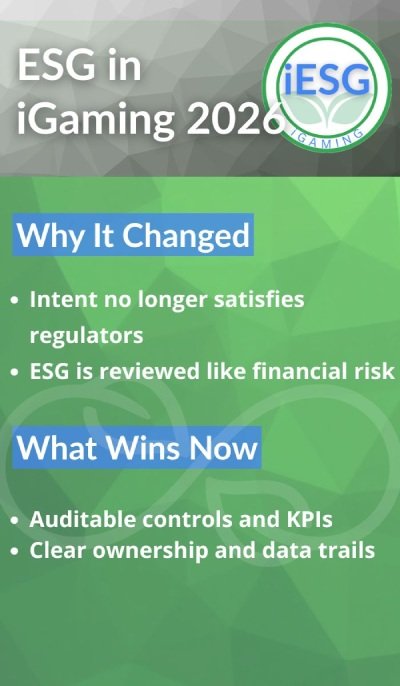
Proof-ready ESG is not about adding layers of bureaucracy. ESG in iGaming 2026 is about capability maturity.
In operational terms, this usually includes:
- Clear ownership of ESG domains, with defined escalation paths
- Measurable KPIs supported by consistent methodologies
- Centralised capture of responsible gambling interventions, AML flags, and compliance actions
- Documentation that shows decisions, controls, and outcomes over time
- Regular internal review cycles aligned with regulatory and investor expectations
Crucially, this level of structure supports decision-making. Boards and executives gain visibility into where risks concentrate, which controls are effective, and where thresholds should change. ESG stops being retrospective reporting and becomes active oversight.
🎓 The iESG Membership supports ESG as an ongoing operating discipline, not a one-off exercise.
It gives iGaming businesses continuous guidance, benchmarking, and tools to maintain oversight, update controls, and keep ESG evidence aligned with evolving regulatory expectations.
Conclusion: ESG in iGaming 2026
ESG in iGaming 2026 is not defined by new promises. It is defined by evidence.
Signals from recent years point in one direction: tighter scrutiny, deeper supervision, and less tolerance for claims that cannot be substantiated. Operators are not being asked to do more ESG. They are being asked to prove the ESG they already describe.In effect, 2026 draws a clear line between operators who invested early in ESG capability and those who relied mainly on intent. The former move forward with fewer interruptions. The latter are drawn into repeated explanations of where they stand. ESG credibility, at this point, is no longer something that can simply be asserted.
To assess how proof-ready your ESG setup really is, book a free call and walk through the gaps before they turn into friction.
FAQ – ESG in iGaming 2026
What does ESG in iGaming 2026 mean?
It describes a shift toward evidence-led ESG, where operators are expected to show controls, data, and outcomes rather than rely on high-level commitments.
Why is regulation tightening around ESG in iGaming 2026?
Because regulators increasingly treat ESG as part of governance and risk management, not a standalone sustainability exercise.
Are iGaming operators required to undergo ESG audits?
Not in all markets. However, audit-style scrutiny and independent assurance are becoming common expectations from regulators, investors, and partners.
How does regulatory tightening affect operators commercially?
In practice, the effects appear as licensing delays, expanded due diligence, and growing compliance workload.
What makes ESG in iGaming 2026 proof-ready?
Clear ownership, measurable KPIs, documented controls, and data trails across responsible gambling, AML, and governance.
Is ESG still a competitive advantage in iGaming?
Yes, but only when it is credible. When ESG is supported by evidence, it removes uncertainty and strengthens trust with regulators and capital providers.
Do these ESG in iGaming 2026 trends apply only to Europe?
Europe is setting the pace, but expectations increasingly spill into global operations through licensing requirements, partnerships, and investment criteria.
Sources:
- OECD: “Corporate Governance and Sustainability”
https://www.oecd.org/corporate/corporate-governance-sustainability.htm
