
European gambling regulation is entering a new phase, and the shift is more significant than a routine compliance update. Seven major regulators Germany, Austria, France, Great Britain, Italy, Portugal and Spain have formalised a joint plan to share intelligence, coordinate enforcement, and pressure global platforms to restrict illegal gambling visibility. This collaboration marks the strongest cross-border regulatory alignment in Europe in over a decade. For operators, affiliates, and suppliers, this new posture is not just a legal issue. It is a direct governance challenge that must be addressed.
Illegal online gambling is no longer treated as a fringe threat confined to offshore rogue sites. Regulators now view the networks that promote and monetise unlicensed operators as a structural governance risk. The pressure is rising on affiliates, paid influencers, sponsorships, social platforms, and any marketing channel that helps illegal operators reach vulnerable groups. This shift lands squarely in the ESG governance domain, where risk oversight, supply chain due diligence, and accountability frameworks are becoming non-negotiable.
The regulators themselves have made it clear in the new European gambling regulation. Cross-border cooperation is designed to expose patterns of misconduct, track repeat offenders, and hold off illegal gambling. That means governance practices must evolve. The question is how quickly.
A New Phase in European Gambling Regulation and its Governance Implications
When seven European regulators aligned in Madrid to share data and synchronise action, the message to the market was clear. Illegal gambling is now a coordinated target, and enforcement will no longer stop at national borders. The European gambling regulation includes intelligence exchange, operator blacklists, affiliate mapping, and joint complaints to global tech platforms to remove illegal advertising. It also introduces a new enforcement frontier. Regulators will now look at the marketing ecosystems that support unlicensed operators. That includes social media channels, video platforms, and advertising networks.
This is a governance issue for one simple reason. Operators are responsible for the conduct of the networks they pay. Even indirect exposure creates measurable regulatory and reputational risk. Under modern ESG frameworks, governance extends beyond the organisation itself to the actors it incentivises, funds, or relies on. European regulators have begun adopting that view. The UK Gambling Commission has already held operators accountable for affiliate misconduct in multiple rulings¹. The Madrid framework simply takes this logic cross-border.
For many operators, this will necessitate a rapid reassessment of their risk posture. Governance teams can no longer separate affiliate oversight from compliance strategy. Nor can boards treat illegal gambling as an offshore problem that does not impact licensed operations. Once regulators collectively start building intelligence maps across markets, risk will be assessed at a Europe wide level. With the new European gambling regulation gaps in due diligence will become more visible, not less.
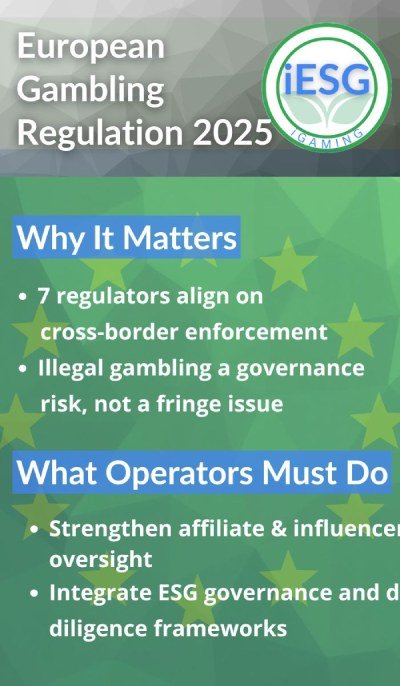
European Gambling Regulation Targets Illegal Operators and Marketing Channels
This coordinated crackdown aligns with a broader European trend: treating consumer protection as a shared cross-border priority. Regulators have made clear that minors and vulnerable groups are being disproportionately exposed to illegal gambling promotion, often through paid influencers and sponsorships. The emerging European harm standard, discussed by authorities at the International Gaming Congress in Madrid, reinforces this direction. Although voluntary (for now), regulators expect it to shape future policy.
This directly increases governance risk. Operators need to assume that regulators will evaluate:
- the completeness of due diligence records
- the monitoring of influencer and sponsorship activity
- the capability to detect cross-border compliance breaches
- the organisation’s approach to documenting and escalating ESG governance risks
In an ESG context, illegal gambling visibility becomes a social and governance risk category. It touches consumer protection obligations, responsible marketing standards, and harm reduction expectations. The European Commission itself has stressed that cross-border consumer risks require tighter regulatory alignment². The Madrid agreement is consistent with that outlook.
This results in greater exposure which means governance accountability is expanding. If an operator benefits from dubious traffic sources without clear oversight, the consequences are … serious. Any missteps or overlooks will be treated as a governance control failure under the new European gambling regulation.
What This Means for Operators: The Governance Playbook for 2025
The next twelve months will be defined by governance maturity. Operators that adapt quickly will build a defensible position. Those that rely on fragmented oversight processes will be eventually exposed.
Governance playbook to keep operators on the safe side
- Strengthen Affiliate & Paid Media Due Diligence
Clear partnership / network criteria guidelines, mandatory documentation, and ongoing monitoring are essential. Simply put, this is a necessity. As regulators increasingly expect operators to prove they understand who promotes them, how and on which channels they are promoted. - Build Cross-Border Incident Reporting Workflows
The Madrid agreement means a violation in one market can trigger interest in others. Governance teams need a centralised system for identifying, recording, and escalating multi-country incidents. - Implement Mandatory Governance Controls for Marketing
This includes controls for influencers and brand ambassadors,as well as sponsorship, and agency guidelines. Contracts need to be in compliance with market restrictions and responsible marketing standards. - Monitor Platforms Proactively
Regulators will file joint complaints with major tech platforms to remove illegal advertising. Operators must document their monitoring efforts and takedown actions … if required. This is governance hygiene. - ESG Reporting as a Strategic Asset
CSRD pressures will make ESG governance reporting a fundamental compliance deliverable. Illegal gambling advertising and affiliate marketing risks are part of governance metrics that have to be taken seriously.
The operators that win in 2026 will treat governance like an operational discipline, not a checkbox. Regulators are coordinating. Operators must do the same.
💡 iESG Assessment
Our iESG Assessment is a focused audit and tailored for the iGaming industry. It shows where you are exposed to ESG risks, from governance blind spots to unregulated market activity. It’s free and helps identify weak spots before they become big issues.
The Bigger ESG Picture: Why This Crackdown Sets a New Baseline for European Operators
This enforcement pivot is bigger than illegal gambling itself. It signals a structural change in how regulators view the ecosystem around gambling. The industry is moving toward integrated governance expectations that sit across markets rather than within them.
Three macro shifts stand out:
#1. Governance is becoming the dominant ESG factor in gambling
Environmental topics will grow, but governance is where the immediate risk lies. For both regulators and investors, proof of strong (internal) systems, transparent reporting, and responsible marketing oversight are signals of a sustainable business.
#2. Operators better build governance capacity ahead
Waiting for a mandatory rule change is not a future-proof approach. When seven regulators coordinate, timelines shorten. Voluntary harm standards and ESG governance expectations will quietly become the informal benchmark for compliance.
#3. Competitive advantage to the ones demonstrating control
The level of governance maturity or lack of, directly influences investor confidence and regulatory perception. Strong ESG governance is good for business! It signals discipline, risk awareness, and operational reliability.
The European gambling regulation is tightening, and the governance bar is rising with it. Operators who prepare early will reduce enforcement exposure and strengthen stakeholder trust. Those who delay will face preventable risk.
Conclusion: European Gambling Regulation
European gambling regulation has entered a coordinated enforcement era, and governance is at the centre of it. Illegal gambling exposure, affiliate oversight gaps, influencer risks, and cross-border marketing failures now have direct regulatory, reputational, and ESG consequences.
FAQ – European Gambling Regulation
What is changing in European gambling regulation?
Seven regulators are coordinating data sharing, enforcement, and platform takedowns to reduce illegal gambling visibility in the new European gambling regulation.
How the new European gambling regulation impacts marketing.
Because operators are accountable for the conduct of their affiliates, influencers, and marketing channels, all of which affect consumer protection.
How does the European gambling regulation affect operators?
Even licensed operators risk penalties if their marketing network supports unlicensed sites or breaches local rules.
Does the European gambling regulation impact affiliates?
Yes, the Europen gambling regulation will evaluate affiliate due diligence, onboarding standards, and cross-border compliance.
Is European gambling regulation likely to tighten further?
Yes due to coordinated enforcement, that typically precedes harmonised policy development.
Sources:
- ¹ UK Gambling Commission (UKGC): “Enforcement Reports and Regulatory Updates.“
https://www.gamblingcommission.gov.uk - ² European Commission: “Consumer Policy and Cross Border Enforcement.“
https://commission.europa.eu/strategy-and-policy/policies/consumers/consumer-protection-policy_en - ³ Kansspelautoriteit (KSA): “Illegal gambling enforcement and regulatory actions.“
https://kansspelautoriteit.nl
