
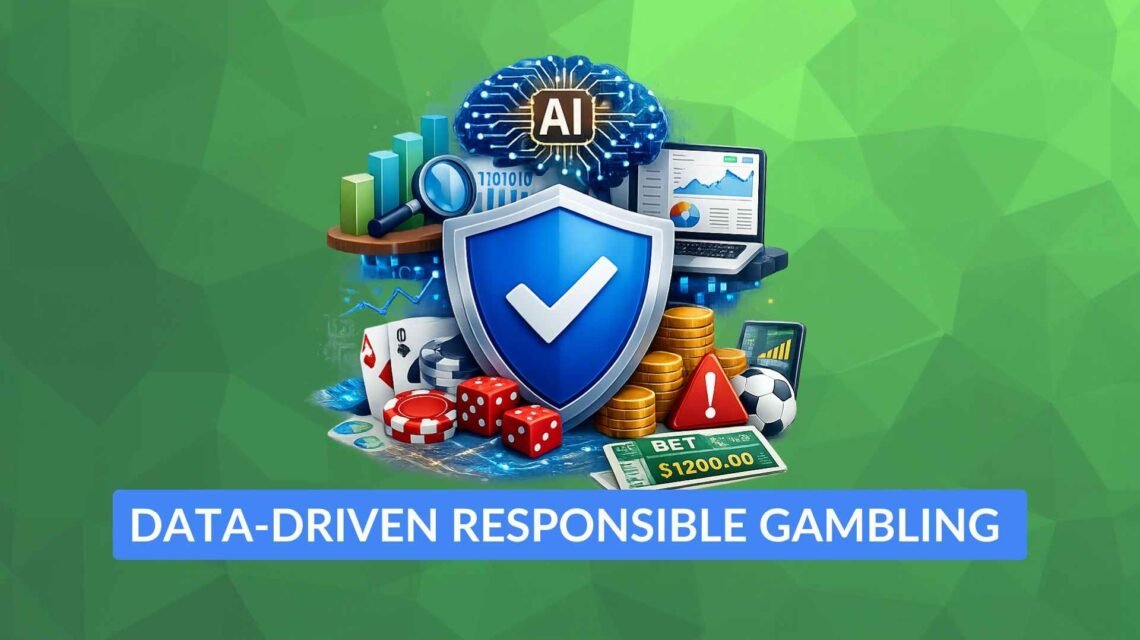
Responsible gambling strategy is entering a new phase. What used to rely on static policies and periodic reviews is now being reshaped by real-time data, tighter regulation, and more capable technology. Data-driven responsible gambling is no longer theoretical. It’s becoming operational. Regulators are no longer satisfied with reactive safeguards. They expect operators to identify risk early and act while player behaviour is still evolving.
At the same time, leading operators are shifting toward monitoring systems that run continuously rather than being triggered after incidents. Recent updates from the UK Gambling Commission reflect this direction, with a stronger emphasis on proactive customer interaction and earlier identification of harm indicators¹.
Responsible Gambling Strategy shifts from being a compliance checkpoint to something that runs inside daily operations. Operators that move early are not just keeping up with regulations. Data-driven responsible gambling initiatives are building more stable player relationships that are less likely to break under pressure.
Why traditional responsible gambling strategy falls short at scale
Traditional responsible gambling strategy was built for a very different environment. Lower volumes, slower gameplay cycles, and fewer data points made manual oversight workable. That model held up. At today’s scale, it doesn’t. Modern iGaming platforms generate constant behavioural signals. Session length, deposit frequency, betting intensity, and gameplay shifts all evolve in real time. Managing that without data-driven responsible gambling strategies, through manual processes inevitably creates blind spots
Regulators have started to reflect this reality. The UK Gambling Commission expects operators to identify risk at the earliest possible stage and act without delay¹. Across Europe, similar expectations are emerging around continuous monitoring.
Where older approaches start to break down becomes obvious at scale:
- Detection comes too late: patterns are flagged after escalation
- Manual review slows response: teams cannot keep up with volume
- Data sits in silos: compliance, CRM, and product teams rarely act on the same signals
- Success is measured by process, not outcome
This is exactly where data-driven responsible gambling becomes critical, replacing slow, fragmented processes with systems built for speed, scale, and measurable outcomes.
What data-driven responsible gambling looks like in practice
Data-driven responsible gambling turns player protection into a system that runs continuously. Instead of relying on fixed rules, operators monitor behaviour as it develops and respond when patterns begin to shift.
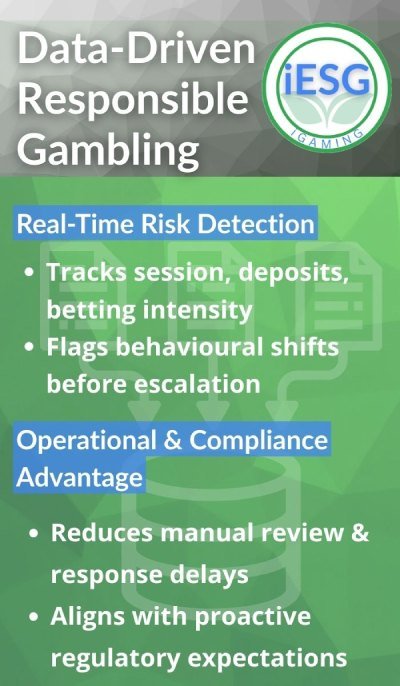
In real environments, that means tracking:
- session frequency and duration
- deposit velocity and transaction changes
- betting intensity and volatility
- behavioural deviations over time
These signals feed into risk models that update continuously. When certain thresholds are crossed, the system can trigger an action immediately or escalate the case for review.
Operators typically monitor signals such as:
- sudden spikes in deposit frequency
- unusually long continuous sessions
- repeated failed withdrawal attempts
- rapid shifts into higher-risk gameplay
The real difference is not reporting after incidents. Data-driven responsible gambling tools are acting while the player is still active. According to Deloitte, advanced analytics and AI-driven monitoring enable earlier detection of risk patterns and more targeted interventions². For operators, that translates into fewer missed high-risk cases and fewer unnecessary interventions.
From compliance cost to operational advantage
Responsible gambling has traditionally been treated as a cost center. That changes once data becomes part of the system.
When monitoring relies on data-driven responsible gambling tools, it is continuous and targeted; the impact becomes measurable.
#1. Intervention efficiency
Teams focus on genuinely high-risk behaviour instead of reviewing large volumes of low-risk activity.
#2. Player trust and retention
When intervention happens earlier and is proportionate to behaviour, it feels less intrusive. That matters. Players are more likely to stay when actions make sense rather than appearing abrupt or overly restrictive.
#3. Regulatory alignment and risk reduction
Real-time monitoring is quickly becoming the expectation, not the exception. Operators that can demonstrate continuous oversight are in a much stronger position when regulators assess risk controls. A report by BDO connects stronger ESG and risk frameworks with higher investor confidence and reduced exposure³.
#4. Scalable player protection
Growth creates pressure. Without automation, that pressure lands on compliance teams. With the right systems in place, it’s absorbed at the system level instead.
This is where the shift becomes tangible. Data-driven responsible gambling initiatives aren’t just about avoiding penalties, they start functioning as part of a scalable fully-integrated operating model.
💡The focus is shifting from isolated gambling incidents to behavioural patterns over time. Signals such as session intensity, loss-response behaviour, and prior interventions help indicate escalation risk. Data-driven responsible gambling systems bring these signals together, while frameworks like our iESG assessment provide a structured way to review them and identify potential gaps.
The acceleration: why adoption is increasing now
This shift isn’t happening in isolation. It’s being pushed forward from multiple directions at once, which is why adoption is speeding up.
1. Regulatory evolution
The UK Gambling Commission and regulators such as the Dutch KSA are placing more weight on early detection and timely intervention¹. The expectation is clear: reacting late is no longer acceptable.
2. Technology maturity
The tooling has caught up. Real-time analytics and AI models are no longer experimental, they are deployable at scale and increasingly cost-efficient.
3. Operator adoption
This is already visible across the market:
- Kindred Group tracks revenue linked to harmful gambling using behavioural data⁴
- Flutter Entertainment continues to expand its player protection capabilities⁵
- Entain integrates real-time analytics into its ARC framework⁶
Once these systems are in place across major operators, the baseline shifts. What was once advanced quickly becomes expected.
Tools are improving, adoption is expanding, and player protection is becoming more measurable and effective utilising data-driven responsible gamlbing strategies.
Conclusion
Data-driven responsible gambling strategy marks a clear evolution. It doesn’t replace existing frameworks, it makes them workable at scale.
By moving from static policies to continuous systems, operators can detect risk earlier, act more precisely, and stay aligned with tightening regulation. At the same time, they build more stable player relationships and reduce operational friction.
Operators that treat data as part of their core infrastructure will shape the next phase of player protection.
🏅 As responsible gambling systems become more data-driven, operators are placing greater emphasis on how governance, oversight, and documentation are structured. Our iESG Membership reflects a sector-specific approach to organising these elements within monitoring and reporting.
FAQ – ESG due diligence
What is data-driven responsible gambling in iGaming?
At its core, it means using live player data to spot early warning signs and act before behaviour escalates.
How does a data-driven responsible gambling strategy work in practice?
AI-powered systems track player behaviour continuously, real-time, score risk, and trigger alerts or actions when patterns start to shift.
Why are operators moving toward data-driven responsible gambling systems?
Because manual reviews and static rules can’t keep up anymore. Volume has increased, and regulators expect earlier, evidence-based intervention.
What data is used in responsible gambling risk detection?
Typically parameters include session length, deposit changes, betting intensity, as well as any unusual behavioural shifts over time.
How does data-driven responsible gambling improve player protection?
The key advantage is timing. Risk can be identified earlier, which allows for smaller, more proportionate interventions instead of late-stage action.
Is data-driven responsible gambling required by regulators?
Not always written as a strict requirement, but expectations are moving in that direction. Proactive monitoring is quickly becoming the benchmark.
What is the role of AI in responsible gambling systems?
AI helps process large volumes of behavioural data in real time, making it easier to detect patterns that would be missed manually.
Sources:
- UK Gambling Commission: “Customer interaction guidance“
https://www.gamblingcommission.gov.uk/guidance/customer-interaction-guidance-for-remote-gambling-licensees-formal-guidance/requirement-8-customer-interaction-guidance-for-remote-gambling-licensees-sr - Deloitte: “Data and risk management (analytics)“
https://www.deloitte.com/us/en/services/consulting/articles/data-and-risk-management-financial-services.html - BDO: “ESG strategy for gaming“
https://www.bdo.com/insights/industries/gaming-leisure/gaming-companies-unlock-the-power-of-esg-strategy-and-investment - Kindred Group: “Zero harmful gambling initiative“
https://www.kindredgroup.com/sustainability/zero-percent-harmful-gambling - Flutter Entertainment: “Sustainability (player protection)“
https://www.flutter.com/sustainability/ - Entain: “Safer betting and gaming (ARC framework)“
https://www.entaingroup.com/sustainability-esg/safer-betting-and-gaming/
