

100% renewable hosting” sounds convincing, but it begs the question: how can you actually verify green hosting iGaming environments in practice?
Across the EU and UK, ESG expectations are tightening. What used to sit comfortably in marketing decks is now moving into compliance territory. For operators, repeating provider claims is no longer enough. At some point, those claims need to hold up against real data.
That shift is being formalised. The EU’s Green Claims Directive will require environmental statements to be backed by verifiable evidence, not assumptions or loosely connected certificates¹. And this is not a marginal issue. The infrastructure behind iGaming is energy-intensive. Data centers already account for roughly 1–1.3% of global electricity demand². That makes energy sourcing a material question, not just a branding detail.
So the challenge becomes practical. Before anyone else starts asking questions, operators need to be able to verify green hosting iGaming setups themselves.
Why it’s hard to verify green hosting in iGaming
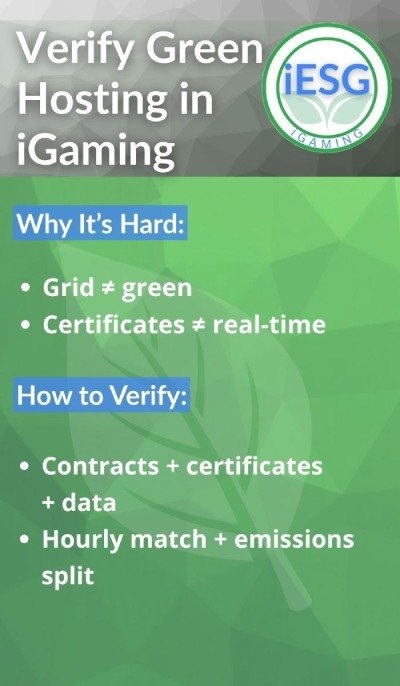
At first glance, many renewable hosting claims look solid. Under closer inspection, they tend to lose clarity. That usually comes down to how energy is sourced and reported. A data center doesn’t operate in isolation. It pulls from the same grid as everything around it, which means the actual energy mix depends on the region, not the label attached to it. A provider can buy renewable certificates, but that does not change what is physically powering servers at any given moment.
That gap between reported sourcing and actual consumption is where things start to blur.
Cloud infrastructure adds another complication. Workloads shift constantly between regions and facilities. From the operator’s side, that movement is largely invisible. So even if a provider reports strong renewable performance overall, it does not necessarily reflect what your workloads are running on in practice.
Then there is timing … in many setups, energy use is balanced over the course of a year, with total consumption offset through renewable purchases. From an accounting perspective, that works. But it smooths over when energy is actually consumed, which is where the underlying reality can differ.
This is why verification is difficult. Not because claims are always wrong, but because they are often simplified.
How to verify green hosting iGaming: The Renewable Proof Stack
To make sense of this, operators need a clearer structure rather than more claims, but in a way to separate signal from noise.
To make this practical, one useful way to approach it is through a “Renewable Proof Stack”, a framework that breaks verification into four layers. Each layer answers a different question, and together they show how far a claim actually holds.
Contractual proof
Start with contracts. Power purchase agreements and supplier deals show that a provider is investing in renewable energy. That matters. It signals intent and financial commitment.
But these agreements sit one step removed from operations. They don’t tell you what energy is powering a specific facility or workload.
They point in the right direction. They don’t confirm the outcome.
Certificate proof
Next comes certificates. Renewable Energy Certificates and Guarantees of Origin confirm that renewable energy has been generated somewhere and fed into the grid. They are widely used within market-based emissions reporting frameworks.
However, under the GHG Protocol, companies are expected to distinguish between market-based and location-based emissions. Certificates support the former. They don’t change the latter. So while they are valid within reporting standards, they don’t necessarily reflect the energy mix powering infrastructure in real time.
Operational proof
This is where things start to become concrete.
Operational proof looks at what is happening at the data center level:
- Where energy is sourced
- What the actual mix looks like
- How infrastructure is powered in practice
When providers share this level of detail, it becomes possible to verify green hosting iGaming claims against something tangible. Without it, you are still working with averages.
Temporal proof
The final layer is about timing. This approach is often described as 24/7 carbon-free energy matching. Instead of averaging energy use across a year, it aligns consumption with renewable generation on an hourly basis.
According to the International Energy Agency, improving this kind of temporal alignment is essential if reported emissions are meant to reflect actual energy use². Some large providers, including Google, have already committed to this model. That signals a broader shift away from annual balancing toward something closer to real-time verification.
At this point, claims begin to move out of reporting language and into something that can actually be tested.
How to audit your hosting provider
If you want to verify green hosting iGaming operations, ESG reports are not the place to start.
The useful answers sit underneath them. Ask your provider to explain how they measure and report energy use. Not the summary, but the method.
Focus on details:
- Do they separate location-based and market-based emissions clearly, in line with GHG Protocol guidance?
- Are certificates tied directly to energy supply, or sourced independently?
- Can they show energy sourcing at data center level, rather than portfolio averages?
- Is their reporting independently verified?
- Do they support any form of hourly or real-time energy matching?
The way these questions are answered tells you more than the answers themselves. If everything stays high-level, you are not looking at verification. You are looking at positioning.
💡Verifying renewable infrastructure goes beyond certificates. It requires visibility into sourcing, matching, and reporting across systems and timeframes. Data-driven approaches consolidate these signals, while our iESG assessment provides a structured way to evaluate, validate, and improve energy claims.
Why weak proof creates real business risk
This is where the conversation shifts from technical detail to business exposure.
Regulation is moving in one direction. Under the European Commission’s Green Claims Directive, environmental statements will need to be backed by verifiable evidence and independent validation¹. At the same time, the Corporate Sustainability Reporting Directive (CSRD) requires companies to disclose both market-based and location-based emissions.
That raises expectations.
Investor due diligence is evolving in parallel. ESG assessments increasingly look beyond policies and into how claims are supported at infrastructure level³. If that link is missing, issues tend to surface quickly.
Claims may be challenged or need adjustment. Questions come from investors, partners, or regulators. And once those questions start, they are difficult to contain. At that point, sustainability stops working as a differentiator. It becomes something that needs to be defended.
Conclusion
A divide is starting to take shape.
Some operators still rely on high-level claims and supplier assurances. Others are building systems they can explain, justify, and back with data. The difference is not ambition. It is evidence. Contracts, certificates, operational transparency, and time-based matching all have a role. But only when they are understood together do they form something credible.
That is what it means to verify green hosting iGaming environments today. And in the next audit, that distinction will matter.
🏅 As renewable claims come under greater scrutiny, structured governance, documentation, and oversight become critical. Our iESG Membership provides a sector-specific framework to organise how energy claims are verified, documented, and aligned with reporting requirements.
FAQ – Verify green hosting iGaming
What does it mean to verify green hosting iGaming?
It means validating renewable energy claims with infrastructure-level data rather than relying on provider statements.
Are Renewable Energy Certificates enough to verify green hosting iGaming?
They support market-based accounting but do not confirm actual energy consumption.
How do you verify green hosting iGaming infrastructure?
By reviewing contracts, certificates, operational data, and whether energy use is matched to renewable generation over time.
What is 24/7 carbon-free energy matching?
It refers to aligning energy consumption with renewable generation on an hourly basis rather than balancing it across a full year.
Why is ESG verification important in iGaming infrastructure?
Because regulators and investors increasingly expect evidence-backed claims.
What is the difference between location-based and market-based emissions?
Location-based reflects actual grid energy, while market-based includes contractual instruments like Renewable Energy Certificates.
How does verify green hosting in iGaming connect to greenwashing risks?
If claims cannot be backed with data, they can be seen as misleading, creating regulatory and reputational exposure.
Sources:
- European Commission: “Green Claims Directive“
https://environment.ec.europa.eu/topics/circular-economy/green-claims_en - International Energy Agency: “Data Centres and Energy“
https://www.iea.org/reports/data-centres-and-data-transmission-networks - BDO: “Gaming Companies: Unlock the Power of ESG Strategy and Investment“
https://www.bdo.com/insights/industries/gaming-leisure/gaming-companies-unlock-the-power-of-esg-strategy-and-investment
