
Most iGaming operators track revenue per partner. Almost none track iGaming supplier risk per vendor. That gap is where problems start. iGaming supplier risk is no longer something buried in ESG reporting. It shows up in operations, in compliance, and eventually in financial performance. As operators scale, they plug in cloud providers, payment processors, game studios, and affiliate networks. Each addition helps growth, but it also adds exposure.
Affiliates make this easy to see. They drive acquisition and revenue, yet sit outside direct control. Messaging, targeting, and promotions are handled externally, while responsibility stays with the operator. The same dynamic exists across payments, infrastructure, and content systems. Outsourcing does not remove responsibility. It shifts it and risk moves into systems operators don’t fully control, but the consequences still come back to them. Regulators have started to focus on this and it is no longer just about single incidents.
What matters now is how systems behave over time. And many of those systems sit in supplier-driven areas like payments, monitoring tools, and affiliate activity.
Where iGaming supplier risk actually sits
The iGaming ecosystem is often described as a stack. In reality, it behaves more like a distribution of risk. Infrastructure providers keep platforms running. But they also define how energy is used, how data is handled, and how stable the platform really is. Most operators only see these systems clearly when something goes wrong.
Payment providers
They sit closest to the risk: every deposit, withdrawal, and check runs through them. That includes KYC and AML processes. If something breaks here, it quickly becomes a compliance issue.
Game providers
Are often underestimated: they don’t just supply content. They determine whether products meet regulatory standards in each market. Certification, fairness, and reporting all sit here.
Affiliate networks
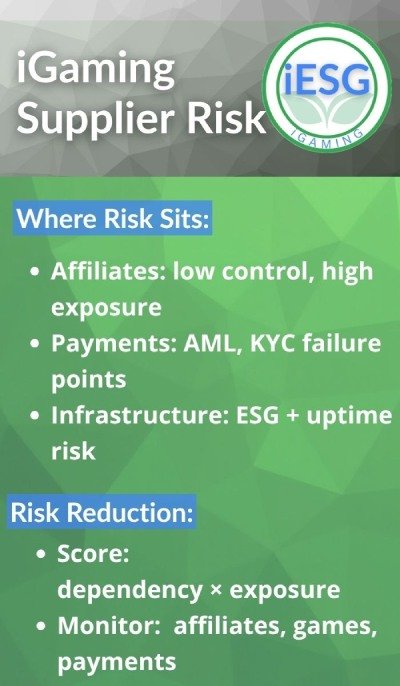
Are one of the highest-risk and least-controlled parts of the supply chain. They decide how offers are framed, where traffic comes from, and how players are targeted. In many setups, oversight is patchy at best. That creates a gap. Execution happens externally, but accountability stays internal. Misleading offers, weak responsible gambling messaging, or targeting the wrong audience are recurring issues.
The UK Gambling Commission has taken action in multiple cases where affiliate activity breached advertising or social responsibility rules.1 Responsibility stayed with the operator. Across all of this, one thing is consistent: operators carry the risk.
Where ESG risk actually hits operators
ESG risk in iGaming doesn’t live in reports. It shows up in costs, compliance issues, and regulator attention. Most of it comes through suppliers.
Infrastructure providers consume large amounts of energy, and that impact is now part of regulatory reporting. Under the CSRD rules introduced by the European Commission, operators are expected to account for emissions across their supplier network. This increases reporting pressure, draws more scrutiny from investors, and can affect cost structures as energy sourcing becomes more relevant.
When transaction monitoring or source-of-funds checks break down, enforcement tends to follow. Entain is a clear example. The £17 million fine from the UK Gambling Commission came back to gaps in financial oversight and how those systems were set up.2 In practice, those layers often involve third-party tools, which makes the line between internal and external risk blurry.
Governance issues don’t usually start with one major failure. It’s more of a gradual escalation, such as a missed check, weak oversight, shortcuts during due diligence. On their own, these issues rarely seem urgent, which is why they are often … ignored. Over time, though, they build into something more serious. The £19.2 million fine issued to William Hill in 2023 by the UK Gambling Commission shows how gaps in player monitoring and interaction systems can escalate into enforcement.3
The shift from vendor choice to regulatory liability
Regulators are not separating internal failures from supplier-related ones. They focus on outcomes, and if something goes wrong, the operator is responsible.
- Affiliate enforcement makes this obvious. Breaches linked to misleading promotions or weak responsible gambling messaging have led to penalties, even when carried out by third parties.
- The same logic applies to payments and player protection. If monitoring fails or risk signals are missed, it is treated as an operator-level issue, regardless of which system was involved.
Regulation is tightening as well. The European Commission is increasing expectations around supply chain transparency through CSRD and related rules.4 Supplier issues are no longer … background noise; they sit directly in the compliance layer.
💡Assessing iGaming supplier risk goes beyond basic checks. It requires visibility across systems and partners. The iESG Assessment provides a structured approach to evaluate and document supplier-related ESG exposure.
The iGaming supplier risk framework
Managing iGaming supplier risk starts with two questions:
- How much do you depend on a supplier?
- And how much risk do they introduce?
Some suppliers are easy to replace and carry low risk. These can be monitored without much effort. Others are less critical but introduce higher ESG exposure. Those are usually the first candidates to change.
Then there are suppliers you depend on heavily. If their risk is low, they become long-term partners and if it isn’t … they become a liability. The biggest exposure sits where dependency and risk meet: these suppliers can cause real damage across compliance, operations, and finances. They need immediate attention.
This changes how supplier management should be handled, it stops being (just) procurement and becomes real risk control.
How operators reduce iGaming supplier risk
Reducing iGaming supplier risk means staying close to how suppliers actually operate.
With infrastructure providers, it starts with understanding what’s actually happening under the hood, how energy is used day to day, and how data is managed beyond the surface level. Both have a direct impact on reporting requirements and, just as importantly, on how stable the platform is day to day.
For payment providers, the focus is on how transactions are monitored. Operators need to know how suspicious activity is flagged, how source-of-funds checks are handled, and where gaps might exist.
Game providers require deeper checks. That means verifying certifications, making sure regulatory requirements are actually met in each market, and understanding how those products are deployed.
Affiliates can’t be left on autopilot. Operators need to keep a close eye on how offers are presented, how messaging comes across, and whether responsible gambling standards are actually being followed in practice.
Suppliers shouldn’t just be reviewed once a year and then left alone. Regular check-ins matter more. Risk scoring can be useful, but only if it’s actually used over time instead of filed away after the first pass. The same goes for contracts. They need to reflect real compliance expectations, not standard wording that looks good on paper but does little in practice.
Relying too heavily on a single provider also increases exposure. Spreading critical functions across multiple suppliers reduces that risk.
Operators that treat suppliers as part of their risk structure, rather than as external vendors, are in a much stronger position when issues arise.
Conclusion
iGaming supplier risk is built into how the industry operates. Growth depends on suppliers, but so does exposure. Regulators focus on outcomes, not internal structures and failures inside supplier-driven systems are treated as operator responsibility.
Operators that keep treating suppliers as external will keep reacting to problems. Those that bring supplier oversight into their core risk strategy will be better prepared.
Understanding where risk sits is no longer optional. It comes with the territory of running a serious iGaming operation.
🏅 As supplier risk increases across the iGaming stack, structured oversight becomes essential. The iESG Certificate provides a framework to assess and manage supplier-related ESG exposure.
FAQ – iGaming supplier risk
What is iGaming supplier risk?
iGaming supplier risk covers the risks that come from working with third-party providers, including payments, affiliates, hosting, and game suppliers.
How does ESG impact iGaming supplier risk?
It shows up through things like emissions reporting, AML failures, or weak governance. In practice, it often becomes a compliance or cost issue.
Are operators liable for third-party failures in iGaming?
Regulators such as the UK Gambling Commission hold operators accountable, even when the issue originates from a supplier.
What is third-party risk in iGaming?
It’s the exposure created by systems or services outside direct control that still affect compliance and operations.
How can operators reduce iGaming supplier risk?
By staying close to supplier operations, running regular reviews, and putting proper controls in place early.
Sources:
- UK Gambling Commission: “Enforcement actions and guidance“
https://www.gamblingcommission.gov.uk/about-us/guide/enforcement - UK Gambling Commission: “Entain fine (2022)“
https://www.gamblingcommission.gov.uk/news/entain-to-pay-17m-for-social-responsibility-and-aml-failures - UK Gambling Commission: “William Hill fine (2023)“
https://www.gamblingcommission.gov.uk/news/william-hill-group-to-pay-19-2m-for-social-responsibility-and-aml-failures - European Commission: “Corporate Sustainability Reporting Directive (CSRD)“
https://finance.ec.europa.eu/financial-markets/company-reporting-and-auditing/company-reporting/corporate-sustainability-reporting_en
