
Responsible gambling is moving away from late-stage intervention and toward earlier risk identification. Gambling behaviour analysis sits at the center of that shift, combining behavioural data with insights from neuroscience.
For operators, this is no longer a side issue for compliance teams. Regulatory expectations are moving toward earlier action, while ESG scrutiny is putting more weight on how the social dimension is managed in practice. The ability to identify risk patterns before they escalate is becoming a core operational capability.
We’re examining how gambling behaviour analysis works, what neuroscience actually adds to the discussion, and why this matters commercially as much as it does from a responsible gambling perspective.
What gambling behaviour analysis actually reveals
Gambling behaviour analysis turns player activity into measurable signals. Those signals reflect underlying cognitive processes that have been studied in both neuroscience and behavioural research.
Neuroimaging studies show that gambling-related cues activate reward-processing regions of the brain, especially the ventral striatum, which is closely linked to reinforcement learning and reward expectation¹. Research also points to altered activity in prefrontal regions associated with impulse control and decision-making².
For operators, the real value is not the brain science on its own. It is the way those mechanisms show up in live player behaviour.
Once gambling intensity rises, behaviour often becomes easier to read. Loss chasing is one of the clearest examples and is commonly followed by faster betting, more abrupt shifts in stake size, and shorter gaps between deposits. Session length can also change, with players staying active longer than their usual pattern even when outcomes remain negative.
The near-miss effect helps explain part of that persistence: Outcomes that are / look close to a potential win can activate reward-related circuitry which means an increased urge to continue, since the win was so close, even though the direct result is a loss³.
Especially in scenarios like this, gambling behaviour analysis becomes so useful as it gives operators a structured way to convert player activity into signals that can be tracked, reviewed, and acted on … before harm becomes obvious.
Behavioural markers gambling operators should track
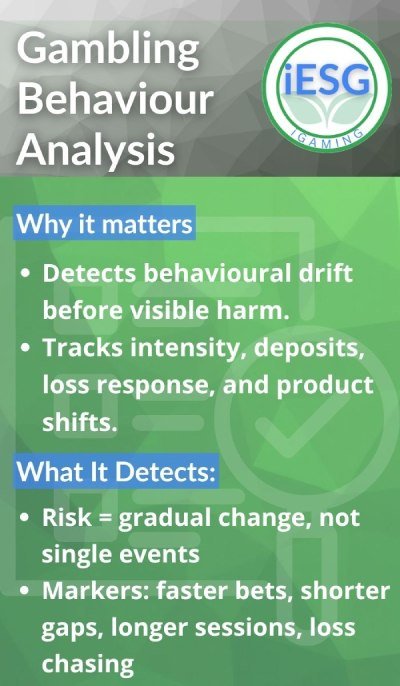
Risk rarely presents itself as one dramatic event. More often, it develops through a sequence of smaller changes that only become meaningful when viewed against a player’s normal pattern.
That is why effective gambling behaviour analysis depends less on fixed thresholds and more on movement over time. A player who suddenly starts depositing more frequently, switches into higher-volatility products after losses, or shifts gambling activity into late-night hours is showing behavioural drift that matters more than any single data point.
Typical early indicators include:
- faster betting cycles and shorter decision intervals
- rising deposit frequency within a short period
- movement toward higher-risk game types after losses
- continued play despite repeated negative outcomes
The important variable is change, not volume alone. A long session is not automatically a problem. A long session that breaks sharply from established behaviour is a different signal entirely. Studies based on tracked player data show that these behavioural shifts are more useful for identifying escalating risk than static limits applied in isolation⁴.
From detection to earlier identification: how neuroscience reshapes responsible gambling
Traditional responsible gambling models tend to react to visible signs of harm, such as sustained losses, self-exclusion, or direct customer disclosure. That approach is still necessary, but it arrives late.
Behavioural science points to a different model. Harmful gambling patterns usually develop gradually rather than all at once. Changes in reward sensitivity, impulse control, and emotional regulation can emerge before financial harm becomes obvious in the account history⁴.
For operators, that changes the timing of intervention. The goal is not simply to document harm after it appears. It is to identify behavioural drift early enough to respond while player behaviour is still within a controllable range. In practice, that means continuous monitoring of behavioural patterns, identification of deviations from baseline, and earlier-stage interventions built around observed risk rather than visible damage.
Regulatory guidance supports that direction. The UK Gambling Commission requires remote licensees to have systems and processes in place to monitor customer activity and identify harm or potential harm from the point an account is opened⁵.
The practical implication is clear. Responsible gambling is shifting from the detection of obvious harm to the earlier identification of developing risk trajectories across the wider player base.
💡Gambling Behaviour Analysis tracks behavioural patterns over time, including session intensity, loss response, and prior interventions to identify early risk. Data-driven systems consolidate these signals, while our iESG assessment structures how risk is monitored, reviewed, and improved.
Why this is an ESG and revenue play, not just compliance
Treating gambling behaviour analysis purely as a compliance tool misses the strategic point.
It can improve retention by reducing the kind of extreme loss events that often drive sudden churn. Earlier intervention does not just protect the player. It can also reduce volatility in player behaviour and support more stable long-term engagement.
It can also reduce regulatory exposure. Operators that can show structured monitoring, documented triggers, and timely interaction are better aligned with current expectations around customer protection.
The same capability matters for ESG. The social pillar is increasingly judged through measurable action rather than broad commitments. Investor-facing ESG frameworks are placing more emphasis on how risk is identified, monitored, and managed in operational terms⁶.
That matters because responsible gambling is no longer judged by policy language alone. It is judged by whether the operator can evidence detection, intervention, and review.
Operators that build stronger behavioural monitoring frameworks will be in a better position to protect customers, satisfy regulators, and strengthen the credibility of their ESG story at the same time.
Conclusion
Gambling behaviour analysis is changing how risk is understood in iGaming.
Neuroscience shows that gambling behaviour is linked to measurable patterns in reward processing and impulse control. Behavioural tracking turns those patterns into practical signals that operators can use in real environments.
The shift now underway is not academic. It is operational. Responsible gambling is moving away from reacting to visible harm and toward identifying risk earlier, while there is still room to intervene effectively.
For operators, that capability increasingly shapes compliance outcomes, player trust, and ESG credibility.
The competitive edge will not come from simply understanding behaviour … it will come from acting on it sooner and with more precision.
🏅 Gambling Behaviour Analysis is becoming more data-driven, increasing the need for clearer governance, oversight, and documentation. Our iESG Membership supports how these elements are structured within behavioural monitoring and reporting.
FAQ – Gambling Behaviour Analysis
What is gambling behaviour analysis?
Gambling behaviour analysis is the structured use of player data to identify patterns associated with elevated risk, including changes in session length, deposit behaviour, and betting intensity.
How does neuroscience explain gambling behaviour?
Neuroscience links gambling to reward processing, reinforcement learning, and impulse control, helping explain why certain gambling cues can intensify continued play¹.
What are behavioural markers in gambling?
Behavioural markers are observable signs such as faster betting, rising deposit frequency, prolonged sessions, or continued gambling after losses, all indicating growing risk⁴.
Can gambling behaviour analysis detect risk early?
Research using objective player tracking data shows that behavioural changes can help identify escalating risk before more visible harm appears⁴.
What is the near-miss effect in gambling?
The near-miss effect describes outcomes that fall short of a win but still increase motivation to continue gambling by activating reward-related processes³.
Why is gambling behaviour analysis important for ESG?
Because it provides measurable evidence of player protection through monitoring, intervention, and evaluation, which strengthens the social pillar of ESG in practice⁶.
How do regulators view behavioural tracking?
Regulators such as the UK Gambling Commission expect operators to monitor customer activity and identify harm or potential harm through effective systems and relevant indicators⁵.
Sources:
- van Holst RJ, Chase HW, Clark L. “Striatal connectivity changes following gambling wins and near-misses: Associations with gambling severity”
https://pmc.ncbi.nlm.nih.gov/articles/PMC4110887/ - Quintero GC. “A biopsychological review of gambling disorder”
https://pmc.ncbi.nlm.nih.gov/articles/PMC5207471/ - Clark L, Lawrence AJ, Astley-Jones F, Gray N. “Gambling near-misses enhance motivation to gamble and recruit win-related brain circuitry”
https://pmc.ncbi.nlm.nih.gov/articles/PMC2658737/ - Delfabbro P, King DL, Browne M, Dowling NA. “Behavioural tracking and profiling studies involving objective data derived from online gambling operators: A review of the evidence”
https://pmc.ncbi.nlm.nih.gov/articles/PMC11272745/ - UK Gambling Commission: “LCCP Condition 3.4.3 – Remote customer interaction”
https://www.gamblingcommission.gov.uk/licensees-and-businesses/lccp/condition/3-4-3-remote-customer-interaction - BDO: “Gaming Companies: Unlock the Power of ESG Strategy and Investment“
- https://www.bdo.com/insights/industries/gaming-leisure/gaming-companies-unlock-the-power-of-esg-strategy-and-investment
