
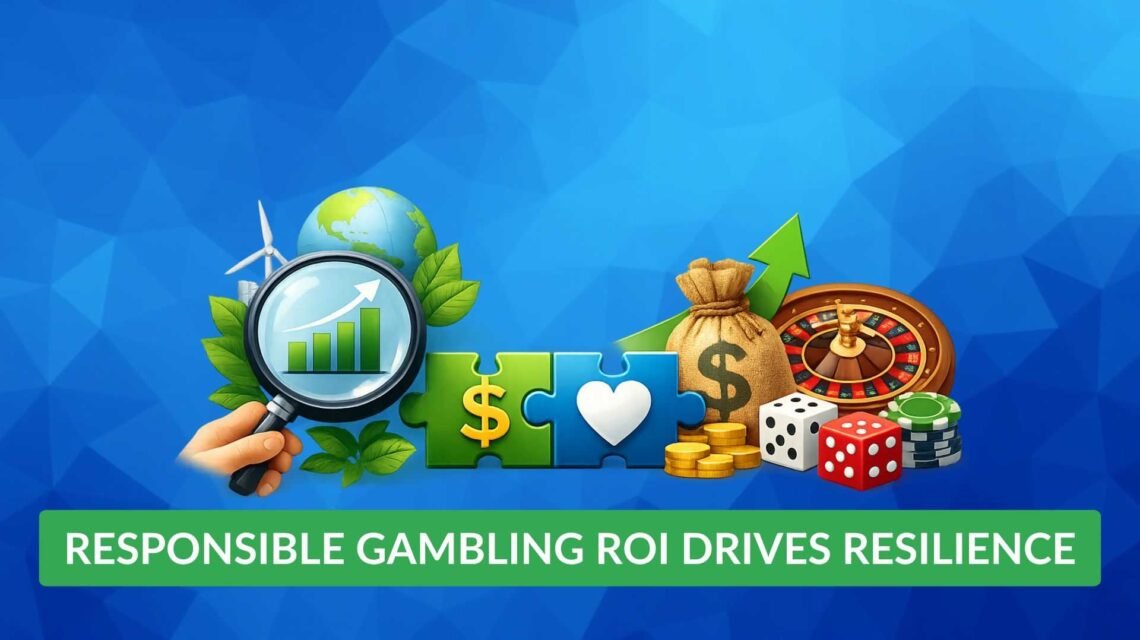
Responsible gambling ROI is becoming a far more serious business discussion inside iGaming. For years, operators focused primarily on acquisition, active users, and quarterly revenue growth. That formula is starting to lose credibility as regulatory pressure rises and acquisition costs continue climbing. Operators are increasingly being evaluated on something more difficult to measure … revenue quality.
Flutter Entertainment now positions safer gambling and sustainability reporting alongside broader governance strategy in investor communications.¹ That shift says a lot about where the market is heading.
Operators heavily dependent on short-term, high-intensity spending are facing pressure from several directions at once: tighter regulation, rising acquisition costs, reputational scrutiny, and growing investor concern around long-term resilience.
At the same time, businesses focused on healthier player relationships are increasingly presenting themselves as lower-risk and more sustainable growth stories.
Responsible gambling ROI is no longer confined to compliance discussions. It is becoming part of a wider commercial conversation around retention, governance, and long-term business durability.
Responsible gambling ROI and revenue quality
Not all gambling revenue strengthens a business equally.
Across the industry, some operators still rely heavily on a relatively small group of high-intensity VIP-players. While this can inflate short-term performance metrics, it often creates instability beneath the surface. When a business relies too heavily on a small group of high-spending players, problems tend to emerge gradually.
Complaint volumes rise, VIP concentration increases, then retention weakens and marketing costs climb because more players need replacing; that pressure spreads across the operation.
Operators chasing aggressive short-term monetization often end up spending heavily just to maintain the same pace of growth. In tightly regulated markets, that becomes harder every year as advertising restrictions expand and acquisition channels become increasingly competitive.
This is why revenue quality and hence responsible gambling ROI matter: A broader, healthier player base is usually easier to retain, less exposed to regulatory shocks, and far more stable commercially over time.
The strongest operators are not necessarily extracting the highest losses from players. They are building customer relationships capable of lasting years instead of months.
That distinction is becoming increasingly important as investors and stakeholders evaluate long-term business durability rather than raw growth alone.
Responsible gambling ROI and player retention
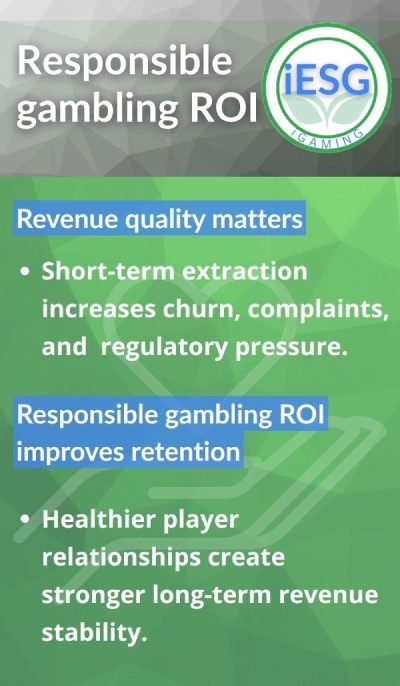
Customer acquisition costs across iGaming continue rising as competition intensifies across paid media, sponsorships, and affiliate channels. Under those conditions, responsible gambling retention becomes even more valuable for operators focused on long-term revenue quality.
Operators capable of maintaining stable long-term player relationships gain a structural advantage over businesses dependent on constant replacement acquisition. That changes how responsible gambling is viewed internally.
Instead of functioning purely as a compliance obligation, responsible gambling increasingly overlaps with retention strategy and sustainable gambling revenue models.
A player who remains active for several years creates far more predictable value than a short-term high spender who churns quickly or creates regulatory friction. That difference is one of the clearest examples of responsible gambling ROI in practice.
Research from Deloitte shows younger demographics place growing importance on trust, transparency, and responsible corporate behaviour when engaging with brands.² That trend increasingly affects gambling operators as well.
Brands perceived as reckless or overly aggressive can face reputational friction extending beyond players themselves. Affiliates, payment providers, sponsors, and commercial partners are all paying closer attention to governance standards, safer gambling policies, and long-term brand reputation than they were five years ago.
The industry is gradually moving from transaction-focused growth toward relationship-focused growth.
That shift changes the economics entirely: Retention compounds over time while short-term extraction does not.
Investor confidence increasingly depends on governance quality
Investor expectations around gambling businesses are evolving alongside regulatory pressure.
Investors are paying far closer attention to how gambling businesses actually operate behind the numbers, particularly when assessing long-term revenue quality and operational resilience.
Revenue growth still matters, but governance, sustainability exposure, and regulatory durability increasingly influence how operators are evaluated. Responsible gambling ROI is starting to signal something larger: whether management is thinking beyond the next reporting quarter.
Entain now integrates player protection metrics directly into broader ESG and governance disclosures within its sustainability reporting.³
Operators constantly dealing with regulatory investigations, public backlash, or governance concerns tend to carry higher perceived risk. That uncertainty affects everything from investor confidence to long-term valuation stability and perceptions around sustainable gambling revenue.
Nasdaq’s ESG guidance places growing emphasis on governance transparency and sustainability planning within modern investment analysis.⁴
For gambling companies, the implication is straightforward …
Businesses built around fragile revenue patterns may find it harder to convince investors that growth remains durable under tighter scrutiny. In contrast, operators demonstrating stronger governance and responsible gambling frameworks are increasingly positioning themselves as more stable long-term businesses.
The conversation among investors is gradually shifting from: “How fast can this operator grow?”, toward: “How resilient is this business model under long-term scrutiny?”
That difference matters and it influences:
valuation stability
institutional appetite
long-term forecasting confidence
perceived operational risk
Responsible gambling ROI is increasingly becoming part of that equation.
💡Responsible gambling risks rarely emerge from a single incident. More often, pressure builds gradually through weak retention oversight, overreliance on high-intensity player revenue, and gaps between compliance, sustainability, and commercial strategy. Our iESG Assessment helps operators identify where fragile revenue patterns and governance gaps may be undermining long-term revenue quality and responsible gambling ROI.
Responsible gambling is evolving into a revenue quality strategy
For years, responsible gambling sat largely inside compliance departments but that separation is becoming harder to maintain.
As acquisition costs rise and investor scrutiny intensifies, operators are beginning to connect responsible gambling more directly with commercial performance itself.
The strongest businesses are not necessarily the ones extracting the highest short-term spend from players. Increasingly, they are the ones building the most sustainable customer relationships.
That creates a very different competitive advantage.
High-quality revenue tends to be:
more stable
less exposed to regulatory shocks
easier to retain over time
less dependent on aggressive monetization cycles
In practice, healthier player ecosystems can reduce operational friction while strengthening long-term brand value.
The next competitive advantage in iGaming may not come from maximizing player spend. It may come from building stronger, longer-lasting player relationships that create more resilient businesses over time. That is where responsible gambling ROI becomes strategically important.
Conclusion
Responsible gambling ROI is no longer limited to compliance discussions or regulatory frameworks.
It is increasingly tied to revenue durability, retention economics, and investor confidence.
The operators likely to perform strongest over the next decade may not be those maximizing short-term extraction, but those building stable, sustainable player ecosystems capable of withstanding regulatory pressure and changing market expectations.
Revenue quality is becoming a strategic differentiator. And as the industry matures, the businesses generating the most sustainable revenue may ultimately build the strongest long-term enterprise value.
FAQ – Responsible Gambling ROI
Are operators talking more about responsible gambling ROI?
Because short-term revenue spikes do not always translate into stable long-term growth. Investors increasingly care about how sustainable that revenue actually is.
Why does responsible gambling ROI improve player retention?
Players are far more likely to return to platforms they trust and responsible gambling retention strategies can strengthen player lifetime value by reducing abrupt churn, disputes, and negative gambling experiences.
Why are investors paying more attention to safer gambling?
Investors increasingly assess whether operators can sustain growth without constant regulatory pressure or reputational setbacks. Responsible gambling ROI is becoming part of how governance quality and long-term operational resilience are evaluated.
What does revenue quality actually mean for gambling operators?
Revenue quality measures how stable and sustainable gambling revenue remains over time. Responsible gambling ROI becomes stronger when operators rely less on volatile short-term spending patterns and more on long-term customer retention.
Can responsible gambling increase enterprise value?
Operators with healthier customer ecosystems, stronger governance standards, and more sustainable gambling revenue are often viewed as lower-risk and more resilient businesses.
Sources:
- Flutter: “Sustainability Reporting“
https://flutter.com/sustainability - Deloitte: “Gen Z and Millennial Survey“
https://www.deloitte.com/global/en/issues/work/genz-millennial-survey.html - Entain: “Sustainability Reporting”
https://www.entaingroup.com/sustainability-esg/ - Nasdaq: “A Guide to Sustainability Reporting”
https://www.nasdaq.com/articles/sustainability/sustainability-reporting
