
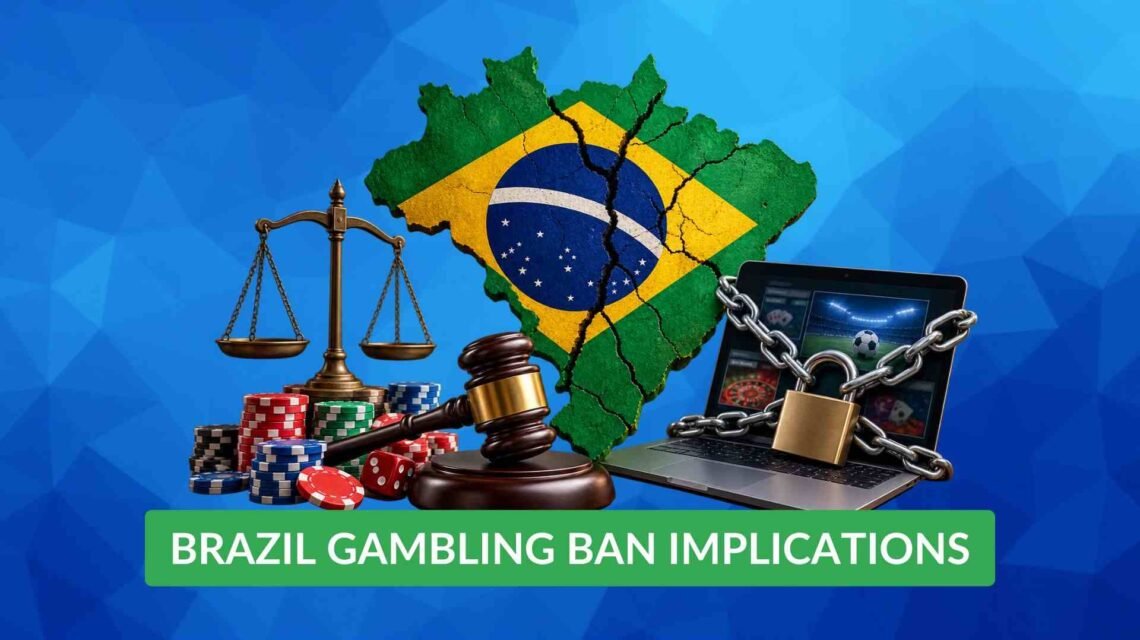
The Brazilian betting industry had barely adapted to its new regulatory framework when the government decided to … pull the plug. On 25 September 2026, President Luiz Inácio Lula da Silva signed Provisional Measure 1.394/2026, banning fixed-odds sports betting and online casino-style games nationwide. The Brazil gambling ban also restricts advertising, sponsorship and payment services connected to these activities.¹
The government’s stated objective is to address gambling-related harm, including household indebtedness, mental health concerns and the exposure of minors.² Among many questions around this decision and the way it was executed, it also raises a serious governance question: What happens when a government completely withdraws authorisations issued under its own recently established regulatory framework?
For operators and investors, Brazil presents a case of regulatory risk becoming an immediate operational reality. For policymakers, the challenge is different: demonstrating that prohibition delivers better consumer outcomes than the regulated system it replaces.
Whether the Brazil gambling ban will deliver the intended results is yet another matter. To assess Brazil’s decision properly, we’re looking at the legal facts, the reasoning behind the intervention and the questions that remain unanswered.
Brazil gambling ban: What the legislation establishes
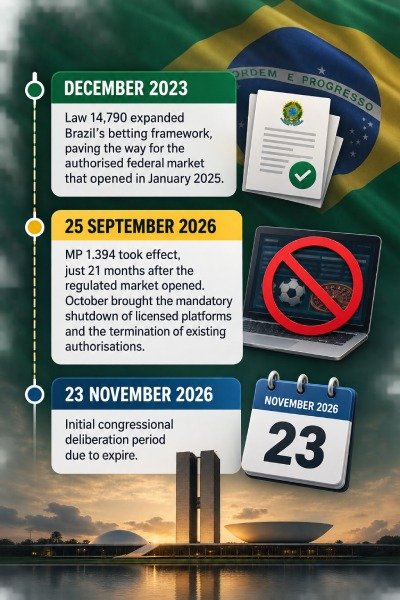
Brazil’s betting regulations have changed considerably over the past eight years: Legislation passed in 2018 laid the groundwork for fixed-odds betting, while Law 14,790/2023 expanded the framework to cover online games. From 1 January 2025, only operators authorised by the Secretariat of Prizes and Betting could legally offer fixed-odds betting nationwide.³
MP 1.394/2026 fundamentally erupted that framework and resulted in the Brazil gambling ban altogether.
Article 1 prohibits the operation, offering, intermediation and advertising of fixed-odds betting throughout Brazil; this covers sports betting and online games, including services offered from abroad to individuals located in Brazil. Other lottery categories authorised by law are excluded from that.¹
Article 4 provides for the termination of existing authorisations 30 days after publication. The legislation also states that termination does not entitle operators to reimbursement of authorisation payments or any compensation from the government.
The Brazil gambling ban leaves licensed operators facing lost licence fees and the closure of their businesses.
How Brazil’s betting regulations changed
The regulatory reversal happened within a remarkably short period:
Operators cannot simply close their platforms and walk away. The measure requires them to return outstanding player balances, retain relevant records and cooperate with regulators on obligations arising from their previous activities.
This is relevant from a governance perspective as the government is withdrawing market authorisations, it has not eliminated operators’ outstanding responsibilities.
The legislation is currently a provisional measure with the force of law and according to the National Congress, its initial deliberation period runs until 23 November 2026, subject to the applicable constitutional procedures.⁴
The Brazil gambling ban is already in force, but it’s important to highlight that Congress could still amend or reject it.
Its long-term impact and the future for operators and consumers remains as of now … uncertain.
Brazil gambling ban: Does prohibition improve player protection?
The government’s justification centres on the social consequences of gambling, stating that the Brazil gambling ban is intended to tackle gambling-related debt, mental health problems and the exposure of minors to betting.²
But will banning licensed operators actually reduce gambling harm? That is the key ESG question, and one the government will have to answer with evidence.
To judge whether the Brazil gambling ban is working, three things matter:
- Are Brazilians gambling less, or simply using other platforms?
- Are fewer families experiencing household debt / financial problems linked to gambling?
- Player protection: Is there a measurable decline in gambling-related harm?
The previous licensing framework required operators to comply with regulatory obligations and player-protection measures.³ That establishes the existence of safeguards, not their effectiveness while equally, the prohibition removes authorised betting opportunities but does not demonstrate that gambling demand has disappeared.
Some Brazilians may stop gambling, while others may turn to unlicensed sites. There is not enough evidence yet to know how consumers will respond. For the Brazil gambling ban, success should not be measured by how many operators shut down, but by whether fewer people experience gambling-related harm. Until those results can be measured, claims that the ban will improve player protection simply remain … unproven.
Brazil gambling ban: The governance risk for iGaming
The Brazil gambling ban also raises serious questions about regulatory predictability and business continuity.
Brazil’s Ministry of Finance confirms that the federal authorisation framework became operational in January 2025. Less than two years later, the government introduced legislation terminating existing authorisations without reimbursement of licensing payments.¹
Brazil’s policy reversal has made one investment risk clear: a betting licence does not guarantee long-term market access. Whether this uncertainty will discourage future investment remains to be seen. The immediate challenge for operators is to cope with the financial and operational risks of sudden regulatory changes.
Operators entering regulated markets face licensing costs, establish compliance systems and enter commercial agreements. These activities create financial commitments that may be difficult to recover following a sudden market closure.
Brazil’s legislation makes that exposure particularly relevant because it expressly excludes reimbursement and government compensation for terminated authorisations.¹ Though the law rules out compensation for cancelled licences, operators may still challenge this decision in court. Whether those challenges would succeed remains uncertain.
The measure also demonstrates that regulatory obligations can survive the loss of market access, as under Articles 8 to 11, operators must: maintain funds for player repayments, supply information to financial institutions and regulators, preserve records and continue fulfilling applicable obligations relating to taxation, responsible gambling and financial crime prevention.¹
Operators that fail to meet certain refund obligations risk daily fines of R$200,000 (~ €32k).
The Brazil gambling ban shows why operators need to prepare for more than regulatory compliance. They must also be ready for sudden market disruptions, closures, including lost licensing investments, customer refunds and outstanding contractual obligations.
For boards and investors, the lesson could be that securing a licence is just one thing … but protecting the business if that licence is withdrawn is another.
Regulatory changes like the Brazil gambling ban show why staying informed matters. The ESG iGaming Membership connects industry professionals with ESG insights, regulatory developments and a network focused on more responsible gambling practices.
Conclusion: Brazil Gambling Ban outcomes must be measured
The Brazil gambling ban is in force, but whether it will reduce gambling harm remains unclear. Its long-term impact on operators and investors is equally uncertain.
For the iGaming industry, Brazil exposes two risks that operators can no longer afford to treat separately: gambling-related harm and regulatory instability. Meeting licensing requirements is not enough. Operators must be able to demonstrate that their player-protection measures deliver results, while preparing for the financial and operational consequences of losing market access.
FAQ:
Why did Brazil introduce the gambling ban?
The government wants to tackle gambling-related debt, mental health problems and the risks betting poses to minors.
What gambling activities are prohibited in Brazil?
The ban covers fixed-odds sports betting and online casino games, along with related advertising and promotion. Other legally authorised lotteries are not affected.
Will operators receive refunds for their licences?
The legislation excludes reimbursement of authorisation payments and compensation from the government following termination.
Does the Brazil gambling ban improve consumer protection?
It is too early to tell and the real test is whether fewer Brazilians experience gambling-related harm, not simply whether licensed betting sites close.
Sources:
- Presidency of Brazil, Provisional Measure 1.394/2026. Articles 1–17, including prohibition, authorisation termination, refund obligations and advertising restrictions.
https://www.planalto.gov.br/ccivil_03/_ato2023-2026/2026/mpv/mpv1394.htm - Brazilian National Congress, MP 1.394/2026. Legislative status and the government’s stated objectives.
https://www.congressonacional.leg.br/pt_BR/materias/medidas-provisorias/-/mpv/175871 - Ministry of Finance, Fixed-Odds Betting. Original regulatory framework and authorisation requirements.
https://www.gov.br/fazenda/pt-br/composicao/orgaos/secretaria-de-premios-e-apostas/apostas-de-quota-fixa - Ministry of Finance, Explanation of MP 1.394/2026. Official implementation and player-refund timetable.
https://www.gov.br/fazenda/pt-br/composicao/orgaos/secretaria-de-premios-e-apostas/medida-provisoria-ndeg-1-394-2026-entenda-as-novas-regras-para-as-apostas-de-quota-fixa
