
Europe is preparing tougher consumer-protection rules, while regulators are still (massively) struggling to keep illegal gambling websites out of their markets.
In September 2026, the British Gambling Commission identified a staggering 586 illegal gambling websites accessible to consumers in Great Britain.¹ The figure illustrates how difficult it remains to restrict access to unlicensed gambling services in practice; even in a heavily regulated market.
On 12 November, the European Gaming and Betting Association (EGBA) responded to the European Commission’s proposed Digital Fairness Act (DFA), calling for regulatory coherence and stronger action against illegal operators.² Its argument deserves attention, but also … scrutiny, as the EGBA represents licensed gambling businesses whose commercial interests also include reducing regulatory complexity and restricting unlawful competition.
The question is how new rules can address the enforcement weaknesses that allow illegal gambling websites to remain easily accessible.
Illegal Gambling Websites: What the Evidence Shows
Europe’s regulatory landscape is fragmented by design since there is no gambling-specific EU legislation harmonising national licensing systems. Member States retain responsibility for regulating gambling, subject to EU treaty obligations.³
EGBA members collectively hold more than 400 online gambling licences across 22 European countries.² That demonstrates the scale of cross-border compliance, although it does not establish that existing obligations are unnecessarily burdensome. The EGBA argues that the proposed DFA must complement national gambling safeguards rather than duplicate them.
The European Commission has a different proposal which would replace divergent national implementations of unfair-commercial-practices legislation with a directly applicable EU regulation. The proposal also addresses digital practices that could affect consumers using illegal gambling websites, including manipulative design, unfair personalisation and mechanisms encouraging excessive spending.⁴
Some requirements could overlap with gambling-specific rules, while others may address consumer risks that existing legislation does not adequately cover.
Are Enforcement Measures Against Illegal Gambling Websites Working?
Independent enforcement data challenges the idea that illegal gambling is an entirely unaddressed problem.
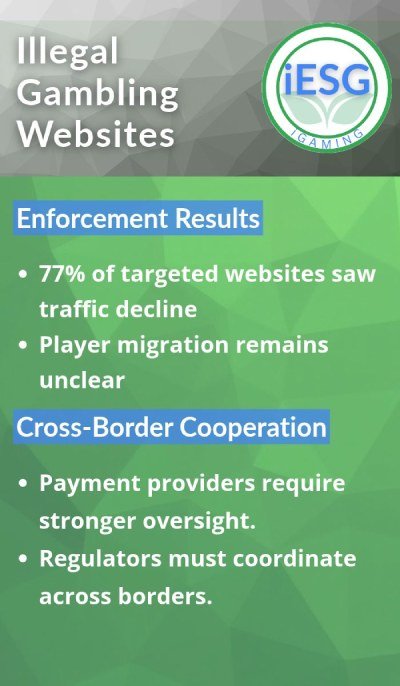
According to the British Gambling Commission, 77% of illegal gambling websites targeted during the second quarter of 2026/27 recorded a decline in estimated traffic.¹ That is a meaningful result for enforcement teams, although the figure tells little about what happened to the players using those sites; traffic estimates cannot tell regulators how much money changed hands or whether consumers became safer.
The Commission’s earlier research adds another complication: Between May 2024 and July 2025, it found no overall increase in estimated engagement with illegal gambling websites.⁵ Taken together, these findings challenge the assumption that illegal gambling is growing unchecked. Enforcement is producing observable results, but the available figures cannot establish how much illegal gambling activity has actually been prevented.
The Enforcement Challenge
Illegal gambling websites cannot operate on visibility alone as it needs customers, payment services and, frequently, commercial relationships with businesses elsewhere in the gambling industry. That is where EGBA’s criticism becomes particularly relevant: In July 2026, the association filed a complaint with the Bank of Lithuania concerning payment provider Walletto whereas EGBA alleged that test transactions linked the provider’s services to deposits on illegal gambling platforms.⁶
These remain allegations, not an established regulatory finding against Walletto but nevertheless, the case raises a legitimate question. If unlawful gambling businesses can (easily) access mainstream payment infrastructure, how effectively can gambling regulators act without cooperation from financial authorities?
In July 2026, the British Gambling Commission announced a £4.75 million regulatory settlement with Evolution Malta Holding Limited after finding deficiencies in its controls: Genuine Evolution games had appeared on six unlicensed websites accessible to British consumers.⁷ Unlike the Walletto complaint, this was a concluded regulatory case and it demonstrates how licensed suppliers can become exposed to enforcement risk through weaknesses in business-partner oversight.
Disruption Strategy & Effectiveness
The Commission has also intensified its disruption activity: During July to September 2026, it referred more than 7.6 million URLs to search engines and reported more than three million URL removals.⁸ These figures establish enforcement activity, not the number of distinct illegal operators eliminated (said distinction is essential when evaluating effectiveness.)
To understand whether enforcement is really working, regulators need answers to three practical questions:
#1. Access
How many illegal gambling websites remain accessible after enforcement action, including replacement domains?
#2. Payments
Are illegal operators losing payment-processing access, or finding alternative providers?
#3. Player behaviour
Are consumers leaving unlicensed platforms, or moving between them?
Removing illegal gambling websites from search results is an identifiable enforcement outcome but whether that prevents someone from gambling with an unlicensed operator is much harder to proof. Without linking the two, authorities risk reporting impressive enforcement volumes without demonstrating lasting impact.
The Digital Fairness Act and the governance test
The Dgitial Fairness Act debate exposes a tension between two legitimate regulatory objectives, namely from the EGBA and the Commission: EGBA wants proportionate obligations that recognise existing national safeguards while the Commission wants more consistent consumer protection across digital markets.
National gambling rules already address matters such as age verification, advertising and safer gambling. However, newer forms of digital marketing, like tailored personalised offers and interface design may raise questions that existing gambling-specific requirements do not yet fully address.
The Commission’s proposal also forms part of a broader Consumer Package, including revisions to the Consumer Protection Cooperation Regulation intended to strengthen cross-border enforcement.⁹
This is particularly relevant to EGBA’s criticism … if the legislative package improves cooperation between authorities, it could address some enforcement weaknesses that allow illegal gambling websites to remain accessible across national borders, while establishing clearer consumer-protection standards. These proposed reforms are not a substitute for national gambling enforcement and their practical effect will depend on their final legal scope, implementation and the cooperation of relevant authorities.
A Lesson in Governance
For licensed operators, the immediate governance lesson is significantly more concrete.
Evolution’s £4.75 million settlement offers a specific warning to licensed gambling businesses: compliance failures can emerge through the companies distributing their products, not only through their own platforms. Operators and suppliers need to know which partners have access to their games, where those products are offered and how suspected breaches are investigated.
Operators should therefore assess where their games, advertising and payment services ultimately reach consumers.
Regulatory developments such as the Digital Fairness Act show why informed governance matters. The ESG iGaming Membership connects industry professionals with ESG insights, regulatory developments and a network focused on more responsible gambling practices.
Conclusion: Enforcement must prove its value
EGBA is right to question whether additional regulation will deliver better consumer protection battling illegal gambling websites.. But its position does not establish that the Digital Fairness Act is … unnecessary.
The Commission must demonstrate where new requirements improve existing safeguards. Regulators need evidence that enforcement is reducing illegal gambling activity and limiting consumers’ contact with unlicensed platforms.
For iGaming businesses, that means looking beyond whether compliance procedures exist. The more revealing questions concern which third parties introduce regulatory risk, how quickly problems are detected and whether remedial action prevents them from recurring.
FAQ: Illegal gambling in Europe
What is illegal gambling in Europe?
Gambling offered without the authorisation required in the jurisdiction where consumers are targeted.
Does the EU regulate online gambling?
Gambling licences and operating conditions are largely determined by individual European countries. EU consumer-protection and other applicable laws can still affect how gambling businesses operate.
What is EGBA’s position on the Digital Fairness Act?
EGBA argues that the proposal should work alongside existing gambling regulations rather than impose duplicate requirements. It also wants EU policymakers to give greater attention to enforcement against unlicensed operators.
Can payment restrictions stop illegal gambling?
Restricting payment services can make it harder for illegal operators to receive deposits. Whether those restrictions work over time depends partly on how easily operators can switch to other providers.
Is illegal gambling increasing in Europe?
Available evidence does not establish a consistent EU-wide trend. National data and measurement methods differ.
Why does illegal gambling wesbites matter for ESG?
It raises governance questions about regulatory effectiveness, third-party accountability and consumer protection.
Sources:
- UK Gambling Commission: Illegal Gambling Data Dashboard, November 2026.
https://www.gamblingcommission.gov.uk/statistics-and-research/publication/illegal-gambling-data-dashboard-november-2026 - EGBA: Digital Fairness Act Response, 12 November 2026.
https://egba.eu/news-post/eu-digital-fairness-act-proposal-egba-calls-for-coherence-with-national-and-eu-consumer-protection-rules/ - European Commission: Online Gambling in the EU.
https://single-market-economy.ec.europa.eu/sectors/online-gambling_en - European Commission: Digital Fairness Act Proposal, 11 November 2026
https://commission.europa.eu/law/law-topic/consumer-protection-law/digital-fairness-act_en - UK Gambling Commission: Consumer Engagement and Trends, 2025.
https://www.gamblingcommission.gov.uk/report/illegal-online-gambling-consumer-engagement-and-trends/illegal-online-gambling-consumer-engagement-and-trends-executive-summary - EGBA: Complaint Against Lithuanian Payment Provider, July 2026
https://www.egba.eu/news-post/egba-files-complaint-against-lithuanian-payment-provider-calls-for-tougher-action-to-cut-off-illegal-gambling-oper - UK Gambling Commission: Evolution Malta Holding Limited Settlement, July 2026.
https://www.gamblingcommission.gov.uk/news/article/evolution-malta-holding-limited-to-pay-gbp4-75m - UK Gambling Commission: Enforcement Activities and Outcomes, 2026.
https://www.gamblingcommission.gov.uk/about-us/impact-metric/ro3-preventing-crime/activity-to-tackle-unlicensed-gambling-and-outcomes - European Commission:Consumer Package Announcement, November 2026
https://commission.europa.eu/law/law-topic/consumer-protection-law/digital-fairness-act_en
