
The cost of ESG failures usually builds quietly, long before it attracts public attention. In iGaming, breakdowns in social, or governance systems seldom result in instant license revocations or sudden market exits. Instead, they raise the cost of operating across the business well ahead of any formal enforcement action.
For regulated operators, ESG negligence usually shows up as added friction in day-to-day operations, not as immediate threats to business survival. They complicate licensing relationships, restrict access to capital, and trigger remediation cycles that absorb cash, time, and executive attention. By the time fines or sanctions appear, much of the economic impact has already been absorbed.
This article examines the cost of ESG failures through a strictly economic lens, mapping where the impact of costs in terms of license maintenance, capital access, remediation, and reputation, drawing on regulator guidance and professional-services research. In an industry with ever-increasing regulatory scrutiny, ESG breakdowns are rarely fatal. They are, however, predictably expensive.
ESG Failures Raise the Cost of Holding a License
In tier-1 markets, a license is not a one-time approval. It is an ongoing supervisory relationship. The cost of ESG failures impacts the relationship with the regulatory body, well before any formal sanction is imposed.
Regulators such as the UK Gambling Commission and the Malta Gaming Authority explicitly link governance, social responsibility, and consumer protection systems to licensing outcomes. Public enforcement frameworks make clear that weaknesses in these areas more often trigger closer supervision, targeted audits, and additional reporting, rather than immediate license loss¹.
Compliance teams grow, outside advisors get involved, and senior leadership is drawn into ongoing regulatory discussions. On top of that, license renewals may include new stricter conditions, due to previous failures, such as continuous monitoring or corrective programmes, which add permanent cost to normal operations.
What matters here is that these costs appear even when licenses are not at risk. The challenge per se is not losing approval, but managing significant additional layers of oversight, which have to be met in order to remain licensed. For global operators, active across multiple jurisdictions, this additional workload scales quickly.
💡 The iESG Assessment reflects how regulators typically identify escalation risk in practice.
It focuses on governance, player protection, and sustainability controls to surface patterns such as weak escalation, repeated control failures, or gaps in oversight.
The Capital Cost of ESG Failures
Capital markets tend to register ESG problems earlier than regulators do. For institutional investors, ESG performance now sits alongside balance sheets and cash flow as part of the initial screening process, rather than being treated as a reputational extra.
PwC research shows that companies with a weak ESG performance are subject to closer scrutiny, especially in the process of raising capital.This includes more extensive due diligence and a smaller pool of willing investors².
In the iGaming ecosystem, these effects are mostly practical. Deal timelines extend, advisory costs increase, and valuation adjustments are made to reflect governance or social concerns. In M&A and private-capital deals, ESG questions are now commonly raised at the outset of the process, sometimes before any deep dives into revenue performance or historical compliance issues.
The result is a higher cost of capital over time. Capital may still be available, but it becomes slower, more conditional, and more expensive to secure, showcasing one aspect of the cost of ESG failures.
Remediation: The Most Immediate ESG Cost
When ESG failures are identified, remediation is unavoidable. This is where costs become most visible and hardest to control.
Remediation typically involves a combination of legal review, policy changes, system updates, staff retraining, and independent assurance work. Guidance from Deloitte indicates that, in regulated sectors, fixing ESG weaknesses after they emerge generally costs more than putting controls in place upfront, especially once regulators are engaged⁴.For iGaming operators, remediation creates upfront expense as well as longer-term cost exposure. Initial corrective actions are often followed by further checks, ongoing reporting, and continued involvement from regulators.
As a result, the cost of ESG failures keeps building up, even after the underlying issues have been addressed.
🏅 The iESG Certificate aligns with how ESG compliance in iGaming is assessed in practice.
It provides independent, sector-specific confirmation that governance, responsible gambling, and AML controls are documented, consistently applied, and capable of standing up to regulatory or investor scrutiny.
Reputation Damage and Long-Term Cost Drag
“It takes 20 years to build a reputation and five minutes to ruin it”, Warren Buffet famously said and in fact, this is where the cost of ESG failures hits hardest and is the most difficult one to repair. Particularly in an (already stigmatised) industry as iGaming, governance and social breakdowns are sanctioned harshly. It can lead to increased political pressure and a sustained bad public attention.
OECD shows that businesses with such ESG collapses can recover, albeit it’s a slow process, even after compliance gaps have been closed⁵.
For operators, this may affect partner confidence, reduce affiliate exposure, and dampen investor appetite.
This should not be read as an automatic or direct loss of revenue. Instead, reputation damage creates access friction, slowing down commercial progress and increasing the effort required to rebuild trust.
🎓 The iESG Membership supports ongoing ESG oversight by helping operators track recurring risk patterns and keep governance, escalation, and evidence aligned with evolving regulatory expectations.
The ESG Cost Stack
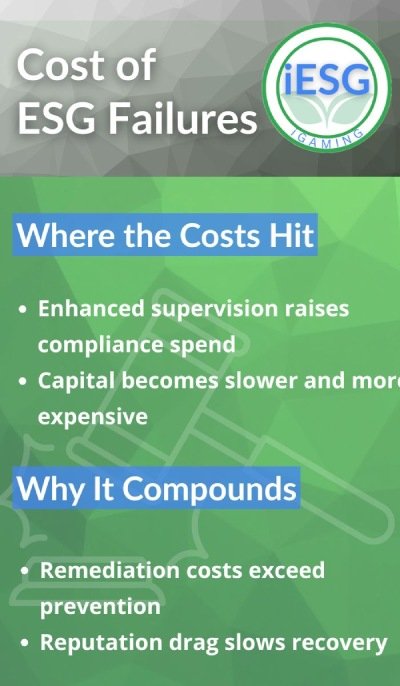
Across regulated markets, the cost of ESG failures consistently appears in four areas:
- License friction through enhanced supervision and reporting
- Capital erosion via financing delays and valuation pressure
- Remediation spend driven by legal, audit, and system upgrades
- Reputation drag that slows commercial recovery
These costs build gradually and often only become obvious after they have already affected performance.
Conclusion: Cost of ESG Failures
The immediate cost of ESG failures in iGaming is at first seldom financially catastrophic on their own. Their real economic impact lies in how they raise operating costs across licensing, capital access, remediation, and reputation over time.
For operators and investors, the strategic question is not whether ESG missteps can be survived. It is how much they will cost before stability is restored. In a highly regulated industry, those costs are predictable, persistent, and increasingly difficult to unwind once they take hold.
FAQ – Cost of ESG Failures
What is the cost of ESG failures?
The cost of ESG failures shows up through higher regulatory friction, increased remediation spend, more expensive capital, and slower reputation recovery.
Is the cost of ESG failures always leading to fines?
In many cases, regulators start by tightening supervision, ordering additional audits, and tightening reporting requirements before financial penalties hit¹.
What’s the cost of ESG failures in the context of capital acquisition?
By 2026, the analysis of the ESG performance is part of risk screening, and failures typically trigger deeper scrutiny and a smaller pool of interested investors².
Why does reputation recover so slowly in the iGaming sector?
Political sensitivity and sustained public scrutiny make trust harder to rebuild after ESG failures⁵.
Sources:
- UK Gambling Commission: “Licensing, Compliance & Enforcement“
https://www.gamblingcommission.gov.uk/policy/licensing-compliance-and-enforcement-under-the-gambling-act-2005/5-regulatory-enforcement Gambling Commission - Malta Gaming Authority: “ESG Code of Good Practice“
https://www.mga.org.mt/app/uploads/MGA-ESG-Code-v2.pdf Malta Gaming Authority - MGA ESG Code Page: “ESG Information & Practice“
https://www.mga.org.mt/licensee-hub/esg/ Malta Gaming Authority - PwC: “ESG Overview and Services“
https://www.pwc.co.uk/services/esg.html - OECD: “Behind ESG ratings: Unpacking sustainability metrics”
https://www.oecd.org/en/publications/behind-esg-ratings_3f055f0c-en.html OECD
