

Scope 3 emissions in iGaming are not yet a routine reporting practice for most operators. In many key jurisdictions they are not explicitly mandated, with regulators more commonly focusing on broader environmental policies than detailed Scope 3 disclosures. Yet the term increasingly appears in investor questionnaires, supplier disclosures, and ESG discussions around digital businesses.
This raises a practical question: if Scope 3 emissions in iGaming were ever accounted for, what would that involve in practice? Not as a compliance forecast or theoretical exercise, but as a workable disclosure approach. iGaming is an asset-light, vendor-dependent sector. Hosting, live streaming, payment processing, and platform technology are typically outsourced. That structure explains why Scope 3 emissions surface in ESG conversations at all, and why any attempt to account for them would be constrained by limited operational control and uneven supplier data.
We examine how Scope 3 emissions in iGaming could be accounted for if expectations emerge, which categories would be most plausible, and what limits would remain.
Understanding emissions scopes in iGaming
Emissions reporting is commonly grouped into three categories under the GHG Protocol¹: Scope 1 (direct emissions), Scope 2 (purchased energy), and Scope 3 (value-chain emissions outside direct control).
In iGaming, Scope 1 emissions are typically minimal. Most iGaming operators simply do not operate asset-heavy environments. In practical terms, there is very little physical infrastructure involved. No factories, no transport fleets, and no large estates to manage on a daily basis. Compared with land-based casinos or hospitality groups, direct emissions are usually limited to office space and basic operations.
Scope 2 emissions tend to matter more, but they are still concentrated in a small number of areas. For many operators, Scope 2 exposure is driven less by office energy use and more by where and how platforms are hosted, including the energy mix of data centres used by cloud or managed hosting providers.
Scope 3 is where operational dependency sits. Cloud infrastructure, live-streaming capacity, payment rails, and core platform vendors fall outside direct control but underpin day-to-day operations. Because Scope 1 and 2 emissions are limited for many iGaming businesses, any future expansion of emissions disclosure would logically focus on Scope 3.
Where Scope 3 reporting already exists in digital sectors
Scope 3 accounting is not unique to gambling or gaming. It already exists, in a limited form, across asset-light digital industries that rely heavily on outsourced infrastructure.
In sectors such as software-as-a-service, cloud platforms, and digital media streaming, Scope 3 reporting usually begins as supplier-referenced disclosure, not a full emissions inventory. Organisations identify critical third-party infrastructure, reference supplier sustainability disclosures where available, and explain how those services support core operations.
In reality, this is less about perfect data and more about being honest about how the platform actually runs. Operators would typically point to their main cloud or hosting partners, call out the parts of the product that consume the most resources, such as live streaming or always-on services, and acknowledge where supplier data simply does not go deep enough to be precise.
The goal is to help readers understand the shape of the exposure, not to present a set of flawless numbers. This precedent matters because iGaming faces the same constraints: reliance on third-party infrastructure and limited access to granular supplier emissions data.
Which Scope 3 categories are most plausible for iGaming
If Scope 3 emissions in iGaming were ever addressed, the scope would almost certainly be selective, not comprehensive. The most plausible categories share three characteristics: high dependency, concentrated suppliers, and a realistic pathway to disclosure.
Hosting and cloud infrastructure
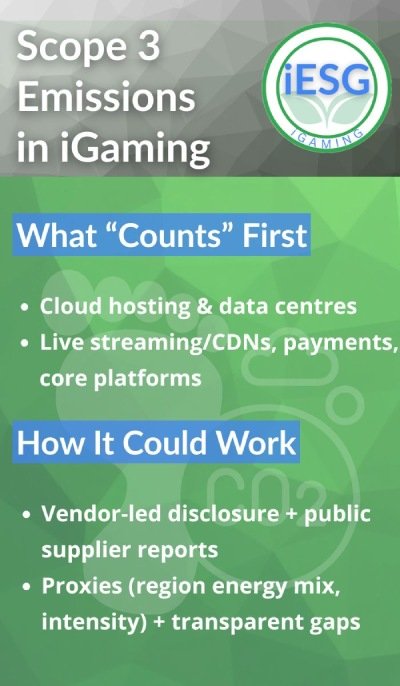
This is the most straightforward category. Energy consumption is centralised at provider level, and major cloud and hosting suppliers already publish environmental disclosures. Operators could reference supplier data and explain hosting arrangements without attempting to calculate emissions per product or player.
Live streaming and content delivery networks
Live casino and sports products depend on continuous, high-bandwidth delivery. Streaming and CDN services are among the more energy-intensive components of digital platforms and are typically sourced from a small number of specialised vendors.
Core platform and payment providers
These are the suppliers the business leans on every day, whether that’s visible or not. If the platform slows down, payments fail, or uptime slips, these are usually the relationships that feel it first. Even where emissions data is hard to isolate, the level of dependency and the cost of switching make these relationships operationally significant.
What would likely be excluded
Other parts of the ecosystem are far less workable. Large affiliate networks, end-user energy use, and smaller service providers are highly fragmented, difficult to track, and largely beyond an operator’s practical influence. Excluding them would not weaken Scope 3 disclosure. It would make it workable.
What “accounting” Scope 3 would mean in practice
If Scope 3 emissions in iGaming were accounted for, it would not resemble traditional carbon accounting. It would look like structured disclosure built on supplier information.
Operators do not control most Scope 3 infrastructure. Hosting environments, streaming capacity, payment rails, and core platforms are outsourced. As a result, operators would not measure emissions internally. They would collect supplier-provided information, where available, and disclose it with clear limitations.
A realistic approach would involve:
- identifying critical vendors by service type
- referencing public supplier disclosures or attestations
- using high-level proxies where data is broad, such as regional energy mix or published emissions intensity
- clearly stating data gaps and limits
This reflects how Scope 3 reporting develops in other asset-light sectors. Sustainability advisors consistently note that supplier engagement and data maturity are the main constraints on Scope 3 quality and comparability².
Just as important is what this would not involve. Operators would not model emissions factors at product level, audit suppliers, or produce consolidated carbon inventories with precise allocation. That level of calculation assumes data access and control most operators do not have.
In practice, accounting for Scope 3 would mean documenting exposure and disclosure quality, not producing perfect numbers.
🏅 The iESG Certificate aligns with how ESG compliance in iGaming is assessed in practice, focusing on whether governance, responsible gambling, and AML controls are clearly documented and consistently applied. It provides sector-specific, independent confirmation that these controls are capable of standing up to regulatory or investor scrutiny.
Who would drive expectations and how they could evolve
If expectations around Scope 3 emissions emerge in iGaming, they are more likely to come from market dynamics than from gambling regulators.
In digital sectors, expectations usually shift because of market behaviour rather than regulation. Enterprise suppliers often standardise the ESG information they share with customers. Investors look for disclosures they can compare across portfolios. Over time, reporting templates emerge that make limited disclosure the norm rather than the exception. When change happens, it tends to be triggered by these practical developments, not by fixed timelines
Any evolution would be event-driven rather than time-bound. As supplier reporting improves and disclosure formats converge, expectations may become more consistent, but not more comprehensive. The direction of travel would be toward clarity, not completeness.
💡 In practice, escalation risk is rarely triggered by a single issue and is more often identified through patterns across governance, player protection, and sustainability controls. The iESG Assessment reflects this approach, surfacing repeated weaknesses or gaps in oversight rather than treating isolated findings as standalone risks.
Conclusion: Scope 3 Emissions in iGaming
Scope 3 emissions are not an imminent reporting requirement for iGaming operators. Still, the structure of the industry means the topic will continue to surface as digital infrastructure becomes more visible in ESG discussions.
Looking at how Scope 3 emissions in iGaming could be accounted for helps reset expectations. It draws a clearer line between what operators can realistically explain, what they cannot influence, and where rough edges in the data are inevitable.
For operators and investors alike, that kind of straight-talk tends to be more valuable than trying to manufacture numbers that look precise but say very little.
FAQ – Scope 3 Emissions in iGaming
What are Scope 3 emissions in iGaming?
They are indirect emissions linked to third-party vendors and infrastructure that operators rely on but do not directly control.
Are Scope 3 emissions in iGaming required for operators?
In most jurisdictions, no. They are not currently a standard reporting requirement.
How do Scope 1, 2, and 3 differ for iGaming?
Scope 1 and 2 are usually limited, while Scope 3 covers outsourced infrastructure such as cloud hosting, streaming, and payments.
Which vendors matter most for disclosure of Scope 3 emissions in iGaming ?
Typically cloud and hosting providers, streaming or CDN suppliers, core platform providers, and key payment processors.
Would Scope 3 accounting require precise emissions data?
It would rely on supplier disclosures and high-level proxies, with clear limitations.
Sources:
- GHG Protocol: “Corporate Value Chain (Scope 3) Accounting and Reporting Standard“
https://ghgprotocol.org/standards/scope-3-standard - Anthesis Group: “Preparing for Scope 3 data requirements“
https://www.anthesisgroup.com/insights/preparing-for-scope-3-data-requirements/
